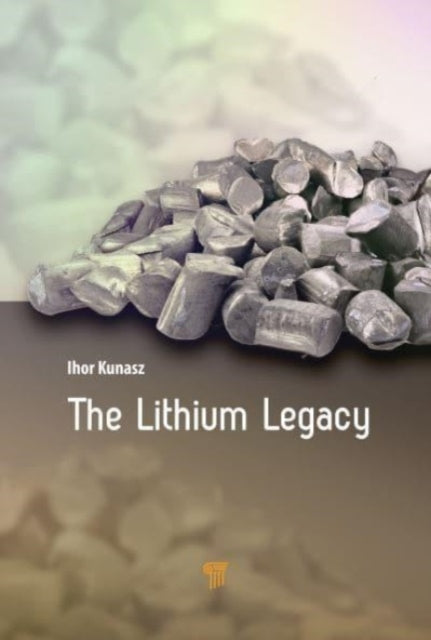
Ihor Kunasz
The Lithium Legacy
The Lithium Legacy
💎 Earn 547 Points (£5.47) on this item.
We can order this item for you. Delivery usually takes about 4 to 6 weeks.
This item is not held in our immediate stock. We will order it for you after checkout.
Estimated delivery: About 4 to 6 weeks
YOU SAVE £6.50
- Condition: Brand new
- UK Delivery times: Usually arrives within 2 - 3 working days
- UK Shipping: Fee starts at £2.39. Subject to product weight & dimension
Bulk ordering. Want 15 or more copies? Get a personalised quote and bigger discounts. Learn more about bulk orders.
Couldn't load pickup availability
- More about The Lithium Legacy
This book explores the original discovery of lithium and its development from a mineral to its present use in the electromotive industry.
Format: Hardback
Length: 324 pages
Publication date: 24 August 2023
Publisher: Jenny Stanford Publishing
Lithium, a remarkable element, has a captivating history that spans from its initial discovery to its diverse range of applications, ultimately leading to its current utilization in the electromotive industry. This comprehensive book delves into the intricate details of lithium's origins, exploring the fascinating stories behind its discovery and the scientific breakthroughs that have shaped its evolution.
From its humble beginnings as a mineral found in the salty waters of Lake Baikal, lithium has undergone a remarkable transformation. Scientists and researchers have tirelessly worked to unlock the full potential of this element, leading to its application in various industries.
In the field of energy storage, lithium plays a pivotal role. Its high energy density and low self-discharge rate make it an ideal candidate for batteries, powering everything from electric vehicles to portable electronics. Lithium-ion batteries, in particular, have revolutionized the way we store and use energy, providing a reliable and efficient means of power generation.
Beyond energy storage, lithium finds its applications in other industries as well. It is used in the manufacturing of ceramics, glass, and alloys, enhancing their strength and durability. Lithium-based lubricants and greases also provide excellent performance in extreme conditions, making them essential in industries such as aerospace and automotive.
In addition to its industrial uses, lithium has significant implications for environmental sustainability. Its use in electric vehicles reduces greenhouse gas emissions and contributes to cleaner air and reduced carbon footprint. Moreover, lithium-ion batteries can be recycled, further promoting sustainability and reducing waste.
However, the development and utilization of lithium also present challenges. One of the major concerns is the sourcing of raw materials. Lithium is primarily mined in a few countries, including Bolivia, Chile, and Argentina, which can lead to geopolitical tensions and resource scarcity. Additionally, the extraction and processing of lithium can have environmental impacts, such as water pollution and habitat destruction.
To address these challenges, there is ongoing research and development in the field of lithium-ion battery technology. Researchers are exploring new materials and manufacturing processes to improve the efficiency and sustainability of lithium-based batteries. Additionally, efforts are being made to develop alternative sources of lithium, such as recycling and renewable energy sources, to reduce reliance on finite resources.
In conclusion, lithium's journey from a mineral to a versatile element is a testament to the power of scientific discovery and innovation. Its applications in energy storage, ceramics, glass, alloys, lubricants, and greases have transformed industries and improved our quality of life. However, the sustainable development of lithium requires careful consideration of its sourcing, extraction, and processing. With ongoing research and development, we can ensure that lithium continues to play a vital role in shaping a cleaner and more sustainable future.
Lithium, a remarkable element, has a captivating history that spans from its initial discovery to its diverse range of applications, ultimately leading to its current utilization in the electromotive industry. This comprehensive book delves into the intricate details of lithium's origins, exploring the fascinating stories behind its discovery and the scientific breakthroughs that have shaped its evolution.
From its humble beginnings as a mineral found in the salty waters of Lake Baikal, lithium has undergone a remarkable transformation. Scientists and researchers have tirelessly worked to unlock the full potential of this element, leading to its application in various industries.
In the field of energy storage, lithium plays a pivotal role. Its high energy density and low self-discharge rate make it an ideal candidate for batteries, powering everything from electric vehicles to portable electronics. Lithium-ion batteries, in particular, have revolutionized the way we store and use energy, providing a reliable and efficient means of power generation.
Beyond energy storage, lithium finds its applications in other industries as well. It is used in the manufacturing of ceramics, glass, and alloys, enhancing their strength and durability. Lithium-based lubricants and greases also provide excellent performance in extreme conditions, making them essential in industries such as aerospace and automotive.
In addition to its industrial uses, lithium has significant implications for environmental sustainability. Its use in electric vehicles reduces greenhouse gas emissions and contributes to cleaner air and reduced carbon footprint. Moreover, lithium-ion batteries can be recycled, further promoting sustainability and reducing waste.
However, the development and utilization of lithium also present challenges. One of the major concerns is the sourcing of raw materials. Lithium is primarily mined in a few countries, including Bolivia, Chile, and Argentina, which can lead to geopolitical tensions and resource scarcity. Additionally, the extraction and processing of lithium can have environmental impacts, such as water pollution and habitat destruction.
To address these challenges, there is ongoing research and development in the field of lithium-ion battery technology. Researchers are exploring new materials and manufacturing processes to improve the efficiency and sustainability of lithium-based batteries. Additionally, efforts are being made to develop alternative sources of lithium, such as recycling and renewable energy sources, to reduce reliance on finite resources.
In conclusion, lithium's journey from a mineral to a versatile element is a testament to the power of scientific discovery and innovation. Its applications in energy storage, ceramics, glass, alloys, lubricants, and greases have transformed industries and improved our quality of life. However, the sustainable development of lithium requires careful consideration of its sourcing, extraction, and processing. With ongoing research and development, we can ensure that lithium continues to play a vital role in shaping a cleaner and more sustainable future.
Dimension: 229 x 152 (mm)
ISBN-13: 9789814968317
This item can be found in:
UK and International shipping information
UK and International shipping information
UK Delivery and returns information:
- Delivery within 2 - 3 days when ordering in the UK.
- Shipping fee for UK customers from £2.39. Fully tracked shipping service available.
- Returns policy: Return within 30 days of receipt for full refund.
International deliveries:
Shulph Ink now ships to Australia, Belgium, Canada, France, Germany, Ireland, Italy, India, Luxembourg Saudi Arabia, Singapore, Spain, Netherlands, New Zealand, United Arab Emirates, United States of America.
- Delivery times: within 5 - 10 days for international orders.
- Shipping fee: charges vary for overseas orders. Only tracked services are available for most international orders. Some countries have untracked shipping options.
- Customs charges: If ordering to addresses outside the United Kingdom, you may or may not incur additional customs and duties fees during local delivery.