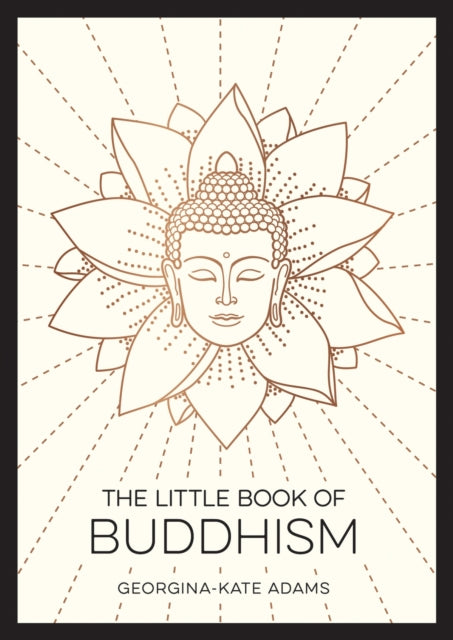
Georgina-Kate Adams
The Little Book of Buddhism: An Introduction to the Key Figures, Beliefs and Practices You Need to Know
The Little Book of Buddhism: An Introduction to the Key Figures, Beliefs and Practices You Need to Know
💎 Earn 28 Points (£0.28) on this item.
YOU SAVE £2.34
- Condition: Brand new
- UK Delivery times: Usually arrives within 2 - 3 working days
- UK Shipping: Fee starts at £2.39. Subject to product weight & dimension
Bulk ordering. Want 15 or more copies? Get a personalised quote and bigger discounts. Learn more about bulk orders.
Couldn't load pickup availability
- More about The Little Book of Buddhism: An Introduction to the Key Figures, Beliefs and Practices You Need to Know
The Little Book of Buddhism is a concise and informative guide to one of the world's oldest and most widely practiced philosophies. It provides an accessible and engaging overview of the religion,including its origins,worldview,and key figures. Whether you are interested in brushing up your knowledge or applying Buddhist practices to your daily life,this book is the perfect guide for you.
Format: Paperback / softback
Length: 128 pages
Publication date: 11 May 2023
Publisher: Octopus Publishing Group
Buddhism, one of the world's oldest religions, has a rich history, teachings, and practices that continue to captivate people worldwide. In this concise guide, we will delve into the origins, worldviews, and key figures of Buddhism, providing you with a comprehensive understanding of this profound philosophy.
Who was the Buddha?
Gautama Buddha, also known as Siddhartha Gautama, was a spiritual teacher who lived in northern India in the 5th century BCE. He is considered the founder of Buddhism and is known for his teachings that led to his enlightenment or awakening.
What is the difference between enlightenment and awakening?
Enlightenment and awakening are two terms often used interchangeably in Buddhism. However, they have distinct meanings. Enlightenment refers to the realization of the true nature of reality, which is characterized by wisdom, compassion, and understanding. Awakening, on the other hand, is the process of becoming fully aware of this reality and living in accordance with it.
Do Buddhists believe in God?
Buddhism is a non-theistic religion that does not believe in the existence of a single God or deity. Instead, Buddhists believe in the interconnectedness of all things and the potential for achieving enlightenment or awakening through one's own actions and behavior.
The Little Book of Buddhism: An Introduction
The Little Book of Buddhism provides an accessible and engaging overview of the religion, including its origins, worldview, and key figures. Written by a renowned Buddhist scholar, this book is the perfect guide for anyone with an interest in the subject, wanting to brush up their knowledge, or looking to apply Buddhist practices to their daily life.
Origins of Buddhism
Buddhism originated in northern India in the 5th century BCE, during the time of the Gupta Empire. Siddhartha Gautama, a young prince, renounced his wealth and privilege to pursue a path of spiritual enlightenment. He spent years meditating and practicing under various teachers until he achieved his enlightenment under the Bodhi Tree.
The Four Noble Truths
The Four Noble Truths are the central teachings of Buddhism. They are:
Suffering (Dukkha): Life is characterized by suffering, which can be physical, mental, or emotional.
Origin of Suffering (Samudaya): Suffering arises from our attachments to material possessions, desires, and ego.
Cessation of Suffering (Nirodha): The path to enlightenment or awakening is through the cessation of suffering.
Path to the Cessation of Suffering (Magga): The path to the cessation of suffering involves following the Eightfold Path, which includes proper understanding, intention, speech, action, livelihood, effort, mindfulness, and concentration.
The Cycle of Rebirth (Samsara)
Buddhism believes in the cycle of rebirth, or Samsara. According to this belief, life is a continuous cycle of birth, death, and rebirth. The cycle is driven by our attachments to material possessions, desires, and ego, and it is perpetuated by our ignorance and delusion.
The Path to Enlightenment or Awakening
The path to enlightenment or awakening is a gradual process that involves the cultivation of mindfulness, compassion, and understanding. It involves following the Eightfold Path and engaging in meditation and mindfulness practices to develop insight and wisdom.
Key Figures in Buddhism
Several key figures have contributed to the development of Buddhism throughout its history. Some of the most notable include:
Buddha: The founder of Buddhism, Siddhartha Gautama, is known for his teachings on the Four Noble Truths and the path to enlightenment or awakening.
Ajahn Chah: A Thai Buddhist monk who is renowned for his teachings on mindfulness and meditation.
Thich Nhat Hanh: A Vietnamese Buddhist monk who is known for his teachings on mindfulness, compassion, and the interdependence of all things.
Mahayana Buddhism
Mahayana Buddhism is one of the two major branches of Buddhism. It emerged in the 1st century CE and emphasizes the importance of compassion and the bodhisattva, or spiritual aspirant, who seeks to achieve enlightenment or awakening for the benefit of all beings.
Mahayana Buddhism includes the teachings of the Buddha, as well as the teachings of several other spiritual masters. It emphasizes the importance of the bodhisattva's practice of compassion and the cultivation of the mind to achieve enlightenment.
Theravada Buddhism
Theravada Buddhism is the other major branch of Buddhism. It emerged in the 2nd century BCE and emphasizes the importance of meditation and the attainment of enlightenment through the practice of mindfulness and concentration.
Theravada Buddhism includes the teachings of the Buddha, as well as the teachings of several other spiritual masters. It emphasizes the importance of the individual's practice and the attainment of enlightenment through the practice of meditation.
Buddhism Today
Buddhism is practiced worldwide today, and its teachings have influenced many other spiritual and philosophical traditions. Buddhism is known for its emphasis on compassion, mindfulness, and the cultivation of inner peace and wisdom.
Buddhism Today is practiced in various forms, including Theravada Buddhism, Mahayana Buddhism, and Vajrayana Buddhism. Each form has its own unique teachings and practices, but all share the common goal of achieving enlightenment or awakening.
In conclusion, Buddhism is a profound and complex philosophy that has a rich history, teachings, and practices. This concise guide provides an accessible and engaging overview of the religion, including its origins
- Who Gautama Buddha was, and how Buddhism developed into the fourth-biggest religion in the world
- The difference between the two major branches of Buddhism: Theravada and Mahayana
- The most important Buddhist beliefs and practices, from the Four Noble Truths and the cycle of rebirth (Samsara) to mindfulness and meditation
- The prevalence of Buddhism around the world today, and how its teachings can apply to modern-day life
- And much more!
Whether you are a beginner interested in learning more about Buddhism or a seasoned practitioner seeking to deepen your understanding, this book is a valuable resource. It offers a comprehensive and accessible introduction to the religion, providing you with the tools you need to embark on a journey of spiritual growth and enlightenment. So why wait? Start exploring the world of Buddhism today and discover the path to inner peace and happiness!
Dimension: 148 x 105 (mm)
ISBN-13: 9781800077072
This item can be found in:
UK and International shipping information
UK and International shipping information
UK Delivery and returns information:
- Delivery within 2 - 3 days when ordering in the UK.
- Shipping fee for UK customers from £2.39. Fully tracked shipping service available.
- Returns policy: Return within 30 days of receipt for full refund.
International deliveries:
Shulph Ink now ships to Australia, Belgium, Canada, France, Germany, Ireland, Italy, India, Luxembourg Saudi Arabia, Singapore, Spain, Netherlands, New Zealand, United Arab Emirates, United States of America.
- Delivery times: within 5 - 10 days for international orders.
- Shipping fee: charges vary for overseas orders. Only tracked services are available for most international orders. Some countries have untracked shipping options.
- Customs charges: If ordering to addresses outside the United Kingdom, you may or may not incur additional customs and duties fees during local delivery.