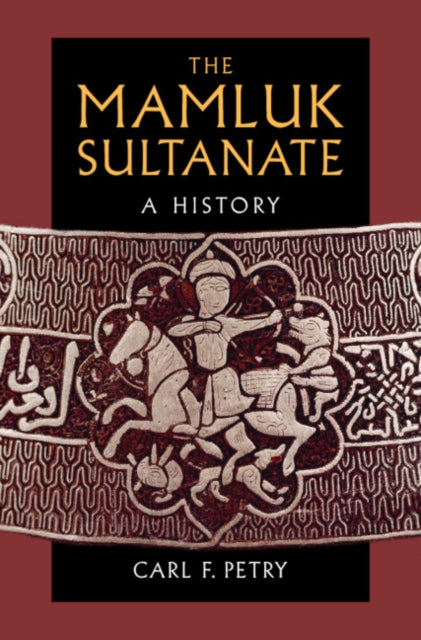
Carl F.Petry
The Mamluk Sultanate: A History
The Mamluk Sultanate: A History
💎 Earn 118 Points (£1.18) on this item.
We can order this item for you. Delivery usually takes about 4 to 6 weeks.
This item is not held in our immediate stock. We will order it for you after checkout.
Estimated delivery: About 4 to 6 weeks
YOU SAVE £1.40
- Condition: Brand new
- UK Delivery times: Usually arrives within 2 - 3 working days
- UK Shipping: Fee starts at £3.89. Subject to product weight & dimension
Bulk ordering. Want 15 or more copies? Get a personalised quote and bigger discounts. Learn more about bulk orders.
Couldn't load pickup availability
- More about The Mamluk Sultanate: A History
The Mamluk Sultanate ruled Egypt, Syria, and the Arabian hinterland along the Red Sea from 1250 to 1517. It incorporated political structures and cultural traditions of its predecessors but had a radical departure from the hierarchies of power. This book explores the Sultanate's identity, heritage, statecraft, foreign policy, economy, and cultural legacy, and its interaction with polities throughout the central Islamic world.
Format: Paperback / softback
Length: 304 pages
Publication date: 26 May 2022
Publisher: Cambridge University Press
The Mamluk Sultanate, spanning from the deposition of the Ayyubid dynasty in 1250 to the Ottoman conquest of Egypt in 1517, exerted its rule over Egypt, Syria, and the Arabian hinterland along the Red Sea. This remarkable regime, composed of slave-soldiers, incorporated numerous political structures and cultural traditions from its Fatimid and Ayyubid predecessors. However, what set the Mamluk Sultanate apart was its unique system of governance and centralization of authority, marking a significant departure from the hierarchies of power that preceded it.
This interdisciplinary book, offering a comprehensive survey of events from the Sultanate's founding to the Ottoman occupation, delves into the Sultanate's identity and heritage after the Mongol conquests, the practicality of conspiratorial politics, and the close symbiosis between the military elite and civil bureaucracy. Carl F. Petry also examines the statecraft, foreign policy, economy, and cultural legacy of the Sultanate, exploring its interactions with polities throughout the central Islamic world and beyond. Through his analysis, Petry sheds light on how the Mamluk Sultanate can be regarded as a significant experiment in state-building within the pre-modern Islamic world.
The Mamluk Sultanate's rule was characterized by a fusion of Arab, Turkic, and Egyptian cultures, resulting in a unique blend of traditions and customs. The Sultanate's military strength was a significant factor in its dominance, with a well-trained and disciplined army that was often able to conquer new territories and maintain control over vast regions. The Sultanate's economy was also thriving, with a robust agricultural sector and a thriving trade network that extended across the Mediterranean and beyond.
One of the most notable features of the Mamluk Sultanate was its system of governance, which was characterized by a centralization of power and a hierarchical structure. The Sultan, who served as the head of state, was the ultimate authority and was surrounded by a council of advisors who helped him make decisions. The military elite played a crucial role in the Sultanate's governance, with generals and commanders holding significant power and influence.
The Sultanate's foreign policy was also shaped by its interactions with other Islamic states and empires. The Mamluk Sultanate maintained close relations with the Ottoman Empire, which allowed it to expand its influence and control over a vast region. The Sultanate also played a significant role in the spread of Islam throughout the Middle East and North Africa, as it was a major center of learning and scholarship.
In conclusion, the Mamluk Sultanate was a remarkable regime that ruled Egypt, Syria, and the Arabian hinterland along the Red Sea for over three centuries. Its unique system of governance and centralization of authority, combined with a fusion of Arab, Turkic, and Egyptian cultures, made it a significant experiment in state-building within the pre-modern Islamic world. The Sultanate's military strength, economic prosperity, and cultural legacy continue to be studied and celebrated to this day.
Weight: 562g
Dimension: 152 x 229 x 24 (mm)
ISBN-13: 9781108456999
UK and International shipping information
UK and International shipping information
We deliver throughout the United Kingdom and to 128 countries and territories worldwide, including the United States, Australia, Canada, Germany, Spain and France.