Kersten T.Hall
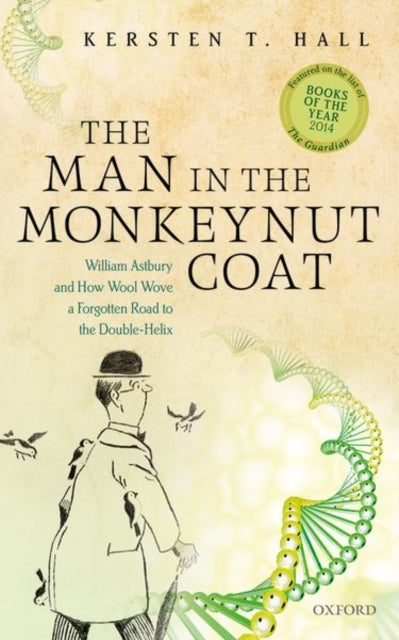
The Man in the Monkeynut Coat: William Astbury and How Wool Wove a Forgotten Road to the Double-Helix
The Man in the Monkeynut Coat: William Astbury and How Wool Wove a Forgotten Road to the Double-Helix
💎 Earn 103 Points (£1.03) on this item.
We can order this item for you. Delivery usually takes about 4 to 6 weeks.
This item is not held in our immediate stock. We will order it for you after checkout.
Estimated delivery: About 4 to 6 weeks
YOU SAVE £1.23
- Condition: Brand new
- UK Delivery times: Usually arrives within 2 - 3 working days
- UK Shipping: Fee starts at £2.39. Subject to product weight & dimension
Bulk ordering. Want 15 or more copies? Get a personalised quote and bigger discounts. Learn more about bulk orders.
Couldn't load pickup availability
- More about The Man in the Monkeynut Coat: William Astbury and How Wool Wove a Forgotten Road to the Double-Helix
The discovery of DNA's structure was a significant scientific breakthrough, made possible by the contributions of many scientists, including Rosalind Franklin and William T. Astbury. Astbury's pioneering work in X-ray crystallography led to the first studies of DNA's structure, which were crucial for Watson and Crick's discovery. Despite his significant contributions, Astbury has been largely forgotten, and his ideas have transformed biology, leaving a lasting legacy.
Format: Paperback / softback
Length: 272 pages
Publication date: 02 August 2022
Publisher: Oxford University Press
Sir Isaac Newton once declared that his momentous discoveries were only made thanks to having stood on the shoulders of giants. The same might also be said of the scientists James Watson and Francis Crick. Their discovery of the structure of DNA was, without doubt, one of the biggest scientific landmarks in history, and, thanks largely to the success of Watson's best-selling memoir, The Double Helix, there might seem to be little new to say about this story. But much remains to be said about the particular giants on whose shoulders Watson and Crick stood. Of these, the crystallographer Rosalind Franklin, whose famous X-ray diffraction photograph known as Photo 51 provided Watson and Crick with a vital clue, is now well recognized. Far less well known is the physicist William T. Astbury, who, working at Leeds in the 1930s on the structure of wool for the local textile industry, pioneered the use of X-ray crystallography to study biological fibers. In so doing, he not only made the very first studies of the structure of DNA, culminating in a photo almost identical to Franklin's Photo 51, but also founded the new science of molecular biology. Yet, whilst Watson and Crick won the Nobel Prize, Astbury has largely been forgotten. The Man in the Monkeynut Coat tells the story of this neglected pioneer, showing not only how it was thanks to him that Watson and Crick were not left empty-handed, but also how his ideas transformed biology, leaving a legacy that is still felt today.
Sir Isaac Newton once declared that his momentous discoveries were only made thanks to having stood on the shoulders of giants. The same might also be said of the scientists James Watson and Francis Crick. Their discovery of the structure of DNA was, without doubt, one of the biggest scientific landmarks in history, and, thanks largely to the success of Watson's best-selling memoir, The Double Helix, there might seem to be little new to say about this story. But much remains to be said about the particular giants on whose shoulders Watson and Crick stood. Of these, the crystallographer Rosalind Franklin, whose famous X-ray diffraction photograph known as Photo 51 provided Watson and Crick with a vital clue, is now well recognized. Far less well known is the physicist William T. Astbury, who, working at Leeds in the 1930s on the structure of wool for the local textile industry, pioneered the use of X-ray crystallography to study biological fibers. In so doing, he not only made the very first studies of the structure of DNA, culminating in a photo almost identical to Franklin's Photo 51, but also founded the new science of molecular biology. Yet, whilst Watson and Crick won the Nobel Prize, Astbury has largely been forgotten. The Man in the Monkeynut Coat tells the story of this neglected pioneer, showing not only how it was thanks to him that Watson and Crick were not left empty-handed, but also how his ideas transformed biology, leaving a legacy that is still felt today.
Weight: 372g
Dimension: 136 x 216 x 22 (mm)
ISBN-13: 9780198766964
Edition number: Revised ed
This item can be found in:
UK and International shipping information
UK and International shipping information
UK Delivery and returns information:
- Delivery within 2 - 3 days when ordering in the UK.
- Shipping fee for UK customers from £2.39. Fully tracked shipping service available.
- Returns policy: Return within 30 days of receipt for full refund.
International deliveries:
Shulph Ink now ships to Australia, Belgium, Canada, France, Germany, Ireland, Italy, India, Luxembourg Saudi Arabia, Singapore, Spain, Netherlands, New Zealand, United Arab Emirates, United States of America.
- Delivery times: within 5 - 10 days for international orders.
- Shipping fee: charges vary for overseas orders. Only tracked services are available for most international orders. Some countries have untracked shipping options.
- Customs charges: If ordering to addresses outside the United Kingdom, you may or may not incur additional customs and duties fees during local delivery.