Dariusz Paduch
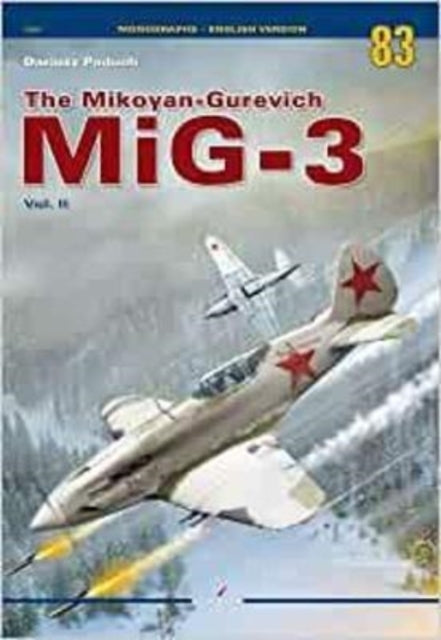
The Mikoyan-Gurevich Mig-3 Vol. II
The Mikoyan-Gurevich Mig-3 Vol. II
💎 Earn 84 Points (£0.84) on this item.
YOU SAVE £7.01
- Condition: Brand new
- UK Delivery times: Usually arrives within 2 - 3 working days
- UK Shipping: Fee starts at £2.39. Subject to product weight & dimension
Bulk ordering. Want 15 or more copies? Get a personalised quote and bigger discounts. Learn more about bulk orders.
Couldn't load pickup availability
- More about The Mikoyan-Gurevich Mig-3 Vol. II
The I-200 fighter project was a compromise between design offices, the Soviet aviation industry, and military requirements. It was a single-seat, single-engine, mixed-design low-wing aircraft with a metal fuselage, wooden tail part, and an all-metal horizontal stabilizer. The prototypes and later MiG-1 and MiG-3 were similar in design.
Format: Paperback / softback
Length: 72 pages
Publication date: 28 May 2022
Publisher: Kagero Oficyna Wydawnicza
The I-200 fighter project was a complex and multifaceted endeavor that involved a delicate balance between the capabilities of design offices, the realities of the Soviet aviation industry, the available technologies, and the military requirements of the time. It was a project that sought to strike a balance between the demands of air superiority, ground attack, and reconnaissance, all while considering the constraints imposed by the technological limitations and the economic realities of the era.
According to the brief description of the MiG-3 from 1941, it was initially intended to serve as an interceptor, but its design also allowed it to be used as an attack aircraft or a light, fast dive bomber. This versatility was a key factor in the I-200's appeal and its eventual success as a fighter aircraft.
Both the I-200 prototypes and the later MiG-1 and MiG-3 were single-seat, single-engine, mixed-design low-wing aircraft. The front part of the fuselage, together with the center wing, up to the rear wall of the pilots cockpit, was made of metal. Only the tail part of the fuselage and wing consoles were wooden. The vertical stabilizer, which was an integral part of the fuselage, was made of wood, while the horizontal stabilizer was all-metal. The rudders and ailerons had a metal construction and canvas cover.
The undercarriage was made of chromansil steel, providing a sturdy foundation for the aircraft. In front part of the fuselage, there was a pilots cabin with a seat, instrument panel, and controls, front fuel tank, main offensive armament, water cooler, and other componentry. The center wing was attached to the front part of the fuselage at seven points, the rear part at four points, while the engine mount was supported by two.
The I-200 fighter project was a remarkable achievement that showcased the Soviet aviation industry's capabilities and ingenuity. It was a product of a collaborative effort between design offices, engineers, and military personnel, and it reflected the Soviet Union's commitment to developing advanced military technology. The I-200's design was a testament to the Soviet Union's determination to maintain its air superiority and its ability to adapt to changing military circumstances.
Despite its many successes, the I-200 fighter project was not without its challenges. One of the biggest challenges was the limited availability of resources and the constraints imposed by the Soviet Union's economic system. The project required a significant investment of time, money, and manpower, and the Soviet Union's limited resources made it difficult to sustain the project's development.
Another challenge was the competition from other aircraft manufacturers, particularly the United States and the United Kingdom. The United States and the United Kingdom had developed advanced fighter aircraft, such as the F-86 Sabre and the Spitfire, which posed a significant threat to the I-200's dominance in the air. The Soviet Union had to work hard to keep up with the technological advancements of its rivals, and it was a constant struggle to stay ahead of the curve.
Despite these challenges, the I-200 fighter project was a significant milestone in the history of aviation. It paved the way.
Weight: 414g
Dimension: 209 x 296 x 9 (mm)
ISBN-13: 9788366673915
This item can be found in:
UK and International shipping information
UK and International shipping information
UK Delivery and returns information:
- Delivery within 2 - 3 days when ordering in the UK.
- Shipping fee for UK customers from £2.39. Fully tracked shipping service available.
- Returns policy: Return within 30 days of receipt for full refund.
International deliveries:
Shulph Ink now ships to Australia, Belgium, Canada, France, Germany, Ireland, Italy, India, Luxembourg Saudi Arabia, Singapore, Spain, Netherlands, New Zealand, United Arab Emirates, United States of America.
- Delivery times: within 5 - 10 days for international orders.
- Shipping fee: charges vary for overseas orders. Only tracked services are available for most international orders. Some countries have untracked shipping options.
- Customs charges: If ordering to addresses outside the United Kingdom, you may or may not incur additional customs and duties fees during local delivery.