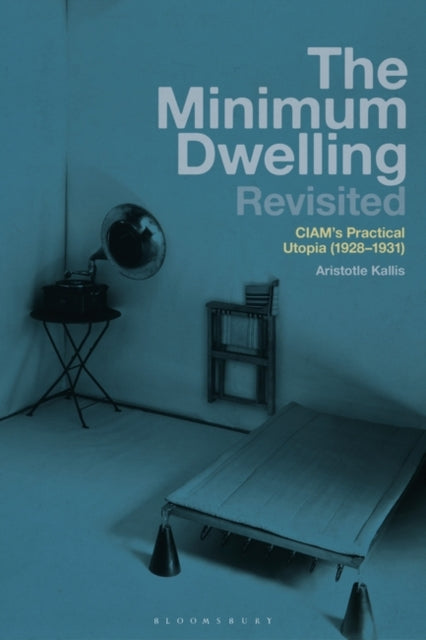
Professor Aristotle Kallis
The Minimum Dwelling Revisited: CIAM's Practical Utopia (1928-31)
The Minimum Dwelling Revisited: CIAM's Practical Utopia (1928-31)
💎 Earn 477 Points (£4.77) on this item.
- Condition: Brand new
- UK Delivery times: Usually arrives within 2 - 3 working days
- UK Shipping: Fee starts at £3.89. Subject to product weight & dimension
Bulk ordering. Want 15 or more copies? Get a personalised quote and bigger discounts. Learn more about bulk orders.
Couldn't load pickup availability
- More about The Minimum Dwelling Revisited: CIAM's Practical Utopia (1928-31)
This book explores the intellectual history of the modernist minimum dwelling, focusing on the 2nd and 3rd CIAM conferences (1929-31) and their engagement with the concept. It re-evaluates these conferences as milestones in the organization's annals and seminal moments in the history of interwar modernism. The architects discussed a design program for cost-effective, good-quality housing, redefining dwelling as the hub of a new way of living. Despite falling short of expectations, the conferences sanctioned a semantic shift from minimum as bare necessity to aspirational minimalism, transforming the conversation on mass low-cost dwelling in design, social, and ethical terms.
Format: Hardback
Length: 248 pages
Publication date: 02 November 2023
Publisher: Bloomsbury Publishing PLC
This book offers an insightful intellectual exploration of the modernist concept of the minimum dwelling, delving into its historical roots and its role in shaping society's utopian aspirations. It sheds light on the often-overlooked 2nd and 3rd CIAM conferences (1929-31), which played a pivotal role in the organization's history and in the development of interwar modernism.
In 1929, a diverse group of avant-garde modernist architects, including Ernst May, Mart Stam, Walter Gropius, and Le Corbusier, gathered in Frankfurt for the second installment of the CIAM conferences. Their aim was to develop a design program for cost-effective, high-quality housing that would cater to the needs of the broader population while maximizing quality and functionality.
Through their discussions on the minimum dwelling, these architects re-defined the concept of dwelling as the center of a new way of living. They proposed a revolutionary multi-scalar approach to urban design, centered around the concept of the Existenzminimum (optimally minimal housing). This approach aimed to create compact, efficient, and functional spaces that would meet the basic needs of individuals while fostering a sense of community and social connectivity.
While the two conferences did not meet the organizers' expectations and were somewhat overshadowed by subsequent installments, the participating architects endorsed a significant semantic shift from minimum as mere necessity to a different, aspirational, and transformative form of minimalism. This shift had profound implications for the discourse on mass low-cost dwelling in design, social, and ethical terms.
The book is divided into two parts. The first part takes a genealogical approach, tracing the origins of the concept of minimum dwelling prior to the 2nd and 3rd CIAM conferences. It explores the historical, cultural, and architectural factors that influenced the development of this concept and its relevance in the context of the modernist movement.
The second part provides a detailed account of the proceedings of the two conferences themselves. It delves into the discussions, debates, and proposals that took place. The architects examined the challenges and opportunities presented by the minimum dwelling, exploring innovative design solutions and strategies to achieve affordability, functionality, and aesthetic appeal.
Through its comprehensive analysis, The Minimum Dwelling Revisited offers a fresh perspective on the history and significance of the modernist minimum dwelling. It sheds light on the role.
Weight: 638g
Dimension: 164 x 242 x 21 (mm)
ISBN-13: 9781350346185
UK and International shipping information
UK and International shipping information
We deliver throughout the United Kingdom and to 128 countries and territories worldwide, including the United States, Australia, Canada, Germany, Spain and France.