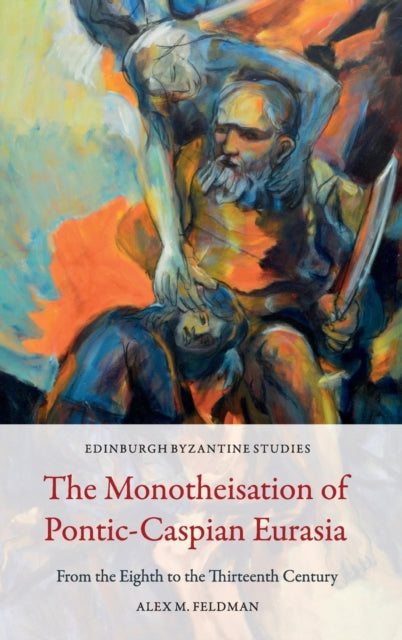
Alex M. Feldman
The Monotheisation of Pontic-Caspian Eurasia: From the Eighth to the Thirteenth Century
The Monotheisation of Pontic-Caspian Eurasia: From the Eighth to the Thirteenth Century
💎 Earn 402 Points (£4.02) on this item.
We can order this item for you. Delivery usually takes about 4 to 6 weeks.
This item is not held in our immediate stock. We will order it for you after checkout.
Estimated delivery: About 4 to 6 weeks
YOU SAVE £24.46
- Condition: Brand new
- UK Delivery times: Usually arrives within 2 - 3 working days
- UK Shipping: Fee starts at £2.39. Subject to product weight & dimension
Bulk ordering. Want 15 or more copies? Get a personalised quote and bigger discounts. Learn more about bulk orders.
Couldn't load pickup availability
- More about The Monotheisation of Pontic-Caspian Eurasia: From the Eighth to the Thirteenth Century
The line between the ancient and medieval worlds is arbitrary, but historians acknowledge that they are different. Alex Feldman challenges us to see them as the same world, except for the imposition of a given monotheism.
Format: Hardback
Length: 304 pages
Publication date: 31 October 2022
Publisher: Edinburgh University Press
The line between the ancient and medieval worlds is a subject of debate among historians, with many acknowledging that these distinctions are arbitrary. However, they still hold significance and take on their own lives. Alex Feldman challenges us to view these periods as part of the same world, except for the imposition of a specific monotheism.
The transition from the ancient to the medieval world is a complex and multifaceted process that spans several centuries. It is marked by significant cultural, social, and economic changes that shaped the world we know today. One of the most notable distinctions between the ancient and medieval worlds is the emergence of Christianity as a dominant religion.
During the ancient period, various religions and belief systems prevailed, including polytheism, animism, and atheism. However, with the rise of the Roman Empire and the spread of Christianity, the religion became increasingly influential and spread throughout Europe and beyond. The Christian worldview, which emphasized the importance of faith, morality, and the afterlife, had a profound impact on the culture, art, and literature of the medieval world.
Another significant difference between the ancient and medieval worlds is the development of feudalism. Feudalism was a social system that emerged in Europe during the medieval period and was characterized by the relationship between lords and vassals. In this system, lords granted land and other privileges to vassals in exchange for loyalty and service. Vassals were bound to their lords and were responsible for providing military support, labor, and taxes.
Feudalism played a crucial role in the organization of medieval society and helped to maintain stability and order. It also contributed to the development of the aristocracy, which emerged as a powerful social class during the medieval period. The aristocracy was characterized by its wealth, power, and influence and was often involved in politics and governance.
In addition to the emergence of Christianity and feudalism, the ancient and medieval worlds also differed in terms of their political systems. During the ancient period, many civilizations were governed by monarchies, empires, or oligarchies. However, during the medieval period, feudalism became increasingly prevalent, and kings and queens lost much of their power. Instead, the power was held by noblemen and bishops, who were often involved in local politics and governance.
The medieval world was also characterized by significant technological advancements. During this period, the printing press was invented, which allowed for the widespread dissemination of knowledge and ideas. The development of the clock and other timekeeping devices also helped to improve the organization of society and increase productivity.
However, the medieval world was also marked by significant challenges and setbacks. One of the most significant was the Black Death, which struck Europe in the 14th century and killed millions of people. The Black Death also had a profound impact on the economy, as it led to a decline in labor and a rise in prices.
Another challenge was the rise of nationalism, which emerged in Europe during the 19th century. Nationalism was characterized by a sense of pride and belonging to a particular nation and was often associated with the idea of a shared cultural heritage. However, nationalism also led to conflicts and wars, as nations sought to expand their territories and influence.
In conclusion, the line between the ancient and medieval worlds is a complex and multifaceted process that spans several centuries. It is marked by significant cultural, social, and economic changes that shaped the world we know today. The emergence of Christianity as a dominant religion, the development of feudalism, the decline of monarchies, and the rise of nationalism are just a few of the distinctions that set these periods apart. While these distinctions may be arbitrary, they still hold significance and continue to influence our understanding of history and society.
Weight: 620g
Dimension: 162 x 240 x 29 (mm)
ISBN-13: 9781474478106
UK and International shipping information
UK and International shipping information
UK Delivery and returns information:
- Delivery within 2 - 3 days when ordering in the UK.
- Shipping fee for UK customers from £2.39. Fully tracked shipping service available.
- Returns policy: Return within 30 days of receipt for full refund.
International deliveries:
Shulph Ink now ships to Australia, Belgium, Canada, France, Germany, Ireland, Italy, India, Luxembourg Saudi Arabia, Singapore, Spain, Netherlands, New Zealand, United Arab Emirates, United States of America.
- Delivery times: within 5 - 10 days for international orders.
- Shipping fee: charges vary for overseas orders. Only tracked services are available for most international orders. Some countries have untracked shipping options.
- Customs charges: If ordering to addresses outside the United Kingdom, you may or may not incur additional customs and duties fees during local delivery.