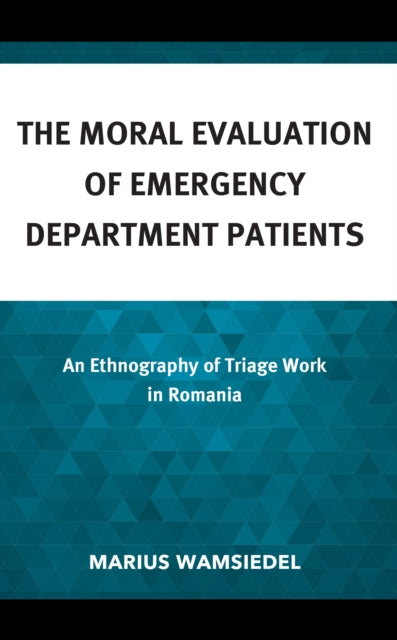
Marius, Duke Kunshan University Wamsiedel
The Moral Evaluation of Emergency Department Patients: An Ethnography of Triage Work in Romania
The Moral Evaluation of Emergency Department Patients: An Ethnography of Triage Work in Romania
We can order this item for you. Delivery usually takes about 4 to 6 weeks.
This item is not held in our immediate stock. We will order it for you after checkout.
Estimated delivery: About 4 to 6 weeks
- Condition: Brand new
- UK Delivery times: Usually arrives within 2 - 3 working days
- UK Shipping: Fee starts at £3.89. Subject to product weight & dimension
Bulk ordering. Want 15 or more copies? Get a personalised quote and bigger discounts. Learn more about bulk orders.
Couldn't load pickup availability
- More about The Moral Evaluation of Emergency Department Patients: An Ethnography of Triage Work in Romania
Marius Wamsiedel examines the social categorization of patients and its consequences at two emergency departments in Romania, arguing that moral evaluation is an attempt to align the provision of emergency services with socially dominant values, norms, and representations.
Format: Hardback
Length: 198 pages
Publication date: 28 March 2023
Publisher: Bloomsbury Publishing Plc
Marius Wamsiedel's book "The Moral Evaluation of Emergency Department Patients: An Ethnography of Triage Work in Romania" explores the social categorization of patients and its consequences in two emergency departments in Romania. Based on long-term ethnographic fieldwork, the book argues that moral evaluation is an attempt by triage nurses and clerks to keep the emergency service afloat in the context of high-care demand, insufficient resources, and uneven access to primary care. At the same time, it argues that moral evaluation is an effort to align the provision of emergency services with socially dominant values, norms, and representations. As such, the moral evaluation of patients becomes a Procrustean bed that reduces some inequities in access to health care while generating or amplifying others. By adopting an interactionist lens, Wamsiedel unravels the underlying social logic of moral evaluation, the criteria and assumptions that inform it, and attempts by triage workers and patients to negotiate access to emergency care.
The book offers new ways of understanding the work of street-level bureaucracies and informal barriers to care. It highlights the importance of social categorization in shaping patients' experiences and outcomes and the ways in which triage workers and patients negotiate these categorizations. Wamsiedel's ethnography provides a rich and detailed account of the daily work of triage nurses and clerks, including their interactions with patients, their decision-making processes, and the challenges they face.
One of the key findings of the book is that moral evaluation is a complex and multifaceted process that involves a range of factors, including the triage nurses' and clerks' own values, beliefs, and experiences, the patients' characteristics and behaviors, and the broader social and political context. Wamsiedel argues that moral evaluation is not simply a matter of applying objective criteria to patients but is also shaped by the triage workers' and patients' own interpretations of these criteria. This can lead to inconsistencies and biases in the evaluation process, which can have significant consequences for patients' access to care.
Another important finding of the book is that moral evaluation can have both positive and negative consequences for patients. On the positive side, moral evaluation can help to ensure that patients receive the care that they need in a timely and efficient manner. By prioritizing patients based on their medical needs, triage workers can help to reduce the risk of complications and deaths. However, moral evaluation can also be used to exclude patients from care, particularly those who are perceived as being less deserving or who have complex medical conditions. This can lead to discrimination and social exclusion and can have a negative impact on patients' health and well-being.
Wamsiedel's book also highlights the ways in which triage workers and patients can negotiate access to emergency care. He argues that triage workers can use a range of strategies to ensure that patients receive the care that they need, including prioritizing patients based on their medical needs, providing clear and transparent information about the evaluation process, and working with patients to develop a care plan that meets their needs. Patients can also play a role in negotiating access to care by being aware of their rights and by advocating for themselves.
However, Wamsiedel also notes that there are significant barriers to negotiating access to emergency care. These include a lack of resources, a lack of training, and a lack of coordination between different healthcare providers. This can lead to long wait times, poor quality of care, and a lack of access to essential services.
In conclusion, Marius Wamsiedel's book "The Moral Evaluation of Emergency Department Patients: An Ethnography of Triage Work in Romania" offers new ways of understanding the work of street-level bureaucracies and informal barriers to care. It highlights the importance of social categorization in shaping patients' experiences and outcomes and the ways in which triage workers and patients negotiate these categorizations. While moral evaluation can have both positive and negative consequences for patients, it is important to ensure that it is applied in a fair and transparent manner. By working to address the barriers to negotiating access to emergency care, we can help to ensure that all patients receive the care that they need in a timely and efficient manner.
Weight: 448g
Dimension: 160 x 237 x 20 (mm)
ISBN-13: 9781666916546
UK and International shipping information
UK and International shipping information
We deliver throughout the United Kingdom and to 128 countries and territories worldwide, including the United States, Australia, Canada, Germany, Spain and France.