Christina Petterson
The Moravian Brethren in a Time of Transition: A Socio-Economic Analysis of a Religious Community in Eighteenth-Century Saxony
The Moravian Brethren in a Time of Transition: A Socio-Economic Analysis of a Religious Community in Eighteenth-Century Saxony
💎 Earn 115 Points (£1.15) on this item.
We can order this item for you. Delivery usually takes about 4 to 6 weeks.
This item is not held in our immediate stock. We will order it for you after checkout.
Estimated delivery: About 4 to 6 weeks
YOU SAVE £6.99
- Condition: Brand new
- UK Delivery times: Usually arrives within 2 - 3 working days
- UK Shipping: Fee starts at £2.39. Subject to product weight & dimension
Bulk ordering. Want 15 or more copies? Get a personalised quote and bigger discounts. Learn more about bulk orders.
Couldn't load pickup availability
- More about The Moravian Brethren in a Time of Transition: A Socio-Economic Analysis of a Religious Community in Eighteenth-Century Saxony
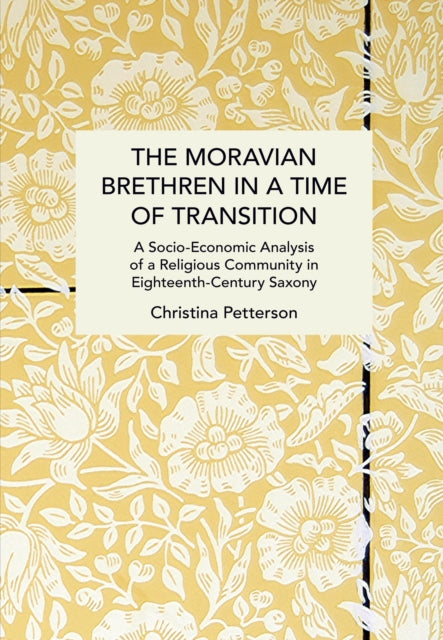
In eighteenth-century Herrnhut, Eastern Germany, between 1740 and 1760, Christina Petterson examines the Moravian Brethren's community-building process and individual and collective subjectification practices. She demonstrates how their social experiments and practices were relevant to early modernity, providing a non-religious reading of categories that became central to liberal ideology.
Format: Paperback / softback
Length: 378 pages
Publication date: 27 October 2022
Publisher: Haymarket Books
Christina Petterson delves into the intricate process of community building and the individual and collective subjectification practices of the Moravian Brethren in eighteenth-century Herrnhut, Eastern Germany, between 1740 and 1760. The Moravian Brethren, although rooted in Protestantism, shed light on the significance of their social experiments and practices for early modernity by uncovering the socio-economic layers within the archival material. Through this non-religious lens, Petterson offers a fresh interpretation of categories that became pivotal to liberal ideology, reflecting the Moravian negotiation of the transition from feudal society to early capitalism.
Petterson's study is a rich tapestry of historical analysis, drawing upon a vast array of archival documents to provide a comprehensive understanding of the Moravian Brethren's community building efforts and the socio-economic dynamics of their time. By meticulously examining the records, she sheds light on the complex interplay between religious beliefs, social structures, and economic developments, offering a nuanced interpretation of the Brethren's experiences.
One of the key insights of Petterson's work is her recognition of the Moravian Brethren as agents of social change. Despite their religious affiliations, the Brethren engaged in a range of social experiments and practices that aimed to improve the lives of their members and the broader community. These experiments included communal living arrangements, shared economic resources, and a focus on education and social welfare.
Petterson's analysis also highlights the role of gender and sexuality in the community building process. She demonstrates how the Brethren negotiated the complex social norms and expectations surrounding gender roles and sexuality, challenging traditional hierarchies and promoting greater equality and inclusivity. This exploration of gender and sexuality adds a new dimension to our understanding of early modern society, as it challenges the notion of fixed and universal categories of identity and highlights the diversity of experiences and practices within communities.
In addition to her analysis of community building and subjectification practices, Petterson also explores the broader cultural and social context in which the Moravian Brethren operated. She examines the influence of Enlightenment ideas, the rise of capitalism, and the broader social and political developments of the eighteenth century on the Brethren's community and practices. This contextualization provides a deeper understanding of the Brethren's experiences and their place within the broader historical landscape.
Overall, Christina Petterson's study is a groundbreaking contribution to the field of early modern history. Through her meticulous analysis of archival documents and her insightful interpretation of the Moravian Brethren's experiences, she offers a fresh perspective on the complexities of community building, subjectification practices, and the socio-economic dynamics of early modern society. Petterson's work demonstrates the value of interdisciplinary research and the importance of exploring the intersections of religion, society, and culture in shaping historical events and experiences.
Dimension: 228 x 152 (mm)
ISBN-13: 9781642597776
UK and International shipping information
UK and International shipping information
UK Delivery and returns information:
- Delivery within 2 - 3 days when ordering in the UK.
- Shipping fee for UK customers from £2.39. Fully tracked shipping service available.
- Returns policy: Return within 30 days of receipt for full refund.
International deliveries:
Shulph Ink now ships to Australia, Belgium, Canada, France, Germany, Ireland, Italy, India, Luxembourg Saudi Arabia, Singapore, Spain, Netherlands, New Zealand, United Arab Emirates, United States of America.
- Delivery times: within 5 - 10 days for international orders.
- Shipping fee: charges vary for overseas orders. Only tracked services are available for most international orders. Some countries have untracked shipping options.
- Customs charges: If ordering to addresses outside the United Kingdom, you may or may not incur additional customs and duties fees during local delivery.