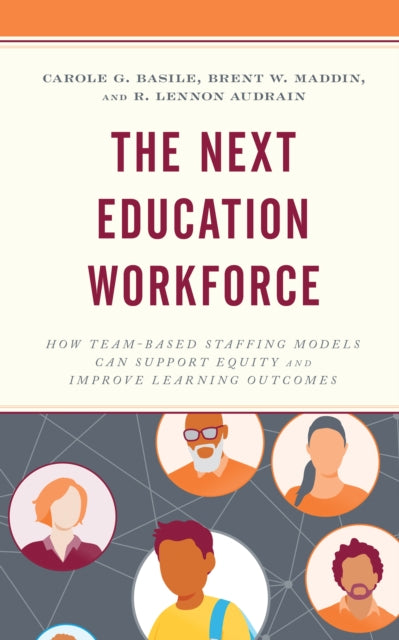
Carole G. Basile,Brent W. Maddin,R. Lennon Audrain
The Next Education Workforce: How Team-Based Staffing Models Can Support Equity and Improve Learning Outcomes
The Next Education Workforce: How Team-Based Staffing Models Can Support Equity and Improve Learning Outcomes
💎 Earn 159 Points (£1.59) on this item.
YOU SAVE £4.14
- Condition: Brand new
- UK Delivery times: Usually arrives within 2 - 3 working days
- UK Shipping: Fee starts at £3.89. Subject to product weight & dimension
Bulk ordering. Want 15 or more copies? Get a personalised quote and bigger discounts. Learn more about bulk orders.
Couldn't load pickup availability
- More about The Next Education Workforce: How Team-Based Staffing Models Can Support Equity and Improve Learning Outcomes
Education has focused on changing teachers' instructional knowledge and skills and the content that students learn, but our education system is not reliably delivering quality learning experiences and outcomes for nearly enough people and communities. To achieve more equitable learning outcomes and better working conditions for teachers, schools should create teams of educators with distributed expertise that can deliver deeper and more personalized learning experiences for students. The Next Education Workforce book outlines core elements of Next Education Workforce models, including new ways for educators to specialize and advance in the profession, offering concrete actions to help leaders navigate and facilitate sustainable systems change, and offering a provocative prescription of how teacher preparation, professional learning, and human resource systems will need to change to support team-based models.
Format: Paperback / softback
Length: 140 pages
Publication date: 26 October 2022
Publisher: Rowman & Littlefield
Education has traditionally focused on improving teachers' instructional knowledge and skills and the content that students learn, but our education system is not reliably delivering quality learning experiences and outcomes for nearly enough people and communities. In the book "The Next Education Workforce: How Team-Based Staffing Models Can Support Equity and Improve Learning Outcomes," Carole G. Basile, Brent W. Maddin, and R. Lennon Audrain argue that we need to redesign how schools organize educators and learners. The authors highlight how the normative one-teacher, one-classroom model underserves both learners and educators and make the case that schools should create teams of educators with distributed expertise that can deliver deeper and more personalized learning experiences for students. The book then addresses practical steps for school and system leaders to take by outlining core elements of Next Education Workforce models, including new ways for educators to specialize and advance in the profession, offering concrete actions to help leaders navigate and facilitate sustainable systems change, and offering a provocative prescription of how teacher preparation, professional learning, and human resource systems will need to change to support team-based models.
Education's Focus on Teacher Knowledge and Skills
Education has traditionally focused on improving teachers' instructional knowledge and skills and the content that students learn. However, our education system is not reliably delivering quality learning experiences and outcomes for nearly enough people and communities. In the book "The Next Education Workforce: How Team-Based Staffing Models Can Support Equity and Improve Learning Outcomes," Carole G. Basile, Brent W. Maddin, and R. Lennon Audrain argue that we need to redesign how schools organize educators and learners. The authors highlight how the normative one-teacher, one-classroom model underserves both learners and educators and make the case that schools should create teams of educators with distributed expertise that can deliver deeper and more personalized learning experiences for students. The book then addresses practical steps for school and system leaders to take by outlining core elements of Next Education Workforce models, including new ways for educators to specialize and advance in the profession, offering concrete actions to help leaders navigate and facilitate sustainable systems change, and offering a provocative prescription of how teacher preparation, professional learning, and human resource systems will need to change to support team-based models.
The Need for a New Education Workforce Model
The Next Education Workforce: How Team-Based Staffing Models Can Support Equity and Improve Learning Outcomes argues that we need to redesign how schools organize educators and learners. The authors highlight how the normative one-teacher, one-classroom model underserves both learners and educators and make the case that schools should create teams of educators with distributed expertise that can deliver deeper and more personalized learning experiences for students. The book then addresses practical steps for school and system leaders to take by outlining core elements of Next Education Workforce models, including new ways for educators to specialize and advance in the profession, offering concrete actions to help leaders navigate and facilitate sustainable systems change, and offering a provocative prescription of how teacher preparation, professional learning, and human resource systems will need to change to support team-based models.
The Benefits of Team-Based Staffing Models
Team-Based Staffing Models can support equity and improve learning outcomes in several ways. First, they can provide educators with more opportunities to specialize and advance in their profession. Second, they can offer concrete actions to help leaders navigate and facilitate sustainable systems change. Third, they can provide a provocative prescription of how teacher preparation, professional learning, and human resource systems will need to change to support team-based models.
The Challenges of Implementing Team-Based Staffing Models
Implementing team-based staffing models can be challenging. First, it can be difficult to find the right balance between specialization and collaboration. Second, it can be difficult to ensure that educators have the necessary skills and knowledge to work effectively in teams. Third, it can be difficult to ensure that educators are paid fairly and equitably.
Conclusion
In conclusion, education has traditionally focused on improving teachers' instructional knowledge and skills and the content that students learn, but our education system is not reliably delivering quality learning experiences and outcomes for nearly enough people and communities. The Next Education Workforce: How Team-Based Staffing Models Can Support Equity and Improve Learning Outcomes argues that we need to redesign how schools organize educators and learners. The book then addresses practical steps for school and system leaders to take by outlining core elements of Next Education Workforce models, including new ways for educators to specialize and advance in the profession, offering concrete actions to help leaders navigate and facilitate sustainable systems change, and offering a provocative prescription of how teacher preparation, professional learning, and human resource systems will need to change to support team-based models.
Weight: 196g
Dimension: 139 x 215 x 15 (mm)
ISBN-13: 9781475867268
UK and International shipping information
UK and International shipping information
We deliver throughout the United Kingdom and to 128 countries and territories worldwide, including the United States, Australia, Canada, Germany, Spain and France.