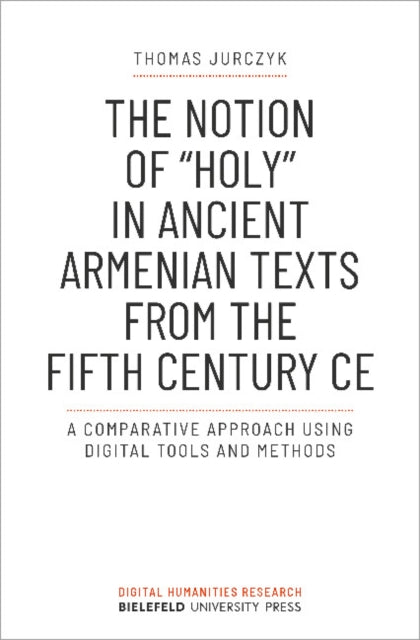
Thomas Jurczyk
The Notion of "holy" in Ancient Armenian Texts from the Fifth Century CE: A Comparative Approach Using Digital Tools and Methods
The Notion of "holy" in Ancient Armenian Texts from the Fifth Century CE: A Comparative Approach Using Digital Tools and Methods
💎 Earn 222 Points (£2.22) on this item.
YOU SAVE £9.40
- Condition: Brand new
- UK Delivery times: Usually arrives within 2 - 3 working days
- UK Shipping: Fee starts at £2.39. Subject to product weight & dimension
Bulk ordering. Want 15 or more copies? Get a personalised quote and bigger discounts. Learn more about bulk orders.
Couldn't load pickup availability
- More about The Notion of "holy" in Ancient Armenian Texts from the Fifth Century CE: A Comparative Approach Using Digital Tools and Methods
Thomas Jurczyk compares the meaning and application of two notions associated with holy, the Ancient Armenian term »surb« and the English word field, using distributional semantics and corpus linguistics.
Format: Paperback / softback
Length: 380 pages
Publication date: 15 May 2022
Publisher: Transcript Verlag
Religious studies have long been engaged in the exploration of the comparative concept of "holy" beyond religious, cultural, and linguistic boundaries. In this book, Thomas Jurczyk undertakes a diachronic comparison of the meaning and application of two key notions and their associated word fields that are commonly associated with a broader comparative notion of holy: the Ancient Armenian term "surb" and its related words, and the English word field associated with "holy." To conduct this comparison, Jurczyk employs a methodological approach rooted in distributional semantics and utilizes various tools and methods from the field of corpus linguistics.
Distributional semantics is a linguistic framework that examines the distribution of words in a corpus, taking into account their contextual usage. It provides insights into the semantic relationships between words and can be used to identify patterns and similarities in word usage across different languages and contexts. In the case of the Ancient Armenian term "surb" and its related words, Jurczyk examines their distribution in various historical texts and cultural contexts to understand their semantic evolution and usage.
On the other hand, the English word field associated with "holy" is examined using corpus linguistics techniques such as corpus analysis and word frequency analysis. Corpus analysis involves the systematic analysis of a large corpus of text to identify patterns and relationships between words. Word frequency analysis measures the frequency of a word in a corpus and can be used to identify the most common words and phrases associated with a particular concept.
By comparing the distribution of words in these two semantic fields, Jurczyk aims to shed light on the similarities and differences in the meaning and application of the notions of "holy" across different cultures and languages. He explores the historical development of these concepts, their cultural significance, and their linguistic expressions.
One of the key findings of Jurczyk's research is the identification of commonalities between the Ancient Armenian term "surb" and the English word field associated with "holy." Both terms are used to refer to a divine or sacred entity or phenomenon. However, Jurczyk notes that there are also significant differences in the way these terms are used and understood. For example, the Ancient Armenian term "surb" is often associated with a specific religious tradition and is used to refer to a deity or a sacred object. In contrast, the English word field associated with "holy" is more diverse and can be used to refer to a wide range of religious and non-religious concepts, including moral values, ethical principles, and spiritual experiences.
Another important aspect of Jurczyk's research is the examination of the cultural and linguistic factors that influence the meaning and application of the notions of "holy." He highlights the role of religious beliefs, practices, and rituals in shaping the way these terms are used and understood. For example, the Ancient Armenian term "surb" is deeply intertwined with the religious practices and beliefs of the Armenian people, and its meaning has evolved over time to reflect the changing religious landscape of the region. Similarly, the English word field associated with "holy" has been influenced by a wide range of cultural and linguistic factors, including the influence of Christianity, Islam, and other religious traditions.
In addition to the diachronic comparison of the Ancient Armenian term "surb" and the English word field associated with "holy," Jurczyk also explores the contemporary use of these terms. He examines the ways in which these terms are used in contemporary religious and non-religious contexts, and how they are interpreted and understood by different individuals and communities.
One of the challenges that Jurczyk faces in his research is the lack of standardized terminology and definitions in the field of religious studies. This can make it difficult to compare and contrast different concepts and their associated word fields. Jurczyk addresses this challenge by developing his own terminology and definitions, which are based on a comprehensive analysis of the relevant literature and cultural contexts.
Another challenge that Jurczyk faces is the issue of cultural bias and prejudice. He recognizes that the study of religious concepts can be influenced by cultural biases and prejudices, and he takes steps to address these issues in his research. He emphasizes the importance of approaching religious concepts with an open mind and a willingness to learn from different perspectives.
In conclusion, Thomas Jurczyk's book "Holy Beyond Religious, Cultural, and Linguistic Boundaries" is a significant contribution to the field of religious studies. It provides a diachronic comparison of the meaning and application of two key notions and their associated word fields that are commonly associated with a broader comparative notion of holy: the Ancient Armenian term "surb" and the English word field associated with "holy." By employing a methodological approach rooted in distributional semantics and utilizing various tools and methods from the field of corpus linguistics, Jurczyk sheds light on the similarities and differences in the meaning and application of these concepts across different cultures and languages. His research highlights the role of religious beliefs, practices, and rituals in shaping the way these terms are used and understood, and it provides valuable insights into the contemporary use of these terms in religious and non-religious contexts. Despite the challenges that Jurczyk faces in his research, his book is a valuable resource for scholars and students interested in the study of religion and its impact on human society.
Weight: 592g
Dimension: 148 x 223 x 33 (mm)
ISBN-13: 9783837661811
UK and International shipping information
UK and International shipping information
UK Delivery and returns information:
- Delivery within 2 - 3 days when ordering in the UK.
- Shipping fee for UK customers from £2.39. Fully tracked shipping service available.
- Returns policy: Return within 30 days of receipt for full refund.
International deliveries:
Shulph Ink now ships to Australia, Belgium, Canada, France, Germany, Ireland, Italy, India, Luxembourg Saudi Arabia, Singapore, Spain, Netherlands, New Zealand, United Arab Emirates, United States of America.
- Delivery times: within 5 - 10 days for international orders.
- Shipping fee: charges vary for overseas orders. Only tracked services are available for most international orders. Some countries have untracked shipping options.
- Customs charges: If ordering to addresses outside the United Kingdom, you may or may not incur additional customs and duties fees during local delivery.