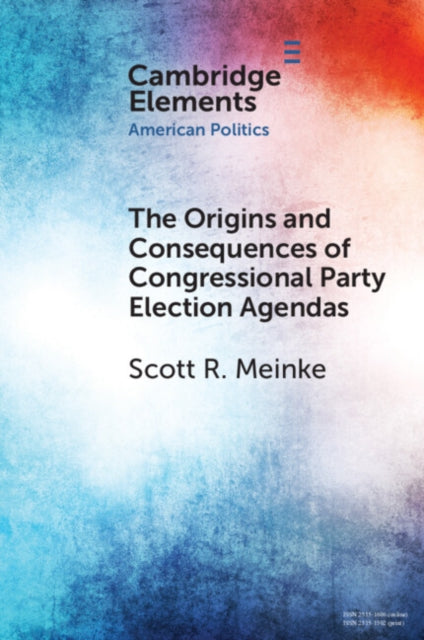
Scott R.Meinke
The Origins and Consequences of Congressional Party Election Agendas
The Origins and Consequences of Congressional Party Election Agendas
💎 Earn 84 Points (£0.84) on this item.
We can order this item for you. Delivery usually takes about 4 to 6 weeks.
This item is not held in our immediate stock. We will order it for you after checkout.
Estimated delivery: About 4 to 6 weeks
YOU SAVE £1.01
- Condition: Brand new
- UK Delivery times: Usually arrives within 2 - 3 working days
- UK Shipping: Fee starts at £2.39. Subject to product weight & dimension
Bulk ordering. Want 15 or more copies? Get a personalised quote and bigger discounts. Learn more about bulk orders.
Couldn't load pickup availability
- More about The Origins and Consequences of Congressional Party Election Agendas
This Element examines congressional party election agendas, how they originate, represent party priorities, and shape post-election legislative activity and policymaking. It focuses on two prominent cases, the Republican Contract with America (1994) and the Democratic New Direction for America (2006). It shows that both agendas were leadership-driven but developed in lengthy and inclusive processes, with parties strategically skewing agenda promises toward select segments of the caucus.
Format: Paperback / softback
Length: 75 pages
Publication date: 23 February 2023
Publisher: Cambridge University Press
This Element examines congressional party election agendas, asking first how they originate and what priorities within the party they strategically represent, and second, how they shape post-election legislative activity and policymaking. After surveying post-1980 agenda efforts, it focuses on two prominent cases, the Republican Contract with America (1994) and the Democratic New Direction for America (2006). Using archived records and other qualitative evidence, it shows that both agendas were leadership-driven but were developed in lengthy and relatively inclusive processes. Quantifying agenda content, it demonstrates that the parties strategically skewed agenda promises toward select segments of the caucus, as measured in bill introduction priorities, and the promises echoed leadership messaging from speeches and floor motions in the Congress before the election. After winning a majority, both parties shifted the House's legislative activity sharply toward agenda priorities, but the impact on policy outcomes was substantially constrained.
Introduction:
Congressional party election agendas play a crucial role in shaping the legislative landscape and policy outcomes after elections. These agendas reflect the priorities and values of the party and can have a significant impact on the direction of government. This Element examines the origins, priorities, and impact of congressional party election agendas.
Origins of Congressional Party Election Agendas:
Congressional party election agendas can originate from a variety of sources. The party's platform, which is a statement of the party's goals and values, is a key source of agenda ideas. The party's leadership, including the party's presidential candidate and congressional leaders, also play a significant role in shaping the agenda. Additionally, external factors, such as economic conditions, social trends, and geopolitical events, can also influence the party's agenda.
Priorities within Congressional Party Election Agendas:
Congressional party election agendas typically include a range of priorities that the party believes will appeal to voters and help it win elections. These priorities can include issues such as economic growth, job creation, healthcare, education, and social welfare. The party may also prioritize issues such as tax cuts, deregulation, and national security.
Shaping Post-Election Legislative Activity and Policymaking:
Congressional party election agendas can shape post-election legislative activity and policymaking in several ways. First, the agenda can serve as a guide for the party's legislative priorities and can influence the selection of bills that are introduced and debated in Congress. Second, the agenda can also shape the party's messaging and political strategy, which can influence public opinion and political outcomes. Finally, the agenda can influence the party's relationship with other political actors, such as the executive branch and interest groups.
Examples of Congressional Party Election Agendas:
Two prominent examples of congressional party election agendas are the Republican Contract with America (1994) and the Democratic New Direction for America (2006). The Republican Contract with America was a platform that was developed by the Republican Party during the 1994 congressional elections. The platform focused on a range of issues, including tax cuts, deregulation, and national security. The platform was widely popular with voters and helped the Republican Party win a majority in both the House and Senate.
The Democratic New Direction for America was a platform that was developed by the Democratic Party during the 2006 congressional elections. The platform focused on a range of issues, including healthcare, education, and environmental protection. The platform was widely popular with voters and helped the Democratic Party win a majority in the House and Senate.
Conclusion:
Congressional party election agendas are a critical component of the political process and can have a significant impact on the direction of government. By examining the origins, priorities, and impact of congressional party election agendas, we can better understand how political parties shape policy and influence public opinion.
Weight: 138g
Dimension: 151 x 228 x 9 (mm)
ISBN-13: 9781009264884
UK and International shipping information
UK and International shipping information
UK Delivery and returns information:
- Delivery within 2 - 3 days when ordering in the UK.
- Shipping fee for UK customers from £2.39. Fully tracked shipping service available.
- Returns policy: Return within 30 days of receipt for full refund.
International deliveries:
Shulph Ink now ships to Australia, Belgium, Canada, France, Germany, Ireland, Italy, India, Luxembourg Saudi Arabia, Singapore, Spain, Netherlands, New Zealand, United Arab Emirates, United States of America.
- Delivery times: within 5 - 10 days for international orders.
- Shipping fee: charges vary for overseas orders. Only tracked services are available for most international orders. Some countries have untracked shipping options.
- Customs charges: If ordering to addresses outside the United Kingdom, you may or may not incur additional customs and duties fees during local delivery.