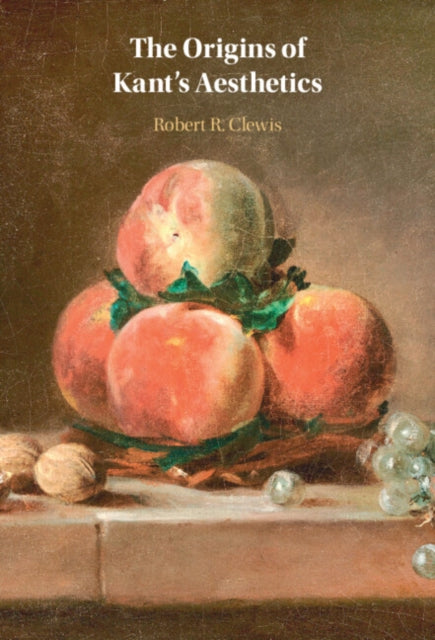
Robert R.Clewis
The Origins of Kant's Aesthetics
The Origins of Kant's Aesthetics
💎 Earn 387 Points (£3.87) on this item.
We can order this item for you. Delivery usually takes about 4 to 6 weeks.
This item is not held in our immediate stock. We will order it for you after checkout.
Estimated delivery: About 4 to 6 weeks
YOU SAVE £4.59
- Condition: Brand new
- UK Delivery times: Usually arrives within 2 - 3 working days
- UK Shipping: Fee starts at £2.39. Subject to product weight & dimension
Bulk ordering. Want 15 or more copies? Get a personalised quote and bigger discounts. Learn more about bulk orders.
Couldn't load pickup availability
- More about The Origins of Kant's Aesthetics
This book explores Kant's aesthetics by examining his publications, correspondence, handwritten notes, and university lectures, focusing on eight themes: aesthetic judgment and normativity, formal beauty, partly conceptual beauty, artistic creativity or genius, the fine arts, the sublime, ugliness and disgust, and humor. It considers how Kant's thought was shaped by authors such as Christian Wolff, Alexander Baumgarten, Georg Meier, Moses Mendelssohn, Johann Sulzer, Johann Herder, Francis Hutcheson, David Hume, Edmund Burke, Henry Home, Charles Batteux, Jean-Jacques Rousseau, and Voltaire, and is useful for advanced students and scholars in the humanities and studies of the arts.
Format: Hardback
Length: 288 pages
Publication date: 26 January 2023
Publisher: Cambridge University Press
This comprehensive book delves into the rich tapestry of Kant's aesthetics, exploring its origins and evolution through a meticulous examination of his publications, correspondence, handwritten notes, and university lectures. Organized around eight central themes that remain integral to aesthetic theory today, the book offers a profound exploration of Kant's philosophical framework.
In the first chapter, "Aesthetic Judgment and Normativity," the author delves into the foundations of aesthetic judgment, examining how Kant conceptualized the nature of beauty and the criteria for evaluating artistic works. Through a close analysis of Kant's writings, the chapter sheds light on the principles that guide our perception and evaluation of art.
The second chapter, "Formal Beauty," explores the concept of formal beauty, examining how Kant defined it and the role it plays in artistic expression. The author examines the elements of form, such as line, shape, color, and texture, and how they contribute to the creation of aesthetically pleasing works.
The third chapter, "Partly Conceptual Beauty," delves into the notion of partly conceptual beauty, examining how Kant distinguished between purely aesthetic and partly cognitive aspects of art. The author explores the interplay between imagination and reason in artistic creation and the role of concepts in shaping our perception of art.
The fourth chapter, "Artistic Creativity or Genius," explores the concept of artistic creativity or genius, examining how Kant regarded the role of the artist in creating works of art. The author examines the qualities that distinguish exceptional artists and the processes they employ to bring their creative vision to life.
The fifth chapter, "The Fine Arts," examines the role of the fine arts in Kant's aesthetic theory. The author explores the various artistic disciplines, such as painting, sculpture, music, and literature, and how they contribute to the development of aesthetic taste.
The sixth chapter, "The Sublime," delves into the concept of the sublime, examining how Kant defined it and the role it plays in artistic expression. The author explores the qualities of the sublime that evoke a sense of awe and wonder and the ways in which artists have employed it to create powerful and transformative works.
The seventh chapter, "Ugliness and Disgust," explores the concept of ugliness and disgust, examining how Kant regarded these qualities as essential components of aesthetic experience. The author examines the ways in which artists have used ugliness and disgust to challenge traditional notions of beauty and to create works that provoke thought and introspection.
The eighth and final chapter, "Humor," explores the role of humor in artistic expression, examining how Kant regarded it as a vital component of aesthetic experience. The author examines the ways in which humor can elicit laughter and joy and the ways in which it can be used to convey complex ideas and emotions.
Throughout the book, Robert R. Clewis engages with a wide range of authors who influenced Kant's thought, including Christian Wolff, Alexander Baumgarten, Georg Meier, Moses Mendelssohn, Johann Sulzer, Johann Herder, Francis Hutcheson, David Hume, Edmund Burke, Henry Home, Charles Batteux, Jean-Jacques Rousseau, and Voltaire. Through a meticulous analysis of their writings, Clewis sheds light on the complex development of Kant's aesthetic theory and its impact on the field of aesthetics.
This book is a valuable resource for advanced students and scholars in fields across the humanities and studies of the arts. It offers a comprehensive and nuanced understanding of Kant's aesthetic philosophy, providing a deeper appreciation of the complexities and richness of his thought. The book's clear and accessible writing style makes it accessible to a wide audience, while its extensive footnotes and bibliography provide further avenues for exploration.
In conclusion, this book is a must-read for anyone interested in aesthetics, philosophy, or the arts. It offers a comprehensive and insightful exploration of Kant's aesthetic theory, providing a valuable contribution to the field. Through its meticulous examination of Kant's writings and engagement with a wide range of influential authors, the book sheds light on the complex development of Kant's aesthetic philosophy and its enduring relevance to contemporary debates.
ISBN-13: 9781009209427
This item can be found in:
UK and International shipping information
UK and International shipping information
UK Delivery and returns information:
- Delivery within 2 - 3 days when ordering in the UK.
- Shipping fee for UK customers from £2.39. Fully tracked shipping service available.
- Returns policy: Return within 30 days of receipt for full refund.
International deliveries:
Shulph Ink now ships to Australia, Belgium, Canada, France, Germany, Ireland, Italy, India, Luxembourg Saudi Arabia, Singapore, Spain, Netherlands, New Zealand, United Arab Emirates, United States of America.
- Delivery times: within 5 - 10 days for international orders.
- Shipping fee: charges vary for overseas orders. Only tracked services are available for most international orders. Some countries have untracked shipping options.
- Customs charges: If ordering to addresses outside the United Kingdom, you may or may not incur additional customs and duties fees during local delivery.