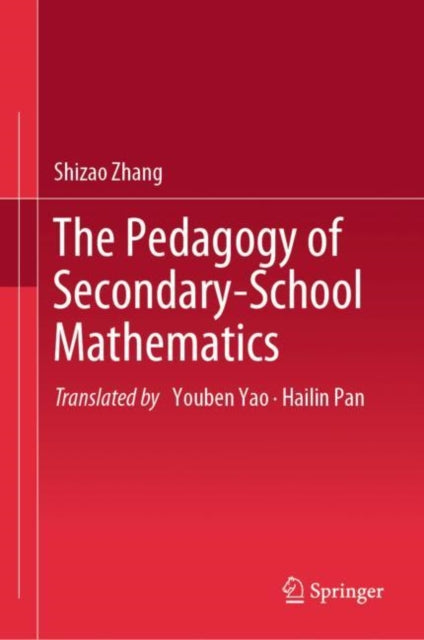
Shizao Zhang
The Pedagogy of Secondary-School Mathematics
The Pedagogy of Secondary-School Mathematics
💎 Earn 660 Points (£6.60) on this item.
We can order this item for you. Delivery usually takes about 4 to 6 weeks.
This item is not held in our immediate stock. We will order it for you after checkout.
Estimated delivery: About 4 to 6 weeks
YOU SAVE £27.84
- Condition: Brand new
- UK Delivery times: Usually arrives within 2 - 3 working days
- UK Shipping: Fee starts at £2.39. Subject to product weight & dimension
Bulk ordering. Want 15 or more copies? Get a personalised quote and bigger discounts. Learn more about bulk orders.
Couldn't load pickup availability
- More about The Pedagogy of Secondary-School Mathematics
This book explores secondary school mathematics teaching and learning in China, combining mathematical abilities and teaching skills, and providing valuable principles and methods for mathematics teachers education.
Format: Hardback
Length: 401 pages
Publication date: 01 August 2023
Publisher: Springer Verlag, Singapore
This comprehensive book delves into the essential elements and features of secondary school mathematics teaching and learning in China, combining the development of students' mathematical abilities with the enhancement of teaching skills. It offers a comprehensive exploration of mathematical pedagogy, drawing from both theoretical and practical perspectives, which has gained widespread recognition among experts in the field. The book presents a range of mathematics teaching principles and methods, serving as a valuable resource for mathematics teacher education.
Title: Secondary School Mathematics Teaching and Learning in China
This book provides a comprehensive overview of secondary school mathematics teaching and learning in China, focusing on the cultivation of students' mathematical abilities and the improvement of teaching skills. It combines theory and practice to create mathematical pedagogy that has been widely recognized by experts in the field. The book presents a number of mathematics teaching principles and methods, which have been used as important resource books for mathematics teacher education.
Overview of Secondary School Mathematics Teaching and Learning in China
Secondary school mathematics teaching and learning in China is characterized by a focus on the development of students' mathematical abilities and the improvement of teaching skills. The curriculum is designed to provide students with a solid foundation in mathematics, including algebra, geometry, trigonometry, and calculus. Teachers are expected to use a variety of teaching methods to engage students and help them understand the concepts. These methods include lectures, discussions, group work, and hands-on activities. Teachers are also expected to provide feedback to students on their progress and to help them improve their skills.
Cultivation of Students' Mathematical Abilities
The cultivation of students' mathematical abilities is a key focus of secondary school mathematics teaching and learning in China. Teachers are expected to provide students with a variety of mathematical problems and exercises to help them develop their problem-solving skills. These problems and exercises can range from simple to complex and can be used to teach a wide range of mathematical concepts. Teachers are also expected to provide students with feedback on their performance and to help them improve their skills.
Improvement of Teaching Skills
The improvement of teaching skills is also a key focus of secondary school mathematics teaching and learning in China. Teachers are expected to use a variety of teaching methods to engage students and help them understand the concepts. These methods include lectures, discussions, group work, and hands-on activities. Teachers are also expected to provide feedback to students on their progress and to help them improve their skills.
Mathematical Pedagogy
Mathematical pedagogy is the study of how mathematics is taught and learned. It involves the development of teaching principles and methods that are effective in promoting student learning. Mathematical pedagogy has been widely recognized by experts in the field and has been used as an important resource book for mathematics teacher education. The book presents a number of mathematics teaching principles and methods, which have been used as important resource books for mathematics teacher education.
Mathematics Teaching Principles and Methods
Mathematics teaching principles and methods are the tools that teachers use to teach mathematics. These principles and methods include the use of visual aids, the use of hands-on activities, the use of problem-solving strategies, and the use of feedback. Visual aids can include diagrams, charts, and graphs, while hands-on activities can include experiments, games, and puzzles. Problem-solving strategies can include the use of logical reasoning, the use of trial and error, and the use of heuristics. Feedback can include the use of praise, the use of criticism, and the use of suggestions for improvement.
Use of Visual Aids
Visual aids are a powerful tool for teaching mathematics. They can help students to visualize mathematical concepts and to understand the relationships between different mathematical objects. Visual aids can include diagrams, charts, and graphs, as well as videos and animations. Diagrams can help students to understand the structure of a mathematical problem, while charts can help students to understand the relationship between different variables. Graphs can help students to understand the relationship between different mathematical functions.
Use of Hands-On Activities
Hands-on activities are a powerful tool for teaching mathematics. They can help students to develop their problem-solving skills and to understand the concepts in a more practical way. Hands-on activities can include experiments, games, and puzzles. Experiments can help students to test hypotheses and to understand the results of their experiments. Games can help students to develop their problem-solving skills and to have fun. Puzzles can help students to develop their problem-solving skills and to think creatively.
Use of Problem-Solving Strategies
Problem-solving strategies are a powerful tool for teaching mathematics. They can help students to solve mathematical problems in a more efficient and effective way. Problem-solving strategies can include the use of logical reasoning, the use of trial and error, and the use of heuristics. Logical reasoning can help students to identify the key elements of a mathematical problem and to develop a solution. Trial and error can help students to identify the wrong solution and to develop a better solution. Heuristics can help students to develop a solution that is not obvious.
Use of Feedback
Feedback is a powerful tool for teaching mathematics. It can help students to understand their progress and to improve their skills. Feedback can include the use of praise, the use of criticism, and the use of suggestions for improvement. Praise can help students to feel good about their work and to continue to work hard. Criticism can help students to identify their weaknesses and to develop strategies to improve their skills. Suggestions for improvement can help students to develop new skills and to improve their performance.
Conclusion
Secondary school mathematics teaching and learning in China is characterized by a focus on the development of students' mathematical abilities and the improvement of teaching skills. The curriculum is designed to provide students with a solid foundation in mathematics, including algebra, geometry, trigonometry, and calculus. Teachers are expected to use a variety of teaching methods to engage students and help them understand the concepts. Mathematical pedagogy has been widely recognized by experts in the field and has been used as an important resource book for mathematics teacher education. The book presents a number of mathematics teaching principles and methods, which have been used as important resource books for mathematics teacher education.
Dimension: 235 x 155 (mm)
ISBN-13: 9789819912476
Edition number: 1st ed. 2023
This item can be found in:
UK and International shipping information
UK and International shipping information
UK Delivery and returns information:
- Delivery within 2 - 3 days when ordering in the UK.
- Shipping fee for UK customers from £2.39. Fully tracked shipping service available.
- Returns policy: Return within 30 days of receipt for full refund.
International deliveries:
Shulph Ink now ships to Australia, Belgium, Canada, France, Germany, Ireland, Italy, India, Luxembourg Saudi Arabia, Singapore, Spain, Netherlands, New Zealand, United Arab Emirates, United States of America.
- Delivery times: within 5 - 10 days for international orders.
- Shipping fee: charges vary for overseas orders. Only tracked services are available for most international orders. Some countries have untracked shipping options.
- Customs charges: If ordering to addresses outside the United Kingdom, you may or may not incur additional customs and duties fees during local delivery.