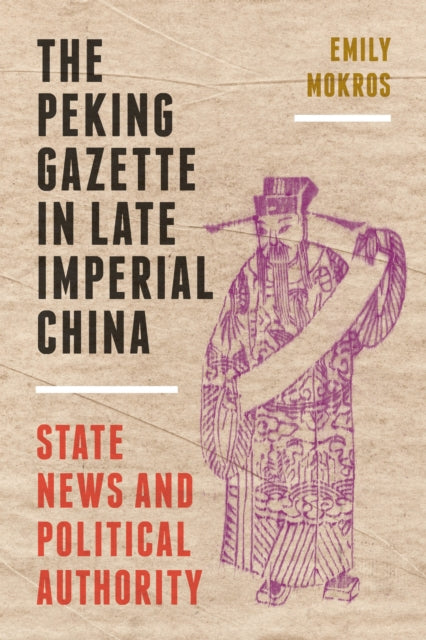
Emily Mokros
The Peking Gazette in Late Imperial China: State News and Political Authority
The Peking Gazette in Late Imperial China: State News and Political Authority
💎 Earn 605 Points (£6.05) on this item.
- Condition: Brand new
- UK Delivery times: Usually arrives within 2 - 3 working days
- UK Shipping: Fee starts at £2.39. Subject to product weight & dimension
Bulk ordering. Want 15 or more copies? Get a personalised quote and bigger discounts. Learn more about bulk orders.
Couldn't load pickup availability
- More about The Peking Gazette in Late Imperial China: State News and Political Authority
During the Qing dynasty, China had greater access to political information than modern Chinese regimes, thanks to a partnership between the court and commercial publishing enterprises. The Peking Gazette was the most essential window into Qing politics, offering vital information about the state and its activities. This study reconstructs who read the gazette and how they used it to interact with the Chinese state, making it essential reading for anyone interested in understanding the relationship between media, information, and state power.
Format: Hardback
Length: 280 pages
Publication date: 20 May 2021
Publisher: University of Washington Press
In the Qing dynasty (1644–1911), China experienced far greater access to political information than suggested by the blunt measures of control and censorship employed by modern Chinese regimes. A tenuous partnership between the court and the dynamic commercial publishing enterprises of late imperial China enabled the publication of gazettes in a wide range of print and manuscript formats. For both domestic and foreign readers, these official gazettes offered vital information about the Qing state and its activities, transmitting state news across a vast empire and beyond. And the most essential window onto Qing politics was the Peking Gazette, a genre that circulated globally over the course of the dynasty.
This illuminating study presents a comprehensive history of the Peking Gazette and frames it as the cornerstone of a Qing information policy that, paradoxically, prized both transparency and secrecy. Gazettes gave readers a glimpse into the states inner workings but also served as a carefully curated form of public relations. Historian Emily Mokros draws from international archives to reconstruct who read the gazette and how they used it to guide their interactions with the Chinese state. Her research into the Peking Gazettes evolution over more than two centuries is essential reading for anyone interested in understanding the relationship between media, information, and state power.
The Peking Gazette, a prominent publication during the Qing dynasty (1644–1911), played a pivotal role in shaping political discourse and providing access to information in China. Despite the strict control and censorship imposed by modern Chinese regimes, the Qing government maintained a delicate balance between transparency and secrecy, allowing the publication of gazettes in various formats. These official gazettes, available to both domestic and foreign readers, served as a vital source of information about the Qing state and its activities.
One of the most significant gazettes was the Peking Gazette, which circulated globally throughout the Qing dynasty. It was a genre that combined news, commentary, and advertising, offering a comprehensive view of Qing politics and society. The Peking Gazette was carefully curated by the government, with its content carefully selected to reflect the interests of the ruling elite and to maintain stability and control.
Despite its official status, the Peking Gazette was not without its critics. Some scholars argue that it was a tool of propaganda, used by the government to control public opinion and suppress dissent. Others argue that it was a valuable source of information for foreign readers, providing insights into Chinese culture, society, and politics.
The Peking Gazette was not the only publication that played a role in shaping political discourse in China during the Qing dynasty. Other gazettes, such as the Shanghai Gazette and the Guangzhou Gazette, also emerged as important outlets for information and commentary. These gazettes were often published by private publishers and were more independent than the Peking Gazette, but they were still subject to government censorship and control.
In conclusion, the Peking Gazette was a significant publication during the Qing dynasty, providing a window into Qing politics and society. While it was subject to government censorship and control, it was also a valuable source of information for both domestic and foreign readers. The gazettes played a crucial role in shaping political discourse and providing access to information in a period when information was tightly controlled by the government.
Weight: 544g
Dimension: 229 x 152 (mm)
ISBN-13: 9780295748788
This item can be found in:
UK and International shipping information
UK and International shipping information
UK Delivery and returns information:
- Delivery within 2 - 3 days when ordering in the UK.
- Shipping fee for UK customers from £2.39. Fully tracked shipping service available.
- Returns policy: Return within 30 days of receipt for full refund.
International deliveries:
Shulph Ink now ships to Australia, Belgium, Canada, France, Germany, Ireland, Italy, India, Luxembourg Saudi Arabia, Singapore, Spain, Netherlands, New Zealand, United Arab Emirates, United States of America.
- Delivery times: within 5 - 10 days for international orders.
- Shipping fee: charges vary for overseas orders. Only tracked services are available for most international orders. Some countries have untracked shipping options.
- Customs charges: If ordering to addresses outside the United Kingdom, you may or may not incur additional customs and duties fees during local delivery.