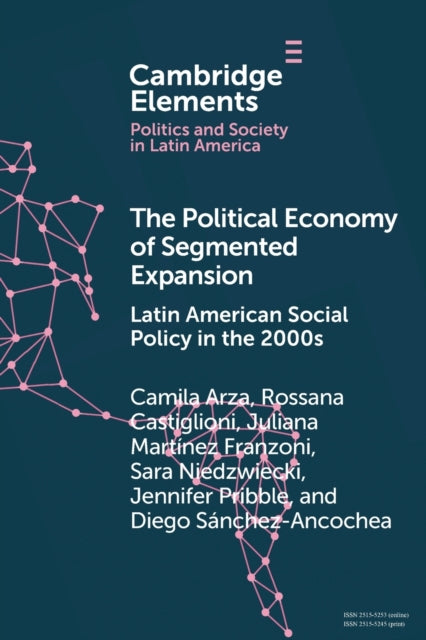
Camila) Arza,RossanaCastiglioni,Juliana MartinezFranzoni,SaraNiedzwiecki,JenniferPribble,DiegoSanchez-Ancochea
The Political Economy of Segmented Expansion: Latin American Social Policy in the 2000s
The Political Economy of Segmented Expansion: Latin American Social Policy in the 2000s
💎 Earn 84 Points (£0.84) on this item.
We can order this item for you. Delivery usually takes about 4 to 6 weeks.
This item is not held in our immediate stock. We will order it for you after checkout.
Estimated delivery: About 4 to 6 weeks
YOU SAVE £1.01
- Condition: Brand new
- UK Delivery times: Usually arrives within 2 - 3 working days
- UK Shipping: Fee starts at £2.39. Subject to product weight & dimension
Bulk ordering. Want 15 or more copies? Get a personalised quote and bigger discounts. Learn more about bulk orders.
Couldn't load pickup availability
- More about The Political Economy of Segmented Expansion: Latin American Social Policy in the 2000s
In the early 2000s, Latin America experienced a period of social policy expansion, incorporating previously excluded groups and creating new programs in healthcare, pensions, and social assistance. However, the gains were segmented, with differences in access, benefit levels, service quality, and unevenness across policy sectors. This expansion resulted from a combination of democratic characteristics, favorable economic conditions, and policy legacies. Scholars in Latin American social policy have contributed important new concepts and theories to our understanding of welfare state development and change.
Format: Paperback / softback
Publication date: 08 December 2022
Publisher: Cambridge University Press
The early 2000s witnessed a significant expansion of social policy in Latin America, marked by the introduction of new programs and initiatives in healthcare, pensions, and social assistance. This expansion aimed to include previously excluded groups and address their needs. However, the character of this social policy expansion and the factors that drove it warrant further exploration.
Drawing on a wealth of research, this Element examines the social policy gains made in the early 2000s in Latin America. It highlights that while these gains were significant, they remained segmented, exhibiting differences in access and benefit levels, gaps in service quality, and unevenness across policy sectors. The analysis suggests that this segmented expansion resulted from a complex interplay of short-term and long-term characteristics of democracy, favorable economic conditions, and policy legacies.
One key factor contributing to the segmented expansion was the varying levels of democratic consolidation in the region. Countries with stronger democratic institutions were more likely to prioritize social policy and implement comprehensive reforms. Conversely, countries with less democratic stability faced challenges in implementing social policy reforms due to political polarization, resistance from interest groups, and limited government capacity.
Another important factor was the favorable economic conditions that prevailed in the early 2000s. The region experienced a period of economic growth and stability, which facilitated the implementation of social policy initiatives. This economic prosperity led to increased government revenue, which in turn allowed for the expansion of social programs and the improvement of service delivery.
Policy legacies also played a significant role in shaping the social policy expansion. Countries that had a history of social welfare programs and progressive policies were more likely to continue and expand these initiatives. Additionally, the influence of international organizations, such as the World Bank and the International Monetary Fund, on social policy in Latin America was significant. These organizations provided technical assistance, financial support, and policy advice to countries seeking to improve their social welfare systems.
Despite the segmented expansion of social policy in Latin America, scholars of Latin American social policy have made significant contributions to our understanding of welfare state development and change. They have developed new concepts and theories that shed light on perennial questions such as the role of the state in providing social protection, the dynamics of social inequality, and the challenges of sustainable welfare state reform.
In conclusion, the early 2000s were a period of social policy expansion in Latin America, driven by factors such as democratic consolidation, favorable economic conditions, and policy legacies. While these gains were significant, they remained segmented, exhibiting differences in access and benefit levels, gaps in service quality, and unevenness across policy sectors. The analysis suggests that further research and policy interventions are needed to address these challenges and ensure that social policy benefits are distributed more equitably and efficiently across the region.
Weight: 141g
Dimension: 229 x 152 x 5 (mm)
ISBN-13: 9781009344111
UK and International shipping information
UK and International shipping information
UK Delivery and returns information:
- Delivery within 2 - 3 days when ordering in the UK.
- Shipping fee for UK customers from £2.39. Fully tracked shipping service available.
- Returns policy: Return within 30 days of receipt for full refund.
International deliveries:
Shulph Ink now ships to Australia, Belgium, Canada, France, Germany, Ireland, Italy, India, Luxembourg Saudi Arabia, Singapore, Spain, Netherlands, New Zealand, United Arab Emirates, United States of America.
- Delivery times: within 5 - 10 days for international orders.
- Shipping fee: charges vary for overseas orders. Only tracked services are available for most international orders. Some countries have untracked shipping options.
- Customs charges: If ordering to addresses outside the United Kingdom, you may or may not incur additional customs and duties fees during local delivery.