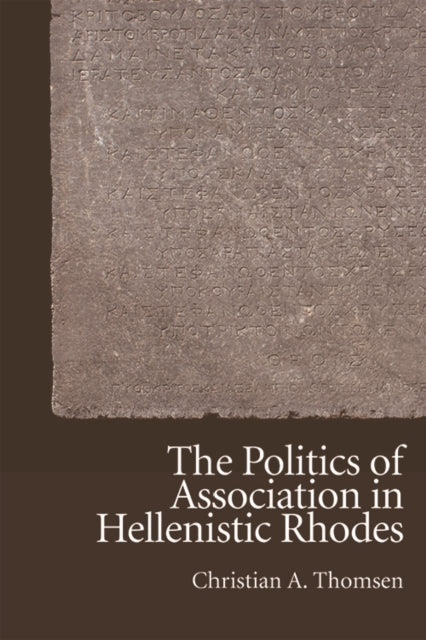
Christian Thomsen
The Politics of Association in Hellenistic Rhodes
The Politics of Association in Hellenistic Rhodes
💎 Earn 88 Points (£0.88) on this item.
We can order this item for you. Delivery usually takes about 4 to 6 weeks.
This item is not held in our immediate stock. We will order it for you after checkout.
Estimated delivery: About 4 to 6 weeks
YOU SAVE £5.36
- Condition: Brand new
- UK Delivery times: Usually arrives within 2 - 3 working days
- UK Shipping: Fee starts at £2.39. Subject to product weight & dimension
Bulk ordering. Want 15 or more copies? Get a personalised quote and bigger discounts. Learn more about bulk orders.
Couldn't load pickup availability
- More about The Politics of Association in Hellenistic Rhodes
Christian Thomsen's study of political institutions on Rhodes, an important power in the eastern Mediterranean, provides an analysis of political institutions using Aristotle's notion of the polis as an association of associations. It surveys the family, civic subdivisions, and private associations, arguing that they served as important junctions in the networks of political elites and shaped the political landscape of Hellenistic Rhodes.
Format: Paperback / softback
Length: 192 pages
Publication date: 31 May 2022
Publisher: Edinburgh University Press
Rhodes, an influential island state in the eastern Mediterranean, holds a significant place in history as the first city of the Hellenistic world. In his comprehensive study, Christian Thomsen delves into the intricate tapestry of political institutions on this remarkable island. Drawing upon Aristotle's notion of the polis as an association of associations, Thomsen offers a fresh perspective on the study of political institutions, expanding the definition beyond traditional examinations of ancient Greek city-states. His analysis encompasses a wide range of institutions, including the family, civic subdivisions such as tribes and demes, and private associations. Thomsen argues compellingly that these organizations played a vital role in connecting the political elites and shaping the political landscape of Hellenistic Rhodes.
The family, as a fundamental unit of society, is explored in depth by Thomsen. He examines how the family structure, roles, and relationships influenced political dynamics and governance. He highlights the significance of familial ties in forming alliances, consolidating power, and maintaining social order. Thomsen also explores the role of women within the family and their influence on political affairs, recognizing their agency and contributions to the political landscape.
Civic subdivisions, such as tribes and demes, are also scrutinized by Thomsen. He examines their organizational structures, functions, and roles in shaping the political landscape of Rhodes. He argues that these subdivisions served as important hubs for political activity, facilitating communication, cooperation, and competition among the elites. Thomsen also explores the dynamics of power distribution and conflict resolution within these civic groups, highlighting the complex interplay of interests and ideologies.
Private associations, such as guilds and merchant groups, are also considered in Thomsen's study. He explores how these organizations functioned as intermediaries between the state and the private sector, shaping economic and social policies. Thomsen argues that these associations played a crucial role in promoting trade, commerce, and cultural exchange, contributing to the prosperity and development of Hellenistic Rhodes.
Through his meticulous analysis, Thomsen sheds light on the interconnectedness and interdependence of these institutions in shaping the political landscape of Hellenistic Rhodes. He demonstrates how they formed a complex web of relationships and interactions, influencing each other's development and contributing to the overall stability and prosperity of the island state. Thomsen's study not only provides valuable insights into the political institutions of ancient Greece but also offers valuable lessons for contemporary political analysis and governance.
In conclusion, Christian Thomsen's study of political institutions on Rhodes is a groundbreaking contribution to the field of ancient history. By expanding the definition of institutions and examining a broader range of organizations, Thomsen offers a fresh perspective on the political landscape of Hellenistic Rhodes. His analysis demonstrates the interconnectedness and interdependence of these institutions, highlighting their role in shaping the political, social, and economic dynamics of the island state. Thomsen's study is a valuable resource for scholars, students, and anyone interested in understanding the complexities of ancient political systems and their relevance to contemporary society.
Dimension: 234 x 156 (mm)
ISBN-13: 9781474452564
UK and International shipping information
UK and International shipping information
UK Delivery and returns information:
- Delivery within 2 - 3 days when ordering in the UK.
- Shipping fee for UK customers from £2.39. Fully tracked shipping service available.
- Returns policy: Return within 30 days of receipt for full refund.
International deliveries:
Shulph Ink now ships to Australia, Belgium, Canada, France, Germany, Ireland, Italy, India, Luxembourg Saudi Arabia, Singapore, Spain, Netherlands, New Zealand, United Arab Emirates, United States of America.
- Delivery times: within 5 - 10 days for international orders.
- Shipping fee: charges vary for overseas orders. Only tracked services are available for most international orders. Some countries have untracked shipping options.
- Customs charges: If ordering to addresses outside the United Kingdom, you may or may not incur additional customs and duties fees during local delivery.