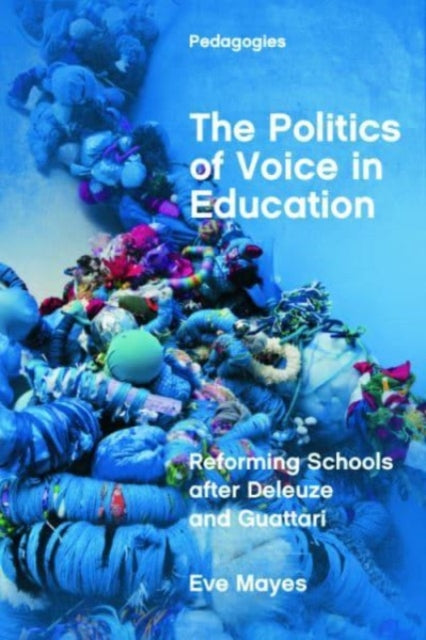
Eve Mayes
The Politics of Voice in Education: Reforming Schools after Deleuze and Guattari
The Politics of Voice in Education: Reforming Schools after Deleuze and Guattari
💎 Earn 95 Points (£0.95) on this item.
YOU SAVE £5.83
- Condition: Brand new
- UK Delivery times: Usually arrives within 2 - 3 working days
- UK Shipping: Fee starts at £2.39. Subject to product weight & dimension
Bulk ordering. Want 15 or more copies? Get a personalised quote and bigger discounts. Learn more about bulk orders.
Couldn't load pickup availability
- More about The Politics of Voice in Education: Reforming Schools after Deleuze and Guattari
Eve Mayes' book explores the role of voice in education, drawing on ethnographic and participatory research in Australian schools. It critiques liberal humanist and late capitalist logics of student voice and affirms other possibilities for transversal pedagogical relations.
Format: Paperback / softback
Length: 264 pages
Publication date: 28 February 2025
Publisher: Edinburgh University Press
Eve Mayes' book "What Voice Can and Must Do in Education" explores the role of voice in education through the perspectives of students and educators, drawing on Gilles Deleuze and Felix Guattari's theories. The book draws on ten years of ethnographic and participatory research in Australian schools, including research encounters with students and puppets, school governance council meetings, school reform evaluation processes, and students' political activism. It offers a critical critique of the liberal humanist and late capitalist logics of student voice in educational reform, while also affirming other possibilities for transversal pedagogical relations in and beyond institutional sites of education.
The book begins by examining the various textures, tremors, and murmurs of voice felt in Australian schools over the course of ten years of ethnographic and participatory research. Mayes highlights the importance of listening to the voices of students and educators, and the ways in which these voices can shape and influence educational reform. She argues that student voice should be seen as a means of empowering students and promoting their agency, rather than as a tool for controlling or manipulating them.
Mayes then critiques the liberal humanist and late capitalist logics of student voice in educational reform. She argues that these logics are based on a narrow understanding of human nature and the role of education in society, and that they fail to recognize the complex and diverse nature of student experiences and perspectives. She suggests that student voice should be seen as a means of promoting social justice and equity, rather than as a means of promoting individualism and competition.
In addition to critiquing the liberal humanist and late capitalist logics of student voice, Mayes also offers an affirmation of other possibilities for transversal pedagogical relations in and beyond institutional sites of education. She argues that student voice can be used to create meaningful connections between students and educators, and that it can be used to promote a sense of belonging and community. She also suggests that student voice can be used to challenge the dominant power structures in education, and to promote a more democratic and inclusive education system.
One of the key themes of the book is the importance of listening to the voices of students and educators. Mayes argues that students and educators have unique perspectives and experiences that can contribute to the development of education, and that these perspectives and experiences should be valued and respected. She suggests that teachers should be trained to listen to their students' voices and to respond to them in a meaningful way.
Mayes also highlights the importance of creating spaces for students to express their voices. She suggests that schools should provide opportunities for students to participate in decision-making processes, to engage in political activism, and to express their creativity and imagination. She argues that these spaces can help to promote a sense of belonging and community, and can also help to challenge the dominant power structures in education.
However, Mayes also acknowledges that there are challenges to creating spaces for students to express their voices. She suggests that some schools may be resistant to change, and that some students may feel marginalized or excluded. She suggests that teachers should be aware of these challenges and should work to address them.
In conclusion, Eve Mayes' book "What Voice Can and Must Do in Education" offers a critical critique of the liberal humanist and late capitalist logics of student voice in educational reform, while also affirming other possibilities for transversal pedagogical relations in and beyond institutional sites of education. The book draws on ten years of ethnographic and participatory research in Australian schools, and offers a timely and important contribution to the field of education.
Dimension: 234 x 156 (mm)
ISBN-13: 9781474451215
UK and International shipping information
UK and International shipping information
UK Delivery and returns information:
- Delivery within 2 - 3 days when ordering in the UK.
- Shipping fee for UK customers from £2.39. Fully tracked shipping service available.
- Returns policy: Return within 30 days of receipt for full refund.
International deliveries:
Shulph Ink now ships to Australia, Belgium, Canada, France, Germany, Ireland, Italy, India, Luxembourg Saudi Arabia, Singapore, Spain, Netherlands, New Zealand, United Arab Emirates, United States of America.
- Delivery times: within 5 - 10 days for international orders.
- Shipping fee: charges vary for overseas orders. Only tracked services are available for most international orders. Some countries have untracked shipping options.
- Customs charges: If ordering to addresses outside the United Kingdom, you may or may not incur additional customs and duties fees during local delivery.