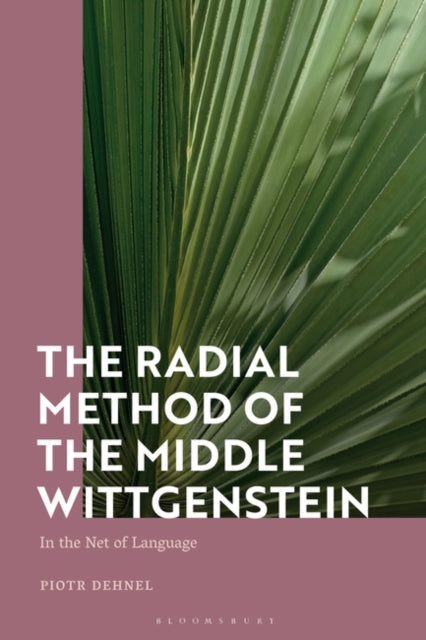
PiotrDehnel
The Radial Method of the Middle Wittgenstein: In the Net of Language
The Radial Method of the Middle Wittgenstein: In the Net of Language
💎 Earn 477 Points (£4.77) on this item.
- Condition: Brand new
- UK Delivery times: Usually arrives within 2 - 3 working days
- UK Shipping: Fee starts at £2.39. Subject to product weight & dimension
Bulk ordering. Want 15 or more copies? Get a personalised quote and bigger discounts. Learn more about bulk orders.
Couldn't load pickup availability
- More about The Radial Method of the Middle Wittgenstein: In the Net of Language
Piotr Dehnel's book explores Ludwig Wittgenstein's philosophical development between 1929 and 1936, highlighting the major issues that engrossed him during this period, such as phenomenology, philosophy of mathematics, and philosophy of language. Contrary to the dominant perspective, Dehnel argues that this stage was distinct and should not be viewed as a mere transitional phase. Wittgenstein's middle work is characterized by a non-linear trajectory of philosophical thinking, with thoughts, ideas, and insights not following a linear path. This book provides a comprehensive view of Wittgenstein's philosophy and its challenges, enabling readers to better understand his conceptual trajectory.
Format: Hardback
Length: 232 pages
Publication date: 15 December 2022
Publisher: Bloomsbury Publishing PLC
Spanning the pivotal era between Ludwig Wittgenstein's return to Cambridge in 1929 and the publication of his groundbreaking work, Philosophical Investigations, in 1936, Piotr Dehnel delves into the middle stage of Wittgenstein's philosophical development, shedding light on the major issues that captivated him. Contrary to the prevailing view, Dehnel contends that this period stands apart from the early and late stages and should not be perceived as a mere transitional phase. The uniqueness of Wittgenstein's middle work becomes evident in his philosophical thinking, which unfolds in a non-linear trajectory, devoid of the sequential and linear progression commonly associated with philosophical discourse. Thoughts do not merely follow one another, ideas do not emerge sequentially, and insights do not form a straight chain. Dehnel vividly portrays the dispersed and multifaceted nature of Wittgenstein's middle thinking, offering readers a comprehensive perspective of his entire philosophy and providing a deeper understanding of his conceptual trajectory, complete with the intricacies and complexities it presents.
In this period, Wittgenstein engaged in extensive discussions with various scholars, including Bertrand Russell, G.E. Moore, and Maurice Merleau-Ponty, which significantly influenced his philosophical development. He also developed his own unique approach to philosophy, known as "linguistic analysis," which aimed to clarify the relationship between language and thought.
One of the central themes in Wittgenstein's middle work is the nature of language and its role in shaping our understanding of the world. Wittgenstein argued that language is not merely a tool for communication but also plays a crucial role in shaping our thoughts and beliefs. He explored the different ways in which language can be used to express and convey meaning, as well as the limitations and constraints of language.
Another important issue that Wittgenstein addressed in his middle work is the philosophy of mathematics. Wittgenstein believed that mathematics is not a separate discipline but is deeply intertwined with the rest of philosophy. He explored the philosophical implications of mathematical concepts and theories, such as the nature of numbers, the principles of logic, and the foundations of set theory.
Wittgenstein's middle work also touched upon the philosophy of mind and the nature of consciousness. He explored the relationship between the mind and the body, the nature of perception, and the role of memory and imagination in shaping our understanding of the world.
Despite the significant contributions of Wittgenstein's middle work, it was met with criticism and controversy from some quarters. Some philosophers argued that Wittgenstein's approach was too abstract and difficult to understand, while others claimed that he had abandoned traditional philosophical methods and was pursuing a non-traditional approach to philosophy.
In conclusion, Piotr Dehnel's exploration of Wittgenstein's middle work provides valuable insights into the philosophical development of one of the most influential thinkers of the 20th century. By examining the major issues that engrossed Wittgenstein during this period, Dehnel sheds light on the unique nature of his philosophical thinking and its significance in shaping our understanding of the world.
Weight: 506g
Dimension: 164 x 242 x 20 (mm)
ISBN-13: 9781350257337
This item can be found in:
UK and International shipping information
UK and International shipping information
UK Delivery and returns information:
- Delivery within 2 - 3 days when ordering in the UK.
- Shipping fee for UK customers from £2.39. Fully tracked shipping service available.
- Returns policy: Return within 30 days of receipt for full refund.
International deliveries:
Shulph Ink now ships to Australia, Belgium, Canada, France, Germany, Ireland, Italy, India, Luxembourg Saudi Arabia, Singapore, Spain, Netherlands, New Zealand, United Arab Emirates, United States of America.
- Delivery times: within 5 - 10 days for international orders.
- Shipping fee: charges vary for overseas orders. Only tracked services are available for most international orders. Some countries have untracked shipping options.
- Customs charges: If ordering to addresses outside the United Kingdom, you may or may not incur additional customs and duties fees during local delivery.