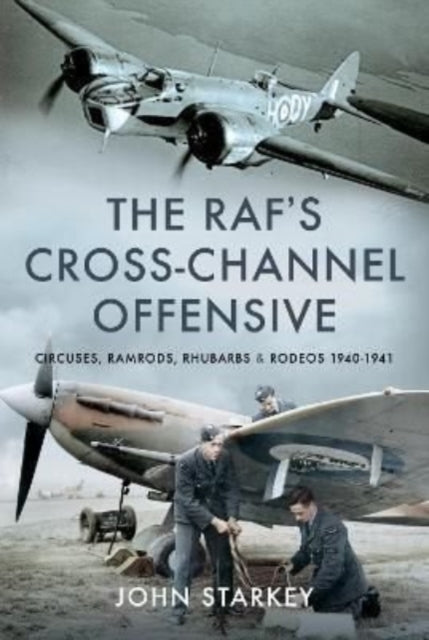
John Starkey
The RAF's Cross-Channel Offensive: Circuses, Ramrods, Rhubarbs and Rodeos 1940-1941
The RAF's Cross-Channel Offensive: Circuses, Ramrods, Rhubarbs and Rodeos 1940-1941
💎 Earn 88 Points (£0.88) on this item.
YOU SAVE £7.30
- Condition: Brand new
- UK Delivery times: Usually arrives within 2 - 3 working days
- UK Shipping: Fee starts at £2.39. Subject to product weight & dimension
Bulk ordering. Want 15 or more copies? Get a personalised quote and bigger discounts. Learn more about bulk orders.
Couldn't load pickup availability
- More about The RAF's Cross-Channel Offensive: Circuses, Ramrods, Rhubarbs and Rodeos 1940-1941
During the Battle of Britain, Marshal of the Royal Air Force Hugh Montague Trenchard proposed that the RAF should Lean Towards France and introduce the Circus sorties, which were attacks undertaken by a small force of bombers with a powerful fighter escort. These were intended to lure enemy fighters into the air so that they could be engaged by RAF fighters, with the primary objective being the destruction of Luftwaffe fighters. A Ramrod was similar to a Circus, while a Rhubarb was a small-scale attack by fighters using cloud cover and/or surprise, and a Rodeo consisted of a fighter sweep over enemy territory with no bombers. James Starkey reveals how Trenchard's views won through and the RAF went on the offensive from late 1940 into 1941, but why was it not halted once the results began to be seen?
Format: Hardback
Length: 256 pages
Publication date: 30 July 2022
Publisher: Pen & Sword Books Ltd
The story of the Royal Air Force (RAF) and, in particular, Fighter Command, during the Battle of Britain has been recounted numerous times. It is a tale of the valiant pilots of "The Few," in their Hurricanes and Spitfires, with the nation's back to the wall, fighting off the Luftwaffe's airborne assault against overwhelming odds. However, the story of Fighter Command's operations immediately after the Battle of Britain is less well known. Marshal of the Royal Air Force Hugh Montague Trenchard commanded the Royal Flying Corps in the First World War. His policy then had been for his aircraft and men to be continually on the offensive, always over the German lines, taking the fight to the enemy. After being promoted to command the RAF, Trenchard retired in 1930. In November 1940, Trenchard reappeared at the Air Ministry and proposed that the RAF should "Lean Towards France" - that it should go on the offensive. The RAF, claimed Trenchard, would win the resulting battle of attrition. One of the primary outcomes of the RAF's new offensive stance was the introduction of the Circus sorties. These were attacks undertaken by a small force of bombers with a powerful fighter escort. They were intended to lure enemy fighters into the air so that they could be engaged by RAF fighters, the primary objective being the destruction of Luftwaffe fighters, followed by the protection of the bombers from attack. A further development of the Circus missions were Ramrods, Rhubarbs, and Rodeos, all of which were variations on the same theme. A Ramrod was similar to a Circus, though in this instance, the primary objective was the destruction of the target, the main role of the accompanying fighters being to protect the bombers from attack. A Rhubarb was a small-scale attack by fighters using cloud cover and/or surprise, the object of which was to disrupt the enemy's air defenses and force them to divert their attention away from the bombers.
The Circus sorties were a significant development in the RAF's offensive strategy during the Battle of Britain. They involved a small force of bombers escorted by a powerful fighter force, which aimed to lure enemy fighters into the air and engage them in combat. The primary objective of these sorties was to destroy Luftwaffe fighters, which were a major threat to the RAF's bombers. The Circus sorties were highly successful in achieving this objective, with the RAF managing to shoot down a significant number of enemy fighters. The success of the Circus sorties led to the development of other types of offensive operations, such as Ramrods, Rhubarbs, and Rodeos. Ramrods were similar to Circus sorties, but with a more focused objective of destroying the target. Rhubarbs were small-scale attacks by fighters using cloud cover and/or surprise to disrupt the enemy's air defenses and force them to divert their attention away from the bombers. Rodeos were larger-scale operations that involved a combination of bombers and fighters, with the fighters providing cover for the bombers and engaging the enemy fighters.
The introduction of these offensive operations was a major turning point in the Battle of Britain. They helped to break the back of the Luftwaffe's aerial assault and allowed the RAF to gain the upper hand in the air war. The Circus sorties, in particular, were a significant achievement, and they played a crucial role in the eventual victory of the Allies in the Battle of Britain.
In conclusion, the story of Fighter Command's operations immediately after the Battle of Britain is a fascinating and important part of the air war history. The introduction of the Circus sorties, Ramrods, Rhubarbs, and Rodeos was a significant development in the RAF's offensive strategy, and they played a crucial role in the eventual victory of the Allies in the Battle of Britain. The bravery and skill of the pilots and ground crew who participated in these operations are a testament to the courage and determination of the British people during a time of great adversity.
Dimension: 234 x 156 (mm)
ISBN-13: 9781399088923
This item can be found in:
UK and International shipping information
UK and International shipping information
UK Delivery and returns information:
- Delivery within 2 - 3 days when ordering in the UK.
- Shipping fee for UK customers from £2.39. Fully tracked shipping service available.
- Returns policy: Return within 30 days of receipt for full refund.
International deliveries:
Shulph Ink now ships to Australia, Belgium, Canada, France, Germany, Ireland, Italy, India, Luxembourg Saudi Arabia, Singapore, Spain, Netherlands, New Zealand, United Arab Emirates, United States of America.
- Delivery times: within 5 - 10 days for international orders.
- Shipping fee: charges vary for overseas orders. Only tracked services are available for most international orders. Some countries have untracked shipping options.
- Customs charges: If ordering to addresses outside the United Kingdom, you may or may not incur additional customs and duties fees during local delivery.