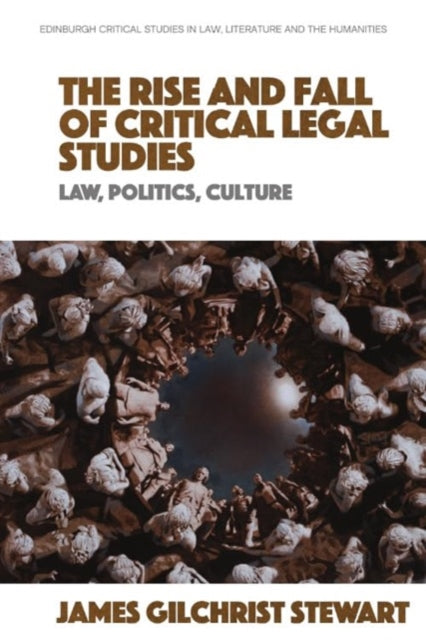
James Gilchrist Stewart
The Rise and Fall of Critical Legal Studies: Law, Politics, Culture
The Rise and Fall of Critical Legal Studies: Law, Politics, Culture
💎 Earn 345 Points (£3.45) on this item.
We can order this item for you. Delivery usually takes about 4 to 6 weeks.
This item is not held in our immediate stock. We will order it for you after checkout.
Estimated delivery: About 4 to 6 weeks
YOU SAVE £20.97
- Condition: Brand new
- UK Delivery times: Usually arrives within 2 - 3 working days
- UK Shipping: Fee starts at £2.39. Subject to product weight & dimension
Bulk ordering. Want 15 or more copies? Get a personalised quote and bigger discounts. Learn more about bulk orders.
Couldn't load pickup availability
- More about The Rise and Fall of Critical Legal Studies: Law, Politics, Culture
The Critical Legal Studies Movement is explored in The Rise and Fall of Critical Legal Studies, drawing from personal accounts, academic works, and the media. It examines CLS's origins, impact, and legacy, applying various legal, literary, filmic, and philosophical lenses to key theorists and their works, with a focus on Duncan Kennedy. The book challenges dominant types of CLS and questions its achievements from different perspectives, arguing that CLS continues to haunt the legal landscape and limit emerging critiques of law.
Format: Hardback
Length: 190 pages
Publication date: 30 June 2024
Publisher: Edinburgh University Press
Critical Legal Studies (CLS) is a movement that has had a significant impact on legal theory and practice. It emerged in the 1970s and 1980s as a response to the traditional legal system, which was seen as oppressive and unjust. CLS scholars sought to challenge the dominant legal discourse and develop alternative theories and practices that would promote social justice and equality.
One of the key figures in CLS was Duncan Kennedy, who wrote several influential books on legal theory and practice. Kennedy's work focused on the role of law in society and the ways in which it could be used to promote social change. He argued that the legal system was inherently biased and that it was necessary to develop new legal theories and practices that would challenge this bias.
CLS scholars also developed a range of legal, literary, and philosophical lenses that they used to analyze legal issues. These lenses included critical race theory, feminist theory, and postcolonial theory, among others. These lenses allowed CLS scholars to see the law in a new light and to develop new ways of thinking about legal problems.
One of the key achievements of CLS was its ability to challenge the dominant legal discourse. CLS scholars argued that the legal system was not neutral and that it was designed to protect the interests of the powerful. They argued that the legal system was often used to justify discrimination and inequality and that it was necessary to develop new legal theories and practices that would promote social justice and equality.
CLS also had a significant impact on legal education. CLS scholars argued that the legal education system was biased and that it was necessary to develop new legal education programs that would promote social justice and equality. They argued that the legal education system should focus on teaching students about the social and political context of the law and should provide them with the skills and knowledge necessary to challenge the dominant legal discourse.
However, CLS also faced several challenges. One of the key challenges was its lack of institutional support. CLS scholars were often marginalized by the legal profession and by the academic community. They were often seen as radical and as challenging the status quo, and they were often not given the resources and support that they needed to develop their theories and practices.
Another challenge was the rise of neoliberalism. Neoliberalism was a political and economic ideology that emphasized the importance of the market and the reduction of government regulation. Neoliberalism was often used to justify the privatization of public services and the reduction of social welfare programs. CLS scholars argued that neoliberalism was a threat to social justice and equality and that it was necessary to develop new legal theories and practices that would challenge it.
Despite these challenges, CLS has continued to have a significant impact on legal theory and practice. CLS scholars have continued to develop new legal theories and practices that promote social justice and equality. They have also been involved in a range of legal activism and advocacy work, including the fight for racial justice, the fight for women's rights, and the fight for LGBTQ+ rights.
In recent years, CLS has also faced a backlash. Some critics have argued that CLS is too radical and that it is not grounded in the legal system. They have argued that CLS is a threat to the stability of the legal system and that it is necessary to return to the traditional legal system.
However, CLS scholars have responded to these criticisms by arguing that CLS is a necessary and important part of the legal system. They have argued that CLS provides a critical perspective on the law and that it is necessary to challenge the dominant legal discourse in order to promote social justice and equality.
In conclusion, Critical Legal Studies (CLS) is a movement that has had a significant impact on legal theory and practice. It emerged in the 1970s and 1980s as a response to the traditional legal system, which was seen as oppressive and unjust. CLS scholars sought to challenge the dominant legal discourse and develop alternative theories and practices that would promote social justice and equality. CLS has had a significant impact on legal education, legal activism, and advocacy work, and it has continued to have a significant impact on legal theory and practice in recent years. However, CLS has also faced several challenges, including its lack of institutional support and the rise of neoliberalism. Despite these challenges, CLS has continued to have a significant impact on legal theory and practice and is a necessary and important part of the legal system.
Dimension: 234 x 156 (mm)
ISBN-13: 9781399515313
This item can be found in:
UK and International shipping information
UK and International shipping information
UK Delivery and returns information:
- Delivery within 2 - 3 days when ordering in the UK.
- Shipping fee for UK customers from £2.39. Fully tracked shipping service available.
- Returns policy: Return within 30 days of receipt for full refund.
International deliveries:
Shulph Ink now ships to Australia, Belgium, Canada, France, Germany, Ireland, Italy, India, Luxembourg Saudi Arabia, Singapore, Spain, Netherlands, New Zealand, United Arab Emirates, United States of America.
- Delivery times: within 5 - 10 days for international orders.
- Shipping fee: charges vary for overseas orders. Only tracked services are available for most international orders. Some countries have untracked shipping options.
- Customs charges: If ordering to addresses outside the United Kingdom, you may or may not incur additional customs and duties fees during local delivery.