George Orwell
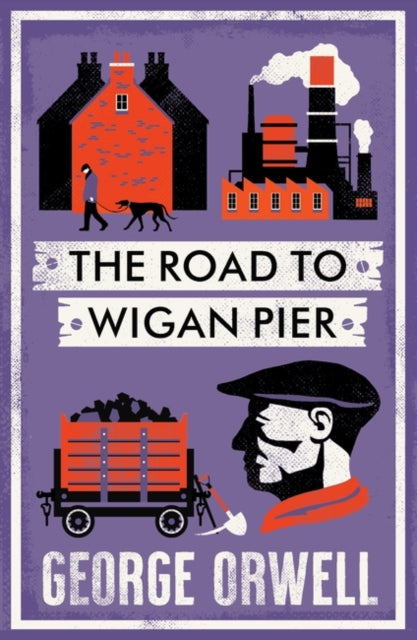
The Road to Wigan Pier
The Road to Wigan Pier
💎 Earn 28 Points (£0.28) on this item.
YOU SAVE £2.34
- Condition: Brand new
- UK Delivery times: Usually arrives within 2 - 3 working days
- UK Shipping: Fee starts at £3.89. Subject to product weight & dimension
Bulk ordering. Want 15 or more copies? Get a personalised quote and bigger discounts. Learn more about bulk orders.
Couldn't load pickup availability
- More about The Road to Wigan Pier
George Orwell traveled to the industrial north of England in 1936 to experience the conditions of the working-class poor and recorded his impressions in a diary that became "The Road to Wigan Pier," a significant work of literary reportage. The book provides a unique record of a country riven by class inequality and plagued by unemployment, inadequate housing, unsafe working conditions, and other social ills, and offers an invaluable insight into the evolution of Orwell's political consciousness.
Format: Paperback / softback
Length: 240 pages
Publication date: 25 July 2024
Publisher: Alma Books Ltd
George Orwell, a thirty-two-year-old writer, embarked on a journey in January 1936 to explore the living conditions of the working-class poor in the industrial north of England. During his two-month expedition, he visited Manchester, Wigan, Liverpool, Sheffield, Leeds, and Barnsley in the north-west and Yorkshire, recording his impressions in a diary that would later become one of the most significant works of literary reportage ever written. The Road to Wigan Pier is a unique record of a country riven by class inequality and plagued by unemployment, inadequate housing, unsafe working conditions, and other social ills, and provides an invaluable insight into the evolution of Orwell's political consciousness.
The book is part sociological survey, part polemic about the potential benefits of socialism, and the failures and idiosyncrasies of many of its middle-class exponents. Orwell's journey began in London, where he witnessed the poverty and squalor of the working-class neighborhoods. He then traveled to the industrial north, where he saw firsthand the conditions in which the working-class poor were forced to live.
One of the most striking aspects of The Road to Wigan Pier is Orwell's description of the working-class communities he visited. He describes the poverty, squalor, and desperation of the people he met, and the ways in which they were struggling to survive. He also highlights the social and economic inequalities that existed in these communities, and the ways in which they were perpetuated by the capitalist system.
Orwell's observations of the working-class communities were not limited to the physical conditions of the people he met. He also observed the political and social systems that were in place in these communities, and the ways in which they were oppressive and exploitative. He saw the rise of fascism in Europe and the threat it posed to democracy, and he was deeply concerned about the potential for a similar movement to emerge in Britain.
Despite the bleakness of the conditions he observed, Orwell also saw the potential for change. He believed that socialism could provide a solution to the social and economic problems that were plaguing the working-class poor, and he was committed to promoting socialism through his writing. However, he also recognized the failures and idiosyncrasies of many of its middle-class exponents, and he was critical of the way in which socialism was being implemented in Britain.
One of the most significant criticisms of socialism that Orwell made in The Road to Wigan Pier was the way in which it was being implemented in Britain. He argued that socialism was being imposed on the working-class poor by a small elite of intellectuals and politicians, who were not truly representative of the working-class. He also argued that socialism was being implemented in a way that was not sustainable, and that it was leading to a decline in the quality of life for the working-class poor.
Orwell's observations of the working-class communities he visited were not limited to the physical conditions of the people he met. He also observed the political and social systems that were in place in these communities, and the ways in which they were oppressive and exploitative. He saw the rise of fascism in Europe and the threat it posed to democracy, and he was deeply concerned about the potential for a similar movement to emerge in Britain.
Despite the bleakness of the conditions he observed, Orwell also saw the potential for change. He believed that socialism could provide a solution to the social and economic problems that were plaguing the working-class poor, and he was committed to promoting socialism through his writing. However, he also recognized the failures and idiosyncrasies of many of its middle-class exponents, and he was critical of the way in which socialism was being implemented in Britain.
One of the most significant criticisms of socialism that Orwell made in The Road to Wigan Pier was the way in which it was being implemented in Britain. He argued that socialism was being imposed on the working-class poor by a small elite of intellectuals and politicians, who were not truly representative of the working-class. He also argued that socialism was being implemented in a way that was not sustainable, and that it was leading to a decline in the quality of life for the working-class poor.
In conclusion, The Road to Wigan Pier is a unique record of a country riven by class inequality and plagued by unemployment, inadequate housing, unsafe working conditions, and other social ills. It is part sociological survey, part polemic about the potential benefits of socialism, and the failures and idiosyncrasies of many of its middle-class exponents. Orwell's journey began in London, where he witnessed the poverty and squalor of the working-class neighborhoods, and then traveled to the industrial north, where he saw firsthand the conditions in which the working-class poor were forced to live. His observations of the working-class communities he visited were not limited to the physical conditions of the people he met, but also included the political and social systems that were in place in these communities, and the ways in which they were oppressive and exploitative. Despite the bleakness of the conditions he observed, Orwell also saw the potential for change, and he was committed to promoting socialism through his writing. However, he also recognized the failures and idiosyncrasies of many of its middle-class exponents, and he was critical of the way in which socialism was being implemented in Britain.
Dimension: 198 x 128 (mm)
ISBN-13: 9781847499196
UK and International shipping information
UK and International shipping information
We deliver throughout the United Kingdom and to 128 countries and territories worldwide, including the United States, Australia, Canada, Germany, Spain and France.