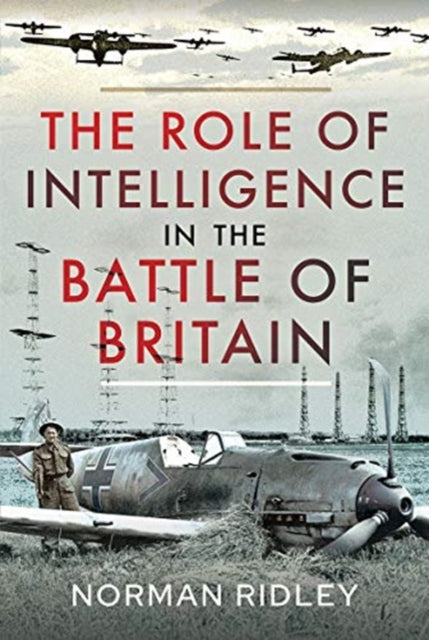
Norman Ridley
The Role of Intelligence in the Battle of Britain
The Role of Intelligence in the Battle of Britain
💎 Earn 88 Points (£0.88) on this item.
YOU SAVE £7.30
- Condition: Brand new
- UK Delivery times: Usually arrives within 2 - 3 working days
- UK Shipping: Fee starts at £2.39. Subject to product weight & dimension
Bulk ordering. Want 15 or more copies? Get a personalised quote and bigger discounts. Learn more about bulk orders.
Couldn't load pickup availability
- More about The Role of Intelligence in the Battle of Britain
The Battle of Britain was fought between two airborne military elites and was a classic example of pure attack against pure defense. The Luftwaffe failed to appreciate the true nature of Fighter Command's operational systems and made fundamental strategic errors when evaluating its plans to degrade them. Both sides lacked detailed information about each other's war production capacity, and the Luftwaffe was unable to use intelligence as a force multiplier. The British had the means to respond quickly and effectively to each new strategic initiative rolled out by the Luftwaffe.
Format: Hardback
Length: 224 pages
Publication date: 15 November 2021
Publisher: Pen & Sword Books Ltd
The Battle of Britain was a pivotal conflict in World War II, fought between two elite airborne military forces, the Royal Air Force (RAF) and the Luftwaffe. Despite being primarily a war of attrition, the battle was characterized by the crucial role of intelligence gathering, assessment, and reaction on both sides. In many respects, both the RAF and the Luftwaffe faced challenges due to poor intelligence, which hindered their efforts during the battle.
One of the most significant Luftwaffe blunders was its failure to understand the operational systems of Fighter Command. This lack of understanding led to fundamental strategic errors when evaluating the Luftwaffe's plans to degrade Fighter Command's capabilities. This was compounded by the underestimation of Fighter Command's capabilities by Luftwaffe's Intelligence chief, Major Josef Beppo Schmid. Schmid's consistent underestimation of Fighter Command's capabilities had a significant negative impact on Reichsmarschall Goering's decision-making at all stages of the conflict.
Both the Luftwaffe and the RAF lacked detailed information about each other's war production capacity. While the Luftwaffe had pre-war aerial surveillance data, it had not been able to update it significantly since the declaration of war in September 1939. Fighter Command, on the other hand, had an advantage through its radar surveillance systems, although these systems were less than totally reliable in the early stages of the conflict. The inexperience of many of Fighter Command's operators also made it difficult to interpret the data coming through.
Another promising source of intelligence was the interception of Luftwaffe communications. While the Luftwaffe was able to intercept some communications, it was unable to use intelligence as a force multiplier by effectively concentrating its resources. Instead, poor intelligence acted as a force diluter, further hindering the Luftwaffe's efforts.
In conclusion, the Battle of Britain was a classic example of pure attack against pure defense. While it was essentially a war of attrition, the gathering, assessment, and reaction to intelligence played a significant role on both sides. The Luftwaffe's failure to appreciate the true nature of Fighter Command's operational systems and its underestimation of Fighter Command's capabilities were significant factors that contributed to its defeat. Additionally, the Luftwaffe lacked detailed information about each other's war production capacity and was unable to use intelligence as a force multiplier. The interception of Luftwaffe communications was a promising source of intelligence, but it was not effectively utilized by the Luftwaffe.
Weight: 790g
Dimension: 165 x 243 x 28 (mm)
ISBN-13: 9781399010382
This item can be found in:
UK and International shipping information
UK and International shipping information
UK Delivery and returns information:
- Delivery within 2 - 3 days when ordering in the UK.
- Shipping fee for UK customers from £2.39. Fully tracked shipping service available.
- Returns policy: Return within 30 days of receipt for full refund.
International deliveries:
Shulph Ink now ships to Australia, Belgium, Canada, France, Germany, Ireland, Italy, India, Luxembourg Saudi Arabia, Singapore, Spain, Netherlands, New Zealand, United Arab Emirates, United States of America.
- Delivery times: within 5 - 10 days for international orders.
- Shipping fee: charges vary for overseas orders. Only tracked services are available for most international orders. Some countries have untracked shipping options.
- Customs charges: If ordering to addresses outside the United Kingdom, you may or may not incur additional customs and duties fees during local delivery.