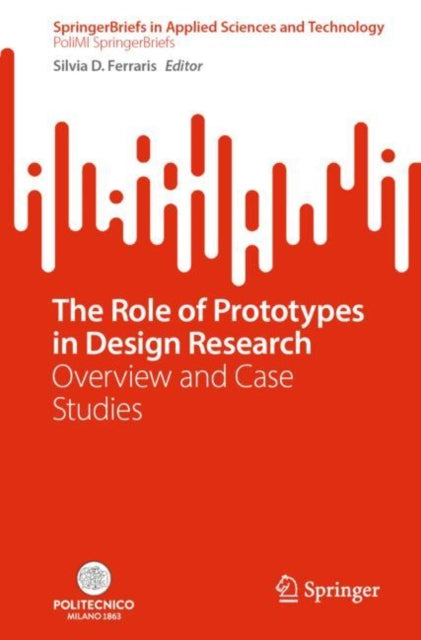
Silvia D. Ferraris
The Role of Prototypes in Design Research: Overview and Cases Studies
The Role of Prototypes in Design Research: Overview and Cases Studies
💎 Earn 206 Points (£2.06) on this item.
We can order this item for you. Delivery usually takes about 4 to 6 weeks.
This item is not held in our immediate stock. We will order it for you after checkout.
Estimated delivery: About 4 to 6 weeks
YOU SAVE £8.70
- Condition: Brand new
- UK Delivery times: Usually arrives within 2 - 3 working days
- UK Shipping: Fee starts at £2.39. Subject to product weight & dimension
Bulk ordering. Want 15 or more copies? Get a personalised quote and bigger discounts. Learn more about bulk orders.
Couldn't load pickup availability
- More about The Role of Prototypes in Design Research: Overview and Cases Studies
This book provides a theoretical framework for design researchers interested in developing their research work about and with prototypes. It defines prototypes' applications, features, and purposes and outlines the criteria for their relationship with research.
Format: Paperback / softback
Length: 138 pages
Publication date: 22 March 2023
Publisher: Springer International Publishing AG
This comprehensive book offers a robust theoretical framework for design researchers seeking to advance their research endeavors concerning and utilizing prototypes. It delves into the diverse definitions and potential roles of prototypes within the intricate landscape of contemporary design research. Notably, as manufacturing and digital advancements necessitate the creation of advanced prototypes, the field of design evolution as an academic discipline continues to expand its horizons, encompassing new perspectives, fields, and research methodologies, including the applications, features, and purposes of prototypes. The framework emerges from an interpretation of these interconnected phenomena and a compilation of case studies. Furthermore, it establishes criteria that delineate the relationship between research context, discipline, and general scope and prototype nature and specific aims. Moreover, the book provides a comprehensive overview of prototypes' roles in design research, offering valuable insights for scholars and practitioners alike.
Introduction:
The book serves as a valuable resource for design researchers who are eager to explore the multifaceted world of prototypes. It provides a comprehensive framework that helps scholars understand the various definitions, functions, and applications of prototypes within the context of design research. By examining the evolution of prototypes as an academic discipline, the book sheds light on the expanding perspectives, fields, and research methods that encompass prototypes.
Definitions and Functions of Prototypes:
The book delves into the rich tapestry of prototypes, exploring their multiple definitions and potential functions within the realm of design research. It acknowledges the diverse perspectives and approaches adopted by researchers, highlighting the importance of considering prototypes as tools for exploration, experimentation, and validation. Prototypes are recognized as dynamic entities that can evolve and adapt to the changing needs and requirements of design projects. They serve as intermediaries between conceptual ideas and tangible manifestations, allowing designers to test and refine their ideas in a tangible and iterative manner.
Applications of Prototypes:
The book highlights the wide range of applications of prototypes in design research. It emphasizes the role of prototypes in shaping and refining design concepts, enabling designers to explore and test alternative solutions. Prototypes facilitate communication and collaboration among stakeholders, allowing for feedback and refinement at an early stage of the design process. They also play a crucial role in user experience research, as they enable designers to simulate and evaluate user interactions with design prototypes.
Features of Prototypes:
The book explores the key features that characterize prototypes in design research. It discusses the importance of prototyping in capturing and conveying design ideas, as well as in facilitating the exploration and evaluation of design alternatives. Prototypes are characterized by their ability to represent and communicate complex concepts, as well as their flexibility and adaptability to changing requirements. They are often characterized by their visual and physical aspects, such as form, material, and functionality, which contribute to their effectiveness in conveying design ideas.
Purpose of Prototypes:
The book delves into the purpose of prototypes in design research. It emphasizes the role of prototypes in shaping and guiding the design process, as well as in facilitating the communication and collaboration between designers and stakeholders. Prototypes serve as a means of testing and evaluating design ideas, allowing designers to identify potential problems and refine their solutions. They also play a vital role in decision-making processes, as they provide a tangible representation of design options that can be evaluated and compared.
Criteria for the Relation between Research and Prototypes:
The book establishes criteria that characterize the relationship between research context, discipline, and general scope and prototype nature and specific aims. It recognizes the importance of aligning the research objectives with the specific goals and characteristics of the prototype. This alignment ensures that the research is focused, relevant, and meaningful, and that the prototype is designed and developed to support the research objectives.
Conclusion:
In conclusion, this comprehensive book offers a robust theoretical framework for design researchers seeking to advance their research endeavors concerning and utilizing prototypes. It provides a deep understanding of the diverse definitions, functions, and applications of prototypes within the context of design research. By examining the evolution of prototypes as an academic discipline, the book sheds light on the expanding perspectives, fields, and research methods that encompass prototypes. The book also establishes criteria that delineate the relationship between research context, discipline, and general scope and prototype nature and specific aims, ensuring that research is focused, relevant, and meaningful. Overall, this book is a valuable resource for scholars and practitioners alike, providing insights and guidance for developing and advancing design research with prototypes.
Weight: 244g
Dimension: 235 x 155 (mm)
ISBN-13: 9783031245480
Edition number: 1st ed. 2023
This item can be found in:
UK and International shipping information
UK and International shipping information
UK Delivery and returns information:
- Delivery within 2 - 3 days when ordering in the UK.
- Shipping fee for UK customers from £2.39. Fully tracked shipping service available.
- Returns policy: Return within 30 days of receipt for full refund.
International deliveries:
Shulph Ink now ships to Australia, Belgium, Canada, France, Germany, Ireland, Italy, India, Luxembourg Saudi Arabia, Singapore, Spain, Netherlands, New Zealand, United Arab Emirates, United States of America.
- Delivery times: within 5 - 10 days for international orders.
- Shipping fee: charges vary for overseas orders. Only tracked services are available for most international orders. Some countries have untracked shipping options.
- Customs charges: If ordering to addresses outside the United Kingdom, you may or may not incur additional customs and duties fees during local delivery.