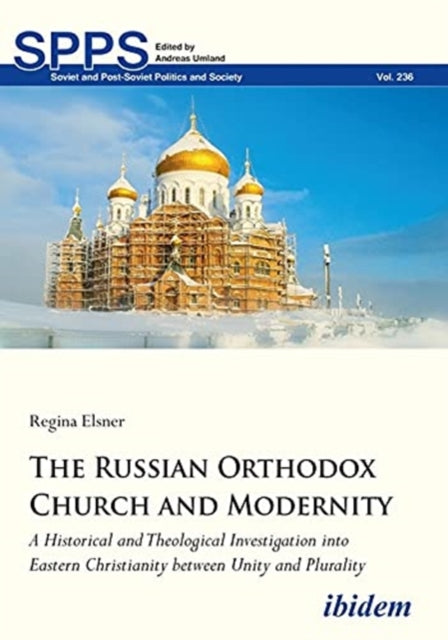
Regina Elsner
The Russian Orthodox Church and Modernity - A Historical and Theological Investigation into Eastern Christianity between Unity and Plurality
The Russian Orthodox Church and Modernity - A Historical and Theological Investigation into Eastern Christianity between Unity and Plurality
💎 Earn 185 Points (£1.85) on this item.
YOU SAVE £7.83
- Condition: Brand new
- UK Delivery times: Usually arrives within 2 - 3 working days
- UK Shipping: Fee starts at £2.39. Subject to product weight & dimension
Bulk ordering. Want 15 or more copies? Get a personalised quote and bigger discounts. Learn more about bulk orders.
Couldn't load pickup availability
- More about The Russian Orthodox Church and Modernity - A Historical and Theological Investigation into Eastern Christianity between Unity and Plurality
The Russian Orthodox Church (ROC) has a complicated history with modernization, which is still present in its opposition to Western values. This study analyzes the ROC's arguments against and preferences for modernization and how they have influenced its official doctrine. The ROC's ability to engage constructively with various aspects of the modern world is demonstrated through its systematic analysis of dogmatic treatises.
Format: Paperback / softback
Length: 440 pages
Publication date: 13 April 2022
Publisher: ibidem-Verlag, Jessica Haunschild u Christian Schon
Throughout its history, the Russian Orthodox Church (ROC) has undergone numerous iterations of modernization, which have often been met with resistance and conflict. This ongoing struggle against what it perceives as Western modernity, encompassing liberal and secular values, continues to shape the ROC's current stance. In order to understand the historical evolution of the ROC's arguments against and preferences for modernization, this study delves into the church's historical development and analyzes the positions that ultimately influenced its official doctrine.
The book's systematic analysis of dogmatic treatises reveals the ROC's remarkable capacity for constructive engagement with various aspects of the modern world. By navigating the delicate balance between theological traditions of unity and plurality, the ROC has found itself in a unique position today, operating within an authoritarian state. This context appears to favor unity, as the church seeks to uphold its traditional beliefs and values while adapting to the challenges posed by the modern world.
The ROC's resistance against Western modernity is rooted in its belief that the modern world is often characterized by materialism, individualism, and secularism, which contradict the church's teachings and values. The church believes that these values threaten the spiritual and moral well-being of individuals and society as a whole and that they undermine the traditional family, social structures, and religious institutions that have sustained Russian culture and society for centuries.
Despite these concerns, the ROC has not been entirely opposed to modernization. In fact, there have been periods of openness and adaptation to the modern world. For example, during the Soviet era, the ROC underwent a period of state-sanctioned religious revival, which aimed to strengthen the church's influence and promote Russian nationalism. The church also played a significant role in the cultural and social life of the Soviet Union, providing education, social services, and spiritual guidance to the Soviet people.
However, the ROC's resistance against Western modernity has also been characterized by a sense of isolation and conservatism. The church has often been accused of being resistant to change and modernization, and it has been criticized for its refusal to engage with the modern world on issues such as human rights, democracy, and social justice. This isolationist stance has led to a decline in the ROC's influence and popularity in Russia and has contributed to the church's marginalization in modern Russian society.
In recent years, there has been a growing movement within the ROC to embrace modernity and engage with the modern world more actively. This movement has been led by a younger generation of clergy and laity who are more open to new ideas and technologies and who are willing to adapt the church's teachings and practices to better serve the needs of the modern world. These efforts have included the development of new religious programs and initiatives, the use of social media and digital technologies to reach out to younger audiences, and the establishment of partnerships with other religious and secular organizations to promote social and economic development.
Despite these positive efforts, the ROC's resistance against Western modernity continues to be a significant challenge for the church. The church's traditional teachings and values are deeply ingrained in Russian culture and society, and it will take time and effort for the ROC to fully embrace modernity and engage with the modern world on a meaningful level. However, the church's commitment to its traditional beliefs and values and its willingness to adapt to the changing world around it give hope for a brighter future for the ROC and for Russian society as a whole.
In conclusion, the Russian Orthodox Church (ROC) has faced numerous iterations of modernization throughout its history, which have often been met with resistance and conflict. This ongoing struggle against what it perceives as Western modernity, encompassing liberal and secular values, continues to shape the ROC's current stance. By examining the historical development of the ROC's arguments against and preferences for modernization, this study provides valuable insights into the church's complex and evolving relationship with the modern world. While the ROC has not been entirely opposed to modernization, it has also been characterized by a sense of isolation and conservatism. In recent years, there has been a growing movement within the ROC to embrace modernity and engage with the modern world more actively. These efforts have the potential to strengthen the ROC's influence and relevance in modern Russian society and to promote the church's teachings and values in a more positive and constructive way. However, the ROC's resistance against Western modernity will continue to be a significant challenge for the church in the years to come.
Weight: 498g
Dimension: 148 x 210 x 26 (mm)
ISBN-13: 9783838215686
UK and International shipping information
UK and International shipping information
UK Delivery and returns information:
- Delivery within 2 - 3 days when ordering in the UK.
- Shipping fee for UK customers from £2.39. Fully tracked shipping service available.
- Returns policy: Return within 30 days of receipt for full refund.
International deliveries:
Shulph Ink now ships to Australia, Belgium, Canada, France, Germany, Ireland, Italy, India, Luxembourg Saudi Arabia, Singapore, Spain, Netherlands, New Zealand, United Arab Emirates, United States of America.
- Delivery times: within 5 - 10 days for international orders.
- Shipping fee: charges vary for overseas orders. Only tracked services are available for most international orders. Some countries have untracked shipping options.
- Customs charges: If ordering to addresses outside the United Kingdom, you may or may not incur additional customs and duties fees during local delivery.