Alexey Tikhomirov
The Stalin Cult in East Germany and the Making of the Postwar Soviet Empire, 1945-1961
The Stalin Cult in East Germany and the Making of the Postwar Soviet Empire, 1945-1961
💎 Earn 191 Points (£1.91) on this item.
We can order this item for you. Delivery usually takes about 4 to 6 weeks.
This item is not held in our immediate stock. We will order it for you after checkout.
Estimated delivery: About 4 to 6 weeks
- Condition: Brand new
- UK Delivery times: Usually arrives within 2 - 3 working days
- UK Shipping: Fee starts at £2.39. Subject to product weight & dimension
Bulk ordering. Want 15 or more copies? Get a personalised quote and bigger discounts. Learn more about bulk orders.
Couldn't load pickup availability
- More about The Stalin Cult in East Germany and the Making of the Postwar Soviet Empire, 1945-1961
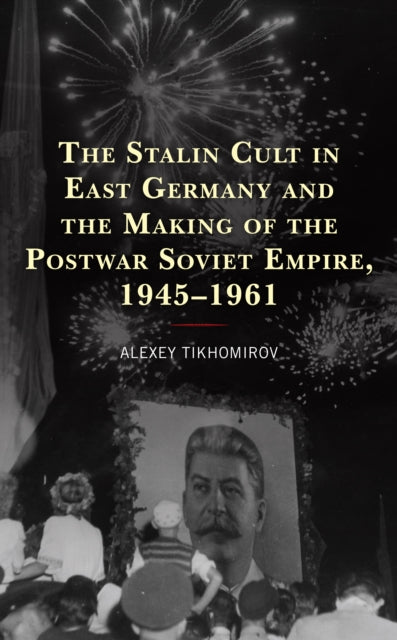
This book explores the construction, dissemination, and reception of the Stalin cult in East Germany from the end of World War II to the building of the Berlin Wall. It analyzes how Soviet representations of power were transferred and adapted in the former "enemy" country and reconstructs "spaces of agency" where different agents and generations interpreted, manipulated, and used the Stalin cult to negotiate social identities and everyday life. It reveals the dynamics of Stalinism as a political system after the Cold War and the foundations of modern politics through mass mobilization, emotional bonding, and social engineering in Soviet-style societies.
Format: Paperback / softback
Length: 384 pages
Publication date: 15 September 2023
Publisher: Lexington Books
This comprehensive book delves into the intricate dynamics of the construction, dissemination, and reception of the Stalin cult in East Germany from the end of World War II to the erection of the Berlin Wall. By exporting Stalin's cult to the Eastern bloc, Moscow sought to forge a symbolic unity among communist states, envisioning a cult community centered around the Soviet leader. Drawing upon extensive Russian and German archives, this work analyzes the transnational dimension of the Stalin cult, exploring how Soviet representations of power were adapted and transplanted in the former "enemy" country. It also reconstructs "spaces of agency" where diverse agents and generations engaged in the interpretation, manipulation, and utilization of the Stalin cult to negotiate social identities and everyday life. This study unveils the intricate interplay of Stalinism as a political system post-Cold War, shedding light on the foundations of modern politics through mass mobilization, emotional bonding, and social engineering in Soviet-style societies. As a pivotal chapter in the global history of communism, this book offers a comparative and interconnected perspective on the emergence of veneration of Stalin and other nationalistic cults in socialist states across Europe and beyond.
Introduction:
The Stalin cult in East Germany emerged as a powerful force during the post-World War II era, exerting a profound influence on society and politics. This book aims to examine the construction, dissemination, and reception of this cult, exploring its transnational dimensions and its impact on the formation of modern politics.
Construction of the Stalin Cult:
The Stalin cult in East Germany was meticulously constructed by the Soviet Union, with the goal of consolidating power and promoting the ideology of communism. The cult was disseminated through various channels, including state-controlled media, educational institutions, and cultural events. The Soviet leadership sought to portray Stalin as a heroic figure, a visionary leader who had led the Soviet Union to victory in World War II and had brought about the socialist revolution in East Germany.
Dissemination of the Stalin Cult:
The Stalin cult was disseminated to the East German population through a variety of means. State-controlled media outlets, such as newspapers, radio, and television, played a crucial role in promoting the cult and presenting Stalin as a saintly figure. Educational institutions were also heavily involved in spreading the cult, with textbooks.
The Stalin cult in East Germany emerged as a powerful force during the post-World War II era, exerting a profound influence on society and politics. This book aims to examine the construction, dissemination, and reception of this cult, exploring its transnational dimensions and its impact on the formation of modern politics.
The Stalin cult in East Germany was meticulously constructed by the Soviet Union, with the goal of consolidating power and promoting the ideology of communism. The cult was disseminated through various channels, including state-controlled media, educational institutions, and cultural events. The Soviet leadership sought to portray Stalin as a heroic figure, a visionary leader who had led the Soviet Union to victory in World War II and had brought about the socialist revolution in East Germany.
Dissemination of the Stalin Cult:
The Stalin cult was disseminated to the East German population through a variety of means. State-controlled media outlets, such as newspapers, radio, and television, played a crucial role in promoting the cult and presenting Stalin as a saintly figure. Educational institutions were also heavily involved in spreading the cult, with teachers incorporating lessons about Stalin into their curricula.
In addition to state-controlled media, the Stalin cult was also spread through informal networks, such as neighborhood associations and social clubs. These networks were often led by individuals who had a strong personal connection to Stalin, and they used their influence to promote the cult and spread its message.
The dissemination of the Stalin cult was not without its challenges. The East German government attempted to control the spread of the cult, and it implemented a series of measures to restrict its influence. These measures included censorship of media outlets, surveillance of individuals suspected of promoting the cult, and the imprisonment of those who were found to be involved in cult activities.
Despite these efforts, the Stalin cult continued to thrive in East Germany. It became an integral part of society, shaping the political and social landscape of the country for decades. The cult was particularly popular among young people, who were drawn to its promise of a better future and its promise of social justice.
Reception of the Stalin Cult:
The reception of the Stalin cult in East Germany was complex and varied. While some individuals embraced the cult as a symbol of national pride and identity, others criticized it as a tool of the state to control and manipulate the population.
One of the most significant criticisms of the cult was its emphasis on the cult of personality. The cult placed Stalin at the center of everything, and it encouraged individuals to worship him as a god-like figure. This emphasis on the cult of personality led to a lack of critical thinking and a willingness to accept the government's claims without question.
Another criticism of the cult was its impact on individual rights and freedoms. The cult placed a strong emphasis on the collective good, and it encouraged individuals to sacrifice their own interests for the sake of the group. This emphasis on the collective good led to a lack of personal autonomy and a sense of disempowerment among many East Germans.
Despite these criticisms, the Stalin cult continued to hold a powerful grip on East German society. It became an integral part of the country's cultural heritage, and it was celebrated in a variety of ways, including through art, music, and literature. The cult also played a significant role in shaping the country's political landscape, with its supporters often being marginalized and persecuted by the government.
Conclusion:
In conclusion, this book has examined the construction, dissemination, and reception of the Stalin cult in East Germany from the end of World War II to the erection of the Berlin Wall. It has demonstrated that the cult was a powerful force that shaped the political and social landscape of the country for decades. The book has also shown that the cult was transnational in nature, with its influence extending beyond East Germany to other socialist states across Europe and beyond. The book has shed light on the foundations of modern politics through mass mobilization, emotional bonding, and social engineering in Soviet-style societies, and it has offered a comparative and interconnected perspective on the emergence of veneration of Stalin and other nationalistic cults in socialist states across Europe and beyond.
Weight: 617g
Dimension: 231 x 154 x 24 (mm)
ISBN-13: 9781666911916
UK and International shipping information
UK and International shipping information
UK Delivery and returns information:
- Delivery within 2 - 3 days when ordering in the UK.
- Shipping fee for UK customers from £2.39. Fully tracked shipping service available.
- Returns policy: Return within 30 days of receipt for full refund.
International deliveries:
Shulph Ink now ships to Australia, Belgium, Canada, France, Germany, Ireland, Italy, India, Luxembourg Saudi Arabia, Singapore, Spain, Netherlands, New Zealand, United Arab Emirates, United States of America.
- Delivery times: within 5 - 10 days for international orders.
- Shipping fee: charges vary for overseas orders. Only tracked services are available for most international orders. Some countries have untracked shipping options.
- Customs charges: If ordering to addresses outside the United Kingdom, you may or may not incur additional customs and duties fees during local delivery.