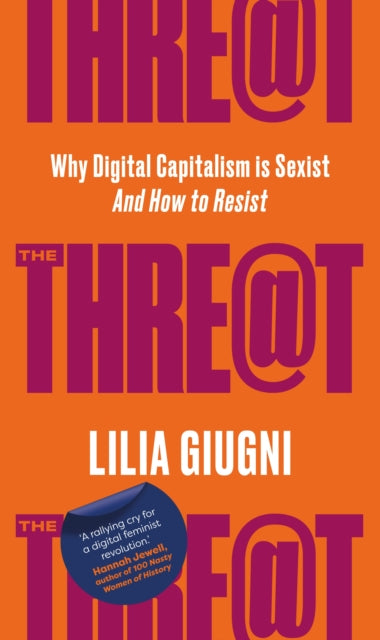
Lilia Giugni
The Threat: Why Digital Capitalism is Sexist - And How to Resist
The Threat: Why Digital Capitalism is Sexist - And How to Resist
💎 Earn 60 Points (£0.60) on this item.
We can order this item for you. Delivery usually takes about 4 to 6 weeks.
This item is not held in our immediate stock. We will order it for you after checkout.
Estimated delivery: About 4 to 6 weeks
YOU SAVE £4.97
- Condition: Brand new
- UK Delivery times: Usually arrives within 2 - 3 working days
- UK Shipping: Fee starts at £2.39. Subject to product weight & dimension
Bulk ordering. Want 15 or more copies? Get a personalised quote and bigger discounts. Learn more about bulk orders.
Couldn't load pickup availability
- More about The Threat: Why Digital Capitalism is Sexist - And How to Resist
The digital revolution has been damaging for many women due to victimisation, exploitation, and marginalisation. Dr Lilia Giugni explores how millions of women are violated, exploited, and marginalised due to processes of technological change and offers practical ideas to help women take back the tech and create a better and more just future.
Format: Hardback
Length: 256 pages
Publication date: 17 November 2022
Publisher: September Publishing
The digital revolution has had a significant impact on women globally, with many being victimized, exploited, and marginalized due to technological change. Dr. Lilia Giugni's book, "The Threat," explores this issue through the stories and interviews of women from around the world. She highlights the tight intersections between technology, patriarchy, and capitalism, exposing the profit-driven market in which our digital devices are designed and built and the patriarchal society that shapes who gets to use them and how.
One of the primary ways that the digital revolution has harmed women is through the use of digital devices. Women are often targeted by cybercriminals, who use their personal information to steal money, access sensitive data, and even blackmail them. This can have devastating consequences for women's personal and professional lives, including job loss, financial instability, and even physical harm.
In addition to cybercrime, women are also exploited while producing digital devices. Many women work in factories and other manufacturing plants that produce electronic components for digital devices. These factories are often unsafe and exploitative, with long hours, low pay, and no access to basic amenities such as clean water and food. Women are also often forced to work in dangerous conditions, such as mines and factories, which can lead to serious injury or even death.
Another way that the digital revolution has harmed women is through the lack of access to the Internet. While the Internet has opened up many opportunities for women, it has also created a digital divide that leaves many women behind. Women in rural areas, for example, may not have access to the Internet, which can limit their ability to access education, healthcare, and employment opportunities. This can lead to a cycle of poverty and inequality that is difficult to break.
To address these issues, Dr. Giugni offers practical ideas to help women take back the tech. She suggests that we should design and build digital devices that are more accessible, affordable, and safe for women. We should also work to create a more equitable and inclusive digital society that values women's rights and promotes gender equality.
One of the most important ways that we can create a more equitable and inclusive digital society is to promote gender equality in the workplace. This can be done by implementing policies that promote equal pay, equal opportunities, and equal treatment for women. We should also work to create a culture of respect and support for women in the workplace, which can help to prevent harassment and discrimination.
In addition to promoting gender equality in the workplace, we should also work to address the issue of cybercrime. This can be done by implementing stronger cybersecurity measures, such as encryption, firewalls, and password protection. We should also work to educate women about the risks of cybercrime and how to protect themselves.
Another way that we can address the issue of the digital divide is to provide access to the Internet to women in rural areas. This can be done by investing in infrastructure such as broadband networks and mobile phones. We should also work to provide training and support to women in rural areas to help them use the Internet effectively.
Finally, we should work to address the issue of gender-based violence in the digital world. This can be done by implementing policies that protect women from online harassment and abuse. We should also work to create a culture of respect and support for women who have experienced gender-based violence in the digital world.
In conclusion, the digital revolution has had a significant impact on women globally, with many being victimized, exploited, and marginalized due to technological change. Dr. Lilia Giugni's book, "The Threat," offers practical ideas to help women take back the tech and create a more equitable and inclusive digital society. By promoting gender equality in the workplace, implementing stronger cybersecurity measures, providing access to the Internet to women in rural areas, and addressing the issue of gender-based violence in the digital world, we can help to ensure that women are able to fully participate in the digital economy and achieve their full potential.
Weight: 412g
Dimension: 145 x 223 x 27 (mm)
ISBN-13: 9781912836970
This item can be found in:
UK and International shipping information
UK and International shipping information
UK Delivery and returns information:
- Delivery within 2 - 3 days when ordering in the UK.
- Shipping fee for UK customers from £2.39. Fully tracked shipping service available.
- Returns policy: Return within 30 days of receipt for full refund.
International deliveries:
Shulph Ink now ships to Australia, Belgium, Canada, France, Germany, Ireland, Italy, India, Luxembourg Saudi Arabia, Singapore, Spain, Netherlands, New Zealand, United Arab Emirates, United States of America.
- Delivery times: within 5 - 10 days for international orders.
- Shipping fee: charges vary for overseas orders. Only tracked services are available for most international orders. Some countries have untracked shipping options.
- Customs charges: If ordering to addresses outside the United Kingdom, you may or may not incur additional customs and duties fees during local delivery.