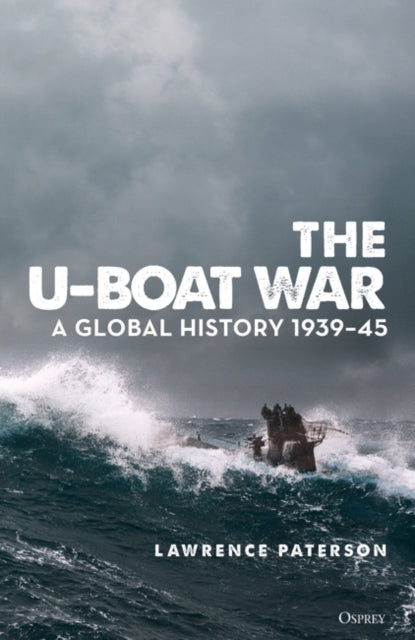
Lawrence Paterson
The U-Boat War: A Global History 1939-45
The U-Boat War: A Global History 1939-45
💎 Earn 110 Points (£1.10) on this item.
YOU SAVE £2.87
- Condition: Brand new
- UK Delivery times: Usually arrives within 2 - 3 working days
- UK Shipping: Fee starts at £2.39. Subject to product weight & dimension
Bulk ordering. Want 15 or more copies? Get a personalised quote and bigger discounts. Learn more about bulk orders.
Couldn't load pickup availability
- More about The U-Boat War: A Global History 1939-45
The accepted historical narrative of the Second World War assigns U-boats to the 'Battle of the Atlantic,' but this is an error. The U-boats war began on the first day of hostilities with Britain and France and ended with the final torpedo sinking on 7 May 1945. They were active in nearly every theatre of operation in which the Wehrmacht served, and within all but the Southern Ocean. This book illustrates the U-boats' often direct relationship with land, sea, and aerial campaigns of both the Allied and Axis powers, dispels certain accepted mythologies, and reveals how the ultimate failure of the U-boats stemmed from chaotic German military and industrial mismanagement as much as from Allied advances in code-breaking and weaponry.
Format: Hardback
Length: 336 pages
Publication date: 14 April 2022
Publisher: Bloomsbury Publishing PLC
The accepted historical narrative of the Second World War predominantly assigns U-boats to the so-called 'Battle of the Atlantic,' almost as if the struggle over convoys between the new world and the old can be viewed in isolation from simultaneous events on land and in the air. This has become an almost accepted error. The U-boats war did not exist solely between 1940 and 1943, nor did the Atlantic battle occur in seclusion from other theatres of action. The story of Germany's second U-boat war began on the first day of hostilities with Britain and France and ended with the final torpedo sinking on 7 May 1945. U-boats were active in nearly every theatre of operation in which the Wehrmacht served, and within all but the Southern Ocean. Moreover, these deployments were not undertaken in isolation from one another; instead, they were frequently interconnected in what became an increasingly inefficient German naval strategy.
This fascinating new book places each theatre of action in which U-boats were deployed into the broader context of the Second World War in its entirety while also studying the interdependence of the various geographic deployments. It illustrates the U-boats often direct relationship with land, sea, and aerial campaigns of both the Allied and Axis powers, dispels certain accepted mythologies, and reveals how the ultimate failure of the U-boats stemmed as much from chaotic German military and industrial mismanagement as it did from Allied advances in code-breaking and weaponry.
The U-boats played a crucial role in the Second World War, particularly in the Battle of the Atlantic. However, the narrative that has been accepted by historians has often portrayed the war as solely between 1940 and 1943, with the Atlantic battle occurring in isolation from other theatres of action. This is an error that needs to be corrected. The U-boats were active in nearly every theatre of operation in which the Wehrmacht served, and within all but the Southern Ocean. Moreover, these deployments were not undertaken in isolation from one another; instead, they were frequently interconnected in what became an increasingly inefficient German naval strategy.
One of the key aspects of the U-boats war was their direct relationship with land, sea, and aerial campaigns of both the Allied and Axis powers. The U-boats were able to launch their attacks from the sea and then move into the coastal areas to launch their attacks on land and air targets. This made them a powerful force in the war, as they were able to strike at the heart of the enemy's supply lines and infrastructure.
However, the U-boats also faced several challenges that contributed to their ultimate failure. One of the most significant was the development of Allied code-breaking and weaponry. As the war progressed, the Allies were able to crack the German naval codes, which allowed them to track the movements of U-boats and launch attacks on them. This was a significant blow to the U-boats, as it made it much more difficult for them to operate in the Atlantic and other theatres of operation.
Another challenge that the U-boats faced was the development of the convoy system. The convoy system was a system of ships that were escorted by warships to protect them from enemy attacks. This system was developed in response to the U-boats' attacks on merchant ships in the early years of the war, and it was highly effective in reducing the number of ships that were lost to the U-boats.
Despite these challenges, the U-boats were able to continue to operate for several years. However, their ultimate failure was due to a combination of factors, including chaotic German military and industrial mismanagement, Allied advances in code-breaking and weaponry, and the development of the convoy system.
In conclusion, the U-boats war was not solely between 1940 and 1943, nor did the Atlantic battle occur in isolation from other theatres of action. The U-boats were active in nearly every theatre of operation in which the Wehrmacht served, and within all but the Southern Ocean. They had a direct relationship with land, sea, and aerial campaigns of both the Allied and Axis powers, and they were able to launch powerful attacks on the enemy's supply lines and infrastructure. However, their ultimate failure was due to a combination of factors, including chaotic German military and industrial mismanagement, Allied advances in code-breaking and weaponry, and the development of the convoy system.
Weight: 702g
Dimension: 163 x 242 x 36 (mm)
ISBN-13: 9781472848253
This item can be found in:
UK and International shipping information
UK and International shipping information
UK Delivery and returns information:
- Delivery within 2 - 3 days when ordering in the UK.
- Shipping fee for UK customers from £2.39. Fully tracked shipping service available.
- Returns policy: Return within 30 days of receipt for full refund.
International deliveries:
Shulph Ink now ships to Australia, Belgium, Canada, France, Germany, Ireland, Italy, India, Luxembourg Saudi Arabia, Singapore, Spain, Netherlands, New Zealand, United Arab Emirates, United States of America.
- Delivery times: within 5 - 10 days for international orders.
- Shipping fee: charges vary for overseas orders. Only tracked services are available for most international orders. Some countries have untracked shipping options.
- Customs charges: If ordering to addresses outside the United Kingdom, you may or may not incur additional customs and duties fees during local delivery.