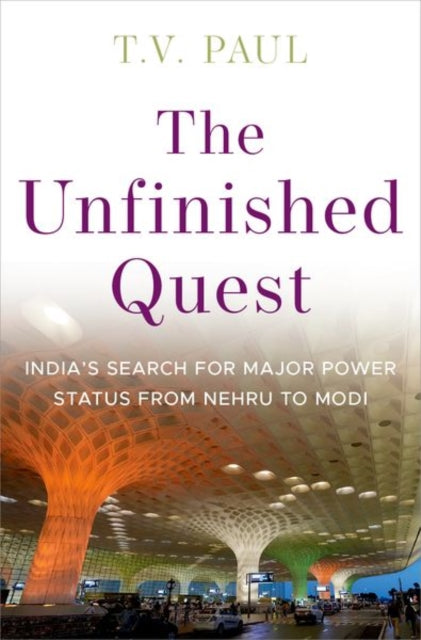
T.V.Paul
The Unfinished Quest: Indiaas Search for Major Power Status from Nehru to Modi
The Unfinished Quest: Indiaas Search for Major Power Status from Nehru to Modi
💎 Earn 108 Points (£1.08) on this item.
YOU SAVE £1.29
- Condition: Brand new
- UK Delivery times: Usually arrives within 2 - 3 working days
- UK Shipping: Fee starts at £2.39. Subject to product weight & dimension
Bulk ordering. Want 15 or more copies? Get a personalised quote and bigger discounts. Learn more about bulk orders.
Couldn't load pickup availability
- More about The Unfinished Quest: Indiaas Search for Major Power Status from Nehru to Modi
T.V. Paul's book, The Unfinished Quest, explores India's quest for higher regional and global status and its significance as a swing power in the Indo-Pacific region. It highlights India's successes and failures since its founding in 1947 and analyzes the motivations and constraints that have shaped its global status. Paul's analysis sheds light on the current geo-strategic situation and the China-India rivalry, and provides a new framework for understanding India's relative position in the broader Indo-Pacific theater.
Format: Hardback
Length: 288 pages
Publication date: 08 August 2024
Publisher: Oxford University Press Inc
India's Journey to Higher Regional and Global Status: An Analysis in The Unfinished Quest by T.V. Paul
India's journey to higher regional and global status has been a complex and multifaceted one, with both successes and failures since its founding in 1947. In 2022, India surpassed the United Kingdom to become the fifth-largest economy in the world, a significant milestone in its economic development. However, despite its growing influence, India has not yet attained the status of a globally recognized great power.
In his book, The Unfinished Quest, leading international relations and South Asia scholar T.V. Paul charts India's checkered path toward higher regional and global status, covering both the successes and failures it has experienced since the modern nation's founding. Paul focuses on the key motivations driving Indian leaders to enhance India's global status and power, as well as the many constraints that have hindered its progress. He carefully specifies what counts as indicators of greater status and uses these as benchmarks in his assessment of each era.
One of the key factors that have contributed to India's quest for status is its growing economic power. India has become a major player in the global economy, with a rapidly growing middle class and a diverse range of industries. This has led to increased international trade and investment, and has helped to improve India's global standing.
However, India's economic success has also been accompanied by significant challenges. The country faces a number of structural issues, including a large informal economy, inadequate infrastructure, and corruption. These issues have hindered India's ability to compete with more developed countries and have contributed to its relatively low ranking in global indices such as the Human Development Index.
Another factor that has influenced India's quest for status is its political stability. India has been a democratic country since its independence, and has maintained a relatively stable political system. This has allowed India to pursue its foreign policy objectives without fear of political instability. However, India's political system has also been criticized for its lack of transparency and accountability, which has led to concerns about corruption and cronyism.
India's quest for status has also been shaped by its cultural and historical heritage. India is a country with a rich and diverse culture, and has a long history of diplomacy and international engagement. This has helped to establish India as a respected member of the international community and has contributed to its status as a swing power in the Indo-Pacific region.
However, India's cultural and historical heritage has also been a source of conflict and tension. India has been involved in a number of territorial disputes with its neighbors, including Pakistan and China. These disputes have led to military conflicts and have contributed to India's relatively low ranking in global indices such as the Global Peace Index.
In recent years, India has been working to address its structural issues and improve its global status. The country has implemented a number of economic reforms, including the introduction of the Goods and Services Tax (GST) and the liberalization of the foreign investment regime. These reforms have helped to improve India's competitiveness and have attracted significant foreign investment.
India has also been active in its foreign policy, seeking to promote peace and stability in the region. The country has played a key role in the negotiations of the Indo-Pacific Quadrilateral Dialogue, which includes the United States, Japan, Australia, and India. This dialogue has helped to establish a framework for cooperation in the region and has contributed to India's status as a swing power.
However, India's quest for status has also been challenged by the rise of China. China has become a major economic and military power in the region, and has been pursuing a more assertive foreign policy. This has led to tensions between India and China, and has contributed to India's relatively low ranking in global indices such as the Global Power Index.
In response to China's rise, India has been pursuing a policy of strategic autonomy. This policy seeks to reduce India's dependence on China and to develop its own capabilities. India has been investing in its military and defense sector, and has been seeking to strengthen its ties with other countries in the region.
However, India's policy of strategic autonomy has also been criticized by some analysts. Some argue that India's focus on strategic autonomy is at the expense of its economic development, and that it is not in India's long-term interests to compete with China.
In conclusion, India's journey to higher regional and global status has been a complex and multifaceted one, with both successes and failures since its founding in 1947. While India has made significant progress in its economic development, it has also faced significant challenges in its political stability, cultural and historical heritage, and foreign policy. India's quest for status has been shaped by a number of factors, including its growing economic power, political stability, cultural and historical heritage, and foreign policy. While India has been working to address its structural issues and improve its global status, it will continue to face challenges from China and other countries in the region.
Weight: 524g
Dimension: 242 x 167 x 27 (mm)
ISBN-13: 9780197669990
UK and International shipping information
UK and International shipping information
UK Delivery and returns information:
- Delivery within 2 - 3 days when ordering in the UK.
- Shipping fee for UK customers from £2.39. Fully tracked shipping service available.
- Returns policy: Return within 30 days of receipt for full refund.
International deliveries:
Shulph Ink now ships to Australia, Belgium, Canada, France, Germany, Ireland, Italy, India, Luxembourg Saudi Arabia, Singapore, Spain, Netherlands, New Zealand, United Arab Emirates, United States of America.
- Delivery times: within 5 - 10 days for international orders.
- Shipping fee: charges vary for overseas orders. Only tracked services are available for most international orders. Some countries have untracked shipping options.
- Customs charges: If ordering to addresses outside the United Kingdom, you may or may not incur additional customs and duties fees during local delivery.