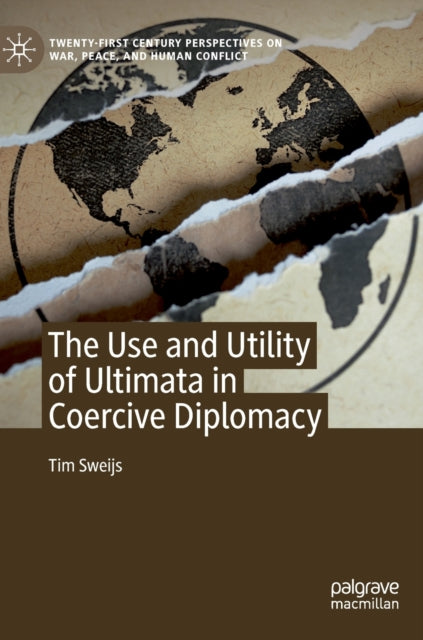
Tim Sweijs
The Use and Utility of Ultimata in Coercive Diplomacy
The Use and Utility of Ultimata in Coercive Diplomacy
💎 Earn 495 Points (£4.95) on this item.
We can order this item for you. Delivery usually takes about 4 to 6 weeks.
This item is not held in our immediate stock. We will order it for you after checkout.
Estimated delivery: About 4 to 6 weeks
YOU SAVE £20.88
- Condition: Brand new
- UK Delivery times: Usually arrives within 2 - 3 working days
- UK Shipping: Fee starts at £3.89. Subject to product weight & dimension
Bulk ordering. Want 15 or more copies? Get a personalised quote and bigger discounts. Learn more about bulk orders.
Couldn't load pickup availability
- More about The Use and Utility of Ultimata in Coercive Diplomacy
Ultimata are a core concept in coercive diplomacy scholarship, but conventional wisdom holds that they are risky. This book shows that the conventional wisdom is wrong based on a new dataset of 87 ultimata issued from 1920-2020. It provides a historical examination of ultimata in Western strategic, political, and legal thought since antiquity until the present and offers a four-pronged typology that explains their various purposes and effects. The book yields a better understanding of interstate threat behavior at a time of surging competition.
Format: Hardback
Length: 293 pages
Publication date: 13 May 2023
Publisher: Springer International Publishing AG
Ultimata have played a significant role in the study of coercive diplomacy, often seen as a risky strategy. However, this book challenges the conventional wisdom by presenting a comprehensive dataset of 87 ultimata issued from 1920 to 2020. Through a historical examination of ultimata in Western strategic, political, and legal thought since antiquity, the book offers a four-pronged typology that explains their various purposes and effects: the dictate, conditional war declaration, bluff, and brinkmanship ultimatum. By analyzing these ultimata, the book provides a deeper understanding of interstate threat behavior in a time of surging competition.
The dictate ultimatum is a direct demand that is issued without any conditions or threats of retaliation. It is used to force the target state to comply with the demands of the issuing state. For example, in 1914, Austria-Hungary issued an ultimatum to Serbia, demanding that it withdraw from the Balkan Wars.
The conditional war declaration ultimatum is a threat of war that is conditional on the target state's compliance with the issuing state's demands. For example, in 1939, Germany issued an ultimatum to Poland, demanding that it cede territory to Germany or face war.
The bluff ultimatum is a threat of war that is intended to intimidate the target state into compliance with the issuing state's demands. For example, in 1962, the United States issued an ultimatum to the Soviet Union, threatening to launch nuclear missiles on Moscow if the Soviet Union did not withdraw its missiles from Cuba.
The brinkmanship ultimatum is a threat of war that is intended to push the target state to the brink of war, with the issuing state holding the option to launch a military attack. For example, in 1983, the United States issued an ultimatum to Iran, demanding that it cease its support for terrorism or face military action.
The book's analysis of these ultimata sheds light on the strategies and tactics used by states in the pursuit of their interests. It demonstrates that ultimata can be effective in achieving certain goals, such as forcing a state to withdraw from a conflict or cede territory, but they can also be counterproductive, leading to increased tensions and the potential for conflict.
Furthermore, the book highlights the importance of considering the historical context and the broader political and economic environment in which ultimata are issued. It emphasizes the need for states to engage in diplomacy and negotiation to resolve conflicts peacefully and to avoid the use of force ultimata as a means of coercion.
In conclusion, this book provides a valuable contribution to the study of coercive diplomacy by challenging the conventional wisdom on the effectiveness of ultimata. It offers a comprehensive dataset and analysis of ultimata issued from 1920 to 2020, and it provides a four-pronged typology that explains their various purposes and effects. By providing a deeper understanding of interstate threat behavior, the book contributes to our understanding of the dynamics of international relations and the strategies used by states to achieve their goals.
Weight: 534g
Dimension: 210 x 148 (mm)
ISBN-13: 9783031213021
Edition number: 1st ed. 2023
UK and International shipping information
UK and International shipping information
We deliver throughout the United Kingdom and to 128 countries and territories worldwide, including the United States, Australia, Canada, Germany, Spain and France.