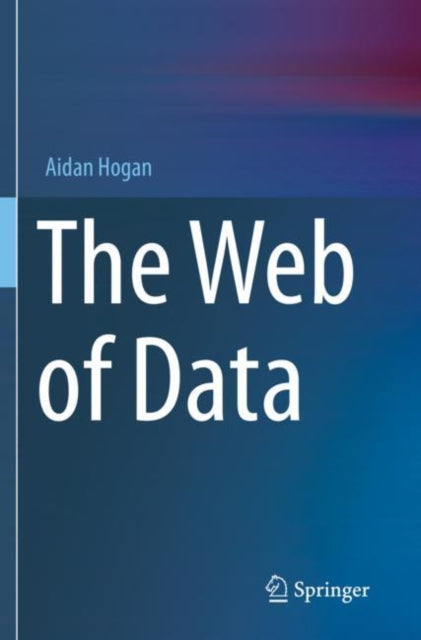
Aidan Hogan
The Web of Data
The Web of Data
💎 Earn 307 Points (£3.07) on this item.
We can order this item for you. Delivery usually takes about 4 to 6 weeks.
This item is not held in our immediate stock. We will order it for you after checkout.
Estimated delivery: About 4 to 6 weeks
YOU SAVE £12.96
- Condition: Brand new
- UK Delivery times: Usually arrives within 2 - 3 working days
- UK Shipping: Fee starts at £2.39. Subject to product weight & dimension
Bulk ordering. Want 15 or more copies? Get a personalised quote and bigger discounts. Learn more about bulk orders.
Couldn't load pickup availability
- More about The Web of Data
The book aims to bring together all methodologies, standards, and recommendations related to machine-readable data on the Web, describe them in detail, provide examples of their use, and discuss how they contribute to the "Web of Data." It is divided into nine chapters, covering topics such as RDF, RDFS, OWL, SPARQL, SHACL, SHEx, Linked Data, and the future of the Web of Data. It is intended for students, researchers, and advanced practitioners interested in learning more about these topics and can be used as a textbook or reference handbook.
Format: Paperback / softback
Length: 680 pages
Publication date: 17 October 2021
Publisher: Springer Nature Switzerland AG
The book aims to provide a comprehensive and concise overview of the methodologies, standards, and recommendations related to data, queries, links, semantics, validation, and other issues concerning machine-readable data on the web. It seeks to describe these concepts in detail, provide examples of their practical applications, and explore how they contribute to and have been utilized in the development of the "web of data."
The book is organized into nine chapters, with the first chapter serving as an introduction to the topic. It discusses the limitations of the current web and highlights the need for a web of data. The second chapter provides an overview of the fundamental concepts involved in the web of data, including resource description framework (RDF), RDF schema (RDFS), web ontology language (OWL), SPARQL query language, shape constraints and expressions (SHACL/SHEx), and linked data.
The third chapter delves into the RDF data model, which is a graph-structured data model proposed by the Semantic Web community as a common data model for the web. It explains the basic concepts and principles of RDF, including triples, properties, and resources. The chapter also discusses the RDFS language, which is a lightweight ontology language used to define an initial semantics for terms used in RDF graphs.
The fourth chapter explores the OWL language, which is an expressive ontology language built upon RDFS. It offers much more powerful ontological features and is widely used for describing and reasoning. The chapter provides an in-depth explanation of the OWL language, its syntax, and its applications in the web of data.
The fifth chapter introduces the SPARQL query language, which is a language for querying and updating RDF graphs. It describes the features of SPARQL, including SELECT, WHERE, AS, and CONSTRUCT queries. The chapter also provides a detailed definition of the semantics of SPARQL queries, including the rules of inference and the rules of aggregation.
The sixth chapter focuses on shape constraints and expressions (SHACL/SHEx), which are two languages for describing the expected. It explains the basic concepts and principles of SHACL and SHEx, including constraints, expressions, and patterns. The chapter also provides examples of how SHACL and SHEx can be used to validate and enforce data on the web.
The seventh chapter explores the use of linked data, which is a web of data that is connected and interlinked through hypermedia links. It discusses the benefits of linked data, including its ability to facilitate data discovery, integration, and reuse. The chapter also provides examples of linked data applications in various domains, such as healthcare, education, and government.
The eighth chapter discusses the challenges and opportunities associated with the web of data. It discusses the need for standards and best practices to ensure the quality and consistency of data. It also highlights the role of metadata and ontologies in the web of data, including their use in describing resources, relationships, and contexts.
The ninth chapter concludes the book by summarizing the key findings and recommendations of the previous chapters. It emphasizes the importance of continued research and development in the field of the web of data to ensure its continued growth and success.
In conclusion, the book provides a comprehensive and concise overview of the methodologies, standards, and recommendations related to data, queries, links, semantics, validation, and other issues concerning machine-readable data on the web. It seeks to describe these concepts in detail, provide examples of their practical applications, and explore how they contribute to and have been utilized in the development of the "web of data." The book is a valuable resource for researchers, practitioners, and policymakers interested in advancing the field of the web of data and building more robust and sustainable web applications.
Weight: 1056g
Dimension: 235 x 155 (mm)
ISBN-13: 9783030515829
Edition number: 1st ed. 2020
This item can be found in:
UK and International shipping information
UK and International shipping information
UK Delivery and returns information:
- Delivery within 2 - 3 days when ordering in the UK.
- Shipping fee for UK customers from £2.39. Fully tracked shipping service available.
- Returns policy: Return within 30 days of receipt for full refund.
International deliveries:
Shulph Ink now ships to Australia, Belgium, Canada, France, Germany, Ireland, Italy, India, Luxembourg Saudi Arabia, Singapore, Spain, Netherlands, New Zealand, United Arab Emirates, United States of America.
- Delivery times: within 5 - 10 days for international orders.
- Shipping fee: charges vary for overseas orders. Only tracked services are available for most international orders. Some countries have untracked shipping options.
- Customs charges: If ordering to addresses outside the United Kingdom, you may or may not incur additional customs and duties fees during local delivery.