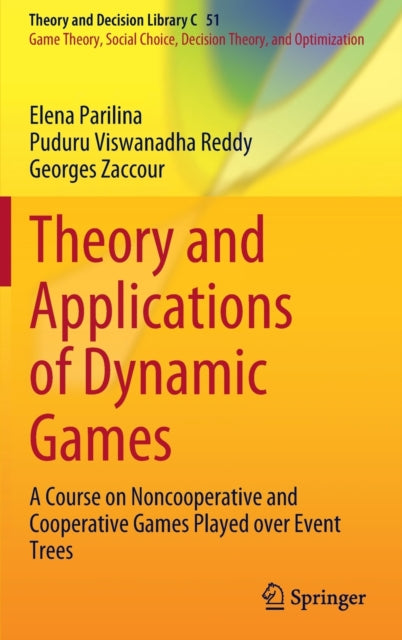
Elena Parilina,Puduru Viswanadha Reddy,Georges Zaccour
Theory and Applications of Dynamic Games: A Course on Noncooperative and Cooperative Games Played over Event Trees
Theory and Applications of Dynamic Games: A Course on Noncooperative and Cooperative Games Played over Event Trees
💎 Earn 227 Points (£2.27) on this item.
We can order this item for you. Delivery usually takes about 4 to 6 weeks.
This item is not held in our immediate stock. We will order it for you after checkout.
Estimated delivery: About 4 to 6 weeks
YOU SAVE £9.57
- Condition: Brand new
- UK Delivery times: Usually arrives within 2 - 3 working days
- UK Shipping: Fee starts at £2.39. Subject to product weight & dimension
Bulk ordering. Want 15 or more copies? Get a personalised quote and bigger discounts. Learn more about bulk orders.
Couldn't load pickup availability
- More about Theory and Applications of Dynamic Games: A Course on Noncooperative and Cooperative Games Played over Event Trees
This textbook covers noncooperative and cooperative dynamic games with uncertain parameter values,using an event tree to describe the stochastic process. It is intended for graduate students in economics, management science, and engineering and covers the sustainability of cooperative contracts, introducing mechanisms to prevent breakdowns. It provides examples of how dynamic games played over event trees can be applied to environmental economics, management science, and engineering.
Format: Hardback
Length: 259 pages
Publication date: 24 November 2022
Publisher: Springer International Publishing AG
This comprehensive textbook offers a thorough exploration of noncooperative and cooperative dynamic games, where uncertain parameter values are modeled using an event tree. Primarily designed for advanced graduate students in economics, management science, and engineering, this self-contained book provides a clear and detailed definition of all relevant concepts, starting from static games and extending them to a dynamic framework. It then delves into the sustainability of cooperative contracts over time, introducing various mechanisms to prevent these agreements from collapsing prematurely. To illustrate these concepts, the book offers numerous examples of how dynamic games played on event trees can be applied to environmental economics, management science, and engineering.
Introduction:
Dynamic games are a fundamental aspect of modern economics, management science, and engineering, as they allow for the analysis of complex systems where the actions of multiple agents interact over time. In these games, the state of the system evolves according to a set of rules, and the agents are motivated by their own self-interest and the interactions between them.
One important aspect of dynamic games is the presence of uncertainty. In many real-world situations, the parameters governing the system are not known with certainty, and they can change over time. This uncertainty can have a significant impact on the behavior of the agents and the outcomes of the game.
To address this uncertainty, event trees are used as a modeling tool. Event trees are a graphical representation of the possible states of the system and the transitions between them. They allow for the analysis of the system in a probabilistic manner, taking into account the randomness of the parameter values and the interactions between the agents.
This textbook provides a comprehensive overview of noncooperative and cooperative dynamic games involving uncertain parameter values, with the stochastic process being described by an event tree. Primarily intended for graduate students of economics, management science, and engineering, the book is self-contained, as it defines and illustrates all relevant concepts originally introduced in static games before extending them to a dynamic framework. It subsequently addresses the sustainability of cooperative contracts over time and introduces a range of mechanisms to help avoid such agreements breaking down before reaching maturity.
Chapter 1:
In this chapter, the authors introduce the concept of dynamic games and discuss the importance of uncertainty in these games. They also introduce the event tree as a modeling tool for dynamic games and discuss its advantages and disadvantages.
The authors then define the basic elements of a dynamic game, including the agents, the actions they can take, the state of the system, and the payoff functions. They also discuss the concept of Nash equilibria, which is a set of actions that all agents can take to maximize their own payoff.
The chapter also introduces the concept of dynamic programming, which is a method for solving dynamic games. The authors discuss the advantages and disadvantages of dynamic programming and introduce some of the basic algorithms used in this field.
Finally, the chapter provides several examples of dynamic games, including the prisoner's dilemma, the stag hunt, and the chicken game. These examples illustrate the different strategies that agents can use to achieve their goals and the outcomes that can result from these strategies.
Chapter 2:
In this chapter, the authors discuss the concept of cooperative games and introduce the idea of cooperative contracts. They define the basic elements of a cooperative contract, including the actions that the agents must take, the payoff functions, and the duration of the contract.
The authors then discuss the sustainability of cooperative contracts over time and introduce several mechanisms to help prevent these agreements from breaking down before reaching maturity. These mechanisms include the use of commitment devices, such as promises and penalties, and the use of reputation systems, such as trust and reputation scores.
The chapter also provides several examples of cooperative games, including the prisoner's dilemma, the stag hunt, and the chicken game. These examples illustrate the different strategies that agents can use to achieve their goals and the outcomes that can result from these strategies.
Chapter 3:
In this chapter, the authors discuss the concept of dynamic games with incomplete information and introduce the idea of Bayesian games. They define the basic elements of a Bayesian game, including the agents, the actions they can take, the state of the system, and the payoff functions.
The authors then discuss the advantages and disadvantages of Bayesian games and introduce some of the basic algorithms used in this field. They also discuss the concept of belief updating, which is a method for updating the agents' beliefs about the state of the system based on their observations and actions.
The chapter also provides several examples of Bayesian games, including the chicken game, the stag hunt, and the prisoner's dilemma. These examples illustrate the different strategies that agents can use to achieve their goals and the outcomes that can result from these strategies.
Chapter 4:
In this chapter, the authors discuss the concept of dynamic games with multiple agents and introduce the idea of strategic games. They define the basic elements of a strategic game, including the agents, the actions they can take, the state of the system, and the payoff functions.
The authors then discuss the advantages and disadvantages of strategic games and introduce some of the basic algorithms used in this field. They also discuss the concept of mixed strategies, which are a set of actions that an agent can take in response to different situations.
The chapter also provides several examples of strategic games, including the chicken game, the stag hunt, and the prisoner's dilemma. These examples illustrate the different strategies that agents can use to achieve their goals and the outcomes that can result from these strategies.
Chapter 5:
In this chapter, the authors discuss the concept of dynamic games with externalities and introduce the idea of social games. They define the basic elements of a social game, including the agents, the actions they can take, the state of the system, and the payoff functions.
The authors then discuss the advantages and disadvantages of social games and introduce some of the basic algorithms used in this field. They also discuss the concept of collective action, which is a situation where multiple agents act to achieve a common goal.
The chapter also provides several examples of social games, including the chicken game, the stag hunt, and the prisoner's dilemma. These examples illustrate the different strategies that agents can use to achieve their goals and the outcomes that can result from these strategies.
Conclusion:
In conclusion, this textbook provides a comprehensive overview of noncooperative and cooperative dynamic games involving uncertain parameter values, with the stochastic process being described by an event tree. Primarily intended for graduate students of economics, management science, and engineering, the book is self-contained, as it defines and illustrates all relevant concepts originally introduced in static games before extending them to a dynamic framework. It subsequently addresses the sustainability of cooperative contracts over time and introduces a range of mechanisms to help avoid such agreements breaking down before reaching maturity. To illustrate the concepts discussed, the book provides various examples of how dynamic games played over event trees can be applied to environmental economics, management science, and engineering.
Weight: 582g
Dimension: 235 x 155 (mm)
ISBN-13: 9783031164545
Edition number: 1st ed. 2022
This item can be found in:
UK and International shipping information
UK and International shipping information
UK Delivery and returns information:
- Delivery within 2 - 3 days when ordering in the UK.
- Shipping fee for UK customers from £2.39. Fully tracked shipping service available.
- Returns policy: Return within 30 days of receipt for full refund.
International deliveries:
Shulph Ink now ships to Australia, Belgium, Canada, France, Germany, Ireland, Italy, India, Luxembourg Saudi Arabia, Singapore, Spain, Netherlands, New Zealand, United Arab Emirates, United States of America.
- Delivery times: within 5 - 10 days for international orders.
- Shipping fee: charges vary for overseas orders. Only tracked services are available for most international orders. Some countries have untracked shipping options.
- Customs charges: If ordering to addresses outside the United Kingdom, you may or may not incur additional customs and duties fees during local delivery.