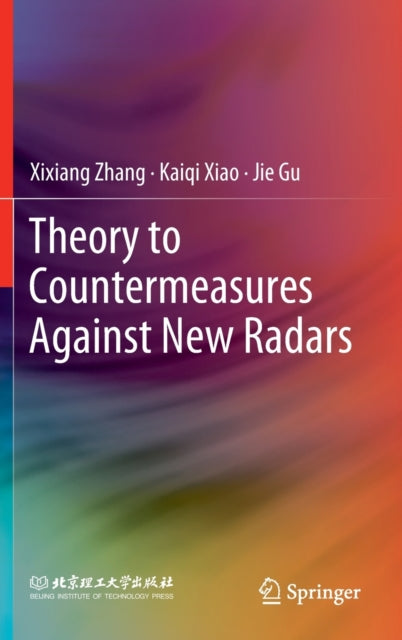
Xixiang Zhang,Kaiqi Xiao,Jie Gu
Theory to Countermeasures Against New Radars
Theory to Countermeasures Against New Radars
We can order this item for you. Delivery usually takes about 4 to 6 weeks.
This item is not held in our immediate stock. We will order it for you after checkout.
Estimated delivery: About 4 to 6 weeks
YOU SAVE £28.28
- Condition: Brand new
- UK Delivery times: Usually arrives within 2 - 3 working days
- UK Shipping: Fee starts at £3.89. Subject to product weight & dimension
Bulk ordering. Want 15 or more copies? Get a personalised quote and bigger discounts. Learn more about bulk orders.
Couldn't load pickup availability
- More about Theory to Countermeasures Against New Radars
This book provides a comprehensive guide to jamming principles and techniques for new radars, covering various types of radars and their jamming techniques, including synthetic aperture radar, pulse compression radar, pulse Doppler radar, and phased array radar. It also discusses the analysis and calculation of effective jamming suppression and exposure zones, as well as solutions for high equivalent radiation power, high reception sensitivity, and transceiver isolation in jammer design.
Format: Hardback
Length: 519 pages
Publication date: 20 April 2022
Publisher: Springer Verlag, Singapore
This comprehensive book delves into the realm of jamming principles and techniques for modern radars, offering a wealth of theoretical analyses, test data, calculations, and charts. As military radar technology continues to evolve rapidly, the need for effective research and development of jamming techniques becomes increasingly urgent. The book covers a wide range of topics, including the development of radar and radar countermeasures, jamming techniques for synthetic aperture radar, pulse compression radar, pulse Doppler radar, general jamming techniques for various radars, analysis and calculation of the effective jamming suppression zone and jamming exposure zone for radars installed on different platforms, jamming techniques for phased array radar, jamming techniques for dual (multiple) static radar, and solutions for high equivalent radiation power, high reception sensitivity, and transceiver isolation in jammer design.
In the first chapter, the book provides an overview of radar and radar countermeasures, highlighting the importance of jamming in modern warfare. It discusses the various types of radar, their characteristics, and the challenges they pose to military operations. The chapter also introduces the concept of jamming suppression zone and jamming exposure zone, which are critical in determining the effectiveness of jamming techniques.
The second chapter focuses on jamming techniques for synthetic aperture radar (SAR). SAR is a type of radar that uses a synthetic aperture to create high-resolution images of the ground. Jamming techniques for SAR can be divided into two categories: active and passive. Active jamming involves transmitting a signal that interferes with the radar's signal processing, while passive jamming involves using natural or man-made objects to reflect or absorb the radar's signal. The chapter provides detailed descriptions of various active and passive jamming techniques, including frequency jamming, pulse jamming, and chirp jamming.
The third chapter discusses jamming techniques for pulse compression radar (PCR). PCR is a type of radar that uses a short pulse to measure the distance to a target. Jamming techniques for PCR can be divided into two categories: active and passive. Active jamming involves transmitting a signal that interferes with the radar's signal processing, while passive jamming involves using natural or man-made objects to reflect or absorb the radar's signal. The chapter provides detailed descriptions of various active and passive jamming techniques, including frequency jamming, pulse jamming, and chirp jamming.
The fourth chapter focuses on jamming techniques for pulse Doppler radar (PDR). PDR is a type of radar that uses a short pulse to measure the velocity of a target. Jamming techniques for PDR can be divided into two categories: active and passive. Active jamming involves transmitting a signal that interferes with the radar's signal processing, while passive jamming involves using natural or man-made objects to reflect or absorb the radar's signal. The chapter provides detailed descriptions of various active and passive jamming techniques, including frequency jamming, pulse jamming, and chirp jamming.
The fifth chapter provides general jamming techniques for various radars. It covers the use of jamming techniques for radar systems operating in different frequency bands, including L-band, S-band, X-band, and Ku-band. The chapter also discusses the use of jamming techniques for radar systems operating in different environments, including urban, rural, and maritime environments.
The sixth chapter analyzes and calculates the effective jamming suppression zone and jamming exposure zone for radars installed on different platforms. It provides detailed calculations for various radar systems, including SAR, PCR, and PDR, and discusses the factors that affect the size of these zones. The chapter also provides recommendations for designing jamming systems that are effective against different radar systems.
The seventh chapter discusses jamming techniques for phased array radar (PAR). PAR is a type of radar that uses a series of antennas to create a narrow beam of radiation. Jamming techniques for PAR can be divided into two categories: active and passive. Active jamming involves transmitting a signal that interferes with the radar's signal processing, while passive jamming involves using natural or man-made objects to reflect or absorb the radar's signal. The chapter provides detailed descriptions of various active and passive jamming techniques, including frequency jamming, pulse jamming, and chirp jamming.
The eighth chapter focuses on jamming techniques for dual (multiple) static radar (DSR). DSR is a type of radar that uses two or more static antennas to create a wide beam of radiation. Jamming techniques for DSR can be divided into two categories: active and passive. Active jamming involves transmitting a signal that interferes with the radar's signal processing, while passive jamming involves using natural or man-made objects to reflect or absorb the radar's signal. The chapter provides detailed descriptions of various active and passive jamming techniques, including frequency jamming, pulse jamming, and chirp jamming.
The ninth chapter discusses solutions for high equivalent radiation power, high reception sensitivity, and transceiver isolation in jammer design. It provides detailed descriptions of various techniques for reducing the equivalent radiation power of jammers, improving the reception sensitivity of jammers, and isolating the transceiver of jammers from the radar's receiver. The chapter also provides recommendations for designing jamming systems that are effective against different radar systems.
In conclusion, this comprehensive book provides a wealth of information on jamming principles and techniques for modern radars. It covers a wide range of topics, including the development of radar and radar countermeasures, jamming techniques for synthetic aperture radar, pulse compression radar, pulse Doppler radar, general jamming techniques for various radars, analysis and calculation of the effective jamming suppression zone and jamming exposure zone for radars installed on different platforms, jamming techniques for phased array radar, jamming techniques for dual (multiple) static radar, and solutions for high equivalent radiation power, high reception sensitivity, and transceiver isolation in jammer design. The book is essential for researchers, engineers, and military personnel who are involved in the development and deployment of radar systems.
Weight: 963g
Dimension: 235 x 155 (mm)
ISBN-13: 9789811667145
Edition number: 1st ed. 2022
UK and International shipping information
UK and International shipping information
We deliver throughout the United Kingdom and to 128 countries and territories worldwide, including the United States, Australia, Canada, Germany, Spain and France.