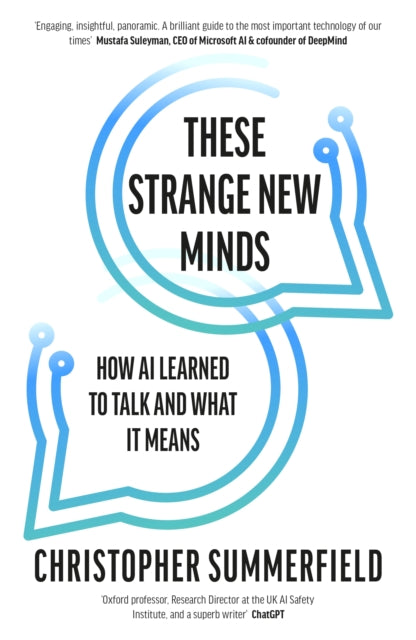
Christopher Summerfield
These Strange New Minds: How AI Learned to Talk and What It Means
These Strange New Minds: How AI Learned to Talk and What It Means
💎 Earn 77 Points (£0.77) on this item.
YOU SAVE £6.42
- Condition: Brand new
- UK Delivery times: Usually arrives within 2 - 3 working days
- UK Shipping: Fee starts at £2.39. Subject to product weight & dimension
Bulk ordering. Want 15 or more copies? Get a personalised quote and bigger discounts. Learn more about bulk orders.
Couldn't load pickup availability
- More about These Strange New Minds: How AI Learned to Talk and What It Means
AI expert Chris Summerfield takes readers on a tour of this astonishing new technology, helping them to understand the issues it raises.
AI expert Chris Summerfield takes readers on a tour of this astonishing new technology, helping them to understand the issues it raises.
Format: Hardback
Length: 384 pages
Publication date: 06 March 2025
Publisher: Penguin Books Ltd
‘An engaging, insightful and panoramic survey of where we are, why we got here and what it means. A brilliant guide to the most important technology of our times Mustafa Suleyman, CEO of Microsoft AI & Cofounder of DeepMind For readers fascinated by the future of AI, this book is an eye-opening exploration of a revolution unfolding before our eyes. New York Journal of Books Stunning advances in digital technology have given us a new wave of disarmingly human-like AI systems. Chatbots like ChatGPT, Claude and Gemini put the knowledge of all the world's experts at our fingertips, and can generate meaningful sentences, equations and computer code. The march of this new technology is set to upend our economies, challenge our democracies, and refashion society in unpredictable ways. We can expect these AI systems to soon be making autonomous decisions on the user's behalf, with transformative impact on everything we do. It is vital we understand how they work. Can AI systems 'think,' 'know' and 'understand'? Could they manipulate or deceive you, and if so, what might they make you do? Whose interests do they ultimately represent? And when will they be able to move beyond words and take actions for themselves in the real world? To answer these questions, neuroscientist and AI researcher Christopher Summerfield explains how these strange new minds work. He charts the evolution of AI, from the earliest inklings about thinking machines in the seventeenth century to today's gargantuan deep neural networks. The resulting book is the most accessible, up-to-date and authoritative exploration of this radical new technology. Ultimately, armed with an understanding of AI's mysterious inner workings, we can begin to grapple with the existential question of our age: can we look forward to a future where AI is a force for good? ‘An engaging, insightful and panoramic survey of where we are, why we got here and what it means. A brilliant guide to the most important technology of our times Mustafa Suleyman, CEO of Microsoft AI & Cofounder of DeepMind For readers fascinated by the future of AI, this book is an eye-opening exploration of a revolution unfolding before our eyes. New York Journal of Books Stunning advances in digital technology have given us a new wave of disarmingly human-like AI systems. Chatbots like ChatGPT, Claude and Gemini put the knowledge of all the world's experts at our fingertips, and can generate meaningful sentences, equations and computer code. The march of this new technology is set to upend our economies, challenge our democracies, and refashion society in unpredictable ways. We can expect these AI systems to soon be making autonomous decisions on the user's behalf, with transformative impact on everything we do. It is vital we understand how they work. Can AI systems 'think,' 'know' and 'understand'? Could they manipulate or deceive you, and if so, what might they make you do? Whose interests do they ultimately represent? And when will they be able to move beyond words and take actions for themselves in the real world? To answer these questions, neuroscientist and AI researcher Christopher Summerfield explains how these strange new minds work. He charts the evolution of AI, from the earliest inklings about thinking machines in the seventeenth century to today's gargantuan deep neural networks. The resulting book is the most accessible, up-to-date and authoritative exploration of this radical new technology. Ultimately, armed with an understanding of AI's mysterious inner workings, we can begin to grapple with the existential question of our age: can we look forward to a future where AI is a force for good?
AI is a rapidly evolving technology that has the potential to transform our world in profound ways. From chatbots like ChatGPT and Claude to deep neural networks, AI systems are becoming increasingly human-like and capable of making autonomous decisions on our behalf. This has the potential to upend our economies, challenge our democracies, and refashion society in unpredictable ways. However, it is important to understand how AI systems work and what their limitations are.
Neuroscientist and AI researcher Christopher Summerfield has written a book that provides an accessible, up-to-date, and authoritative exploration of this radical new technology. The book charts the evolution of AI from the earliest inklings about thinking machines in the seventeenth century to today's gargantuan deep neural networks. It explains how AI systems work, what their limitations are, and what their potential applications are.
One of the key challenges facing AI is the issue of "thinking, knowing, and understanding." Can AI systems really think, know, and understand like humans? Or are they just sophisticated machines that can mimic human behavior? Summerfield argues that AI systems can indeed think, know, and understand, but they do so in a different way than humans.
AI systems are built on a set of algorithms that are designed to process large amounts of data and make predictions based on that data. These algorithms are trained on vast amounts of data, which can include text, images, and videos. As they process this data, they learn to recognize patterns and make connections between different pieces of information.
One of the key advantages of AI is that it can make predictions that are more accurate than human predictions. This is because AI systems can process large amounts of data much faster than humans can. This can be useful in a variety of applications, such as healthcare, finance, and transportation.
However, there are also some limitations to AI. One of the biggest limitations is that AI systems are only as good as the data that they are trained on. If the data is inaccurate or incomplete, the AI system will make inaccurate predictions. This can have serious consequences in areas such as healthcare, where incorrect diagnoses can have fatal consequences.
Another limitation of AI is that it can be difficult to explain how it makes its decisions. AI systems are built on a set of algorithms that are designed to make predictions based on a set of rules. However, it can be difficult to understand how these rules are applied to a particular situation. This can lead to a lack of trust in AI systems and can make it difficult for them to be used in sensitive areas such as healthcare and finance.
Despite these limitations, AI has the potential to transform our world in profound ways. It can help us to solve complex problems, improve our productivity, and make our lives easier. However, it is important to approach AI with caution and to ensure that it is used in a responsible and ethical manner.
One of the ways that we can ensure that AI is used in a responsible and ethical manner is to invest in research and development. This can help to improve the accuracy of AI systems and to develop new applications that can benefit society. It can also help to address some of the ethical concerns that are associated with AI, such as the issue of job displacement.
In addition to investing in research and development, we can also take steps to ensure that AI is used in a transparent and accountable manner. This can include developing guidelines and regulations for the use of AI and ensuring that AI systems are transparent and explainable.
Another way that we can ensure that AI is used in a responsible and ethical manner is to educate people about AI. This can include providing training to people who work with AI systems and providing education to the public about the potential benefits and risks of AI.
In conclusion, AI is a rapidly evolving technology that has the potential to transform our world in profound ways. While there are some limitations to AI, it is important to approach AI with caution and to ensure that it is used in a responsible and ethical manner. By investing in research and development, taking steps to ensure that AI is used in a transparent and accountable manner, and educating people about AI, we can help to ensure that AI is a force for good.
Weight: 598g
Dimension: 162 x 242 x 36 (mm)
ISBN-13: 9780241694657
UK and International shipping information
UK and International shipping information
UK Delivery and returns information:
- Delivery within 2 - 3 days when ordering in the UK.
- Shipping fee for UK customers from £2.39. Fully tracked shipping service available.
- Returns policy: Return within 30 days of receipt for full refund.
International deliveries:
Shulph Ink now ships to Australia, Belgium, Canada, France, Germany, Ireland, Italy, India, Luxembourg Saudi Arabia, Singapore, Spain, Netherlands, New Zealand, United Arab Emirates, United States of America.
- Delivery times: within 5 - 10 days for international orders.
- Shipping fee: charges vary for overseas orders. Only tracked services are available for most international orders. Some countries have untracked shipping options.
- Customs charges: If ordering to addresses outside the United Kingdom, you may or may not incur additional customs and duties fees during local delivery.