Sonya Newland
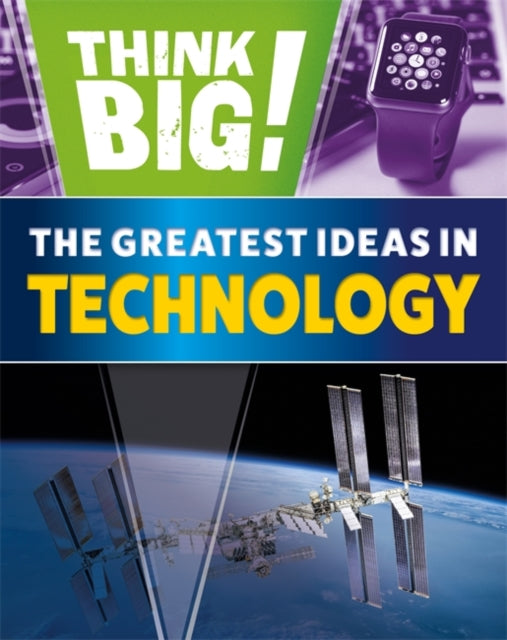
Think Big!: The Greatest Ideas in Technology
Think Big!: The Greatest Ideas in Technology
💎 Earn 53 Points (£0.53) on this item.
YOU SAVE £2.26
- Condition: Brand new
- UK Delivery times: Usually arrives within 2 - 3 working days
- UK Shipping: Fee starts at £3.89. Subject to product weight & dimension
Bulk ordering. Want 15 or more copies? Get a personalised quote and bigger discounts. Learn more about bulk orders.
Couldn't load pickup availability
- More about Think Big!: The Greatest Ideas in Technology
The Greatest Ideas in Technology explores the most influential inventions of the past 100 years, from the first televisions and mobile phones to intelligent gadgets in every corner of a smart home. It highlights the great thinkers behind the ideas, from scientists to inventors, environmentalists, and engineers, and includes activities to inspire readers aged 9 and older to nurture their own big thinking and entrepreneurial spirit.
Format: Hardback
Length: 32 pages
Publication date: 13 January 2022
Publisher: Hachette Children's Group
The Greatest Ideas in Technology takes you on a journey through the most influential inventions of the past 100 years, exploring technology that has changed how we live, work, travel, and communicate. From Apollo 11's historic flight to the wonders of the world wide web, the world has changed beyond recognition in the past hundred years. Think Big takes a close-up look at the amazing ideas that have transformed the way we all live. Each spread explores a big idea in greater depth, explaining how it came to be and what evolved from it, and assessing its impact on the world today. Genius panels highlight the great thinkers behind the ideas, from scientists to inventors, environmentalists, and engineers. Each book includes carefully selected activities designed to inspire readers aged 9 and older and encourage them to nurture their own big thinking and entrepreneurial spirit.
Contents:
Technology:
Television: The television was one of the most significant inventions of the 20th century, revolutionizing how we consume media and communicate. It began with the development of mechanical television in the 1920s and 1930s, followed by the introduction of electronic television in the 1940s. The invention of color television in the 1950s and the rise of cable and satellite TV in the 1980s and 1990s further expanded its reach. Today, television is a staple in most homes and has become an essential tool for news, entertainment, education, and advertising.
Shinkansen: The Shinkansen, or "bullet train," is a high-speed train system that operates in Japan. It was developed in the 1960s and 1970s as a response to the country's growing population and traffic congestion. The Shinkansen uses advanced technology to achieve speeds of up to 350 kilometers per hour (220 miles per hour), making it the fastest train in the world. It has significantly reduced travel times between major cities and has played a crucial role in promoting economic growth and tourism in Japan.
Saturn V: The Saturn V was the most powerful rocket ever built by the United States. It was used for the Apollo 11 mission, which sent the first humans to the moon in 1969. The Saturn V was designed to carry a crew of three and a payload of over 100,000 kilograms (220,000 pounds) into space. It was powered by five F-1 engines and used a combination of liquid hydrogen and liquid oxygen as fuel. The Saturn V's success was a major milestone in the space race between the United States and the Soviet Union.
Motorola DynaTAC: The Motorola DynaTAC was the first mobile phone to be commercially available. It was introduced in 1983 by Motorola and was a significant breakthrough in communication technology. The DynaTAC was small and portable, allowing users to make phone calls anywhere in the world. It was also the first phone to use digital technology, which allowed for better sound quality and more features. The DynaTAC's success paved the way for the development of modern smartphones and mobile devices.
Apple Macintosh: The Apple Macintosh was the first personal computer to be sold by a major consumer electronics company. It was introduced in 1984 by Steve Jobs and Steve Wozniak. The Macintosh was designed to be user-friendly and easy to use, with a graphical user interface (GUI) that made it accessible to a wide range of users. It was also the first computer to use a mouse, which made it more intuitive and easier to navigate. The Macintosh's success paved the way for the development of modern personal computers and the rise of the personal computing industry.
World Wide Web: The World Wide Web was invented by Tim Berners-Lee in 1989. It is a network of web pages and resources that are accessible through the Internet. The Web allows users to access information and communicate with others from anywhere in the world. It has revolutionized the way we work, learn, and communicate, and has become an essential tool for businesses, governments, and individuals alike.
Toyota Prius: The Toyota Prius is a hybrid electric vehicle that was first introduced in 1997. It is one of the most popular and environmentally friendly cars in the world. The Prius is designed to run on both electricity and gasoline, and it is known for its high fuel efficiency and low emissions. The Prius has played a significant role in promoting the use of hybrid vehicles and reducing greenhouse gas emissions.
MP3: The MP3 (MPEG-1 Audio Layer III) is a digital audio file format that was developed by the MPEG-1 Audio Layer III Working Group in 1993. It is a lossy compression format that allows for the storage and playback of high-quality audio files with a smaller file size than traditional audio formats such as WAV or AIFF. The MP3 has become the standard audio format for music playback on digital devices such as smartphones, tablets, and computers.
Large Hadron Collider: The Large Hadron Collider (LHC) is a particle accelerator located near Geneva, Switzerland. It was built by the European Organization for Nuclear Research (CERN) and began operations in 2008. The LHC is the largest and most powerful particle accelerator in the world, and it is used to study the fundamental properties of matter and the universe. The LHC has made significant discoveries in physics, including the discovery of the Higgs boson, a key component of the Standard Model of physics.
International Space Station: The International Space Station (ISS) is a multinational space station that orbits the Earth. It was launched in 1998 and is currently inhabited by a crew of six astronauts from Russia, the United States, Japan, Canada, and Europe. The ISS is used for scientific research, space exploration, and technology development. It has played a crucial role in advancing our understanding of space and the universe and has also provided valuable opportunities for collaboration and cooperation between different countries.
Nest Learning Thermostat: The Nest Learning Thermostat is a smart thermostat that was developed by Nest Labs. It was first introduced in 2011 and is designed to learn the preferences of its users and adjust its temperature settings automatically. The Nest Learning Thermostat uses sensors and algorithms to monitor the temperature and energy usage of a home and adjust its settings accordingly. It has become popular for its energy-efficient design and its ability to save users money on their energy bills.
Siri: Siri is a voice-activated personal assistant that was developed by Apple Inc. It was first introduced on the iPhone 4S in 2011. Siri allows users to perform tasks such as making phone calls, sending messages, setting reminders, and controlling smart home devices using voice commands. It has become popular for its intuitive interface and its ability to understand natural language.
In conclusion, the past hundred years have seen a remarkable transformation in technology, with inventions such as the television, mobile phones, the internet, and personal computers changing the way we live, work, and communicate. These inventions have not only improved our quality of life but have also had a significant impact on the world around us. From the development of the Shinkansen to the discovery of the Higgs boson, technology has continued to push the boundaries of what is possible and has opened up new opportunities for innovation and discovery. As we look to the future, it is clear that technology will continue to play a crucial role in shaping our world, and it will be exciting to see what new inventions and discoveries will emerge in the years to come.
Weight: 342g
Dimension: 217 x 273 x 12 (mm)
ISBN-13: 9781526316936
UK and International shipping information
UK and International shipping information
We deliver throughout the United Kingdom and to 128 countries and territories worldwide, including the United States, Australia, Canada, Germany, Spain and France.