MatthewWard
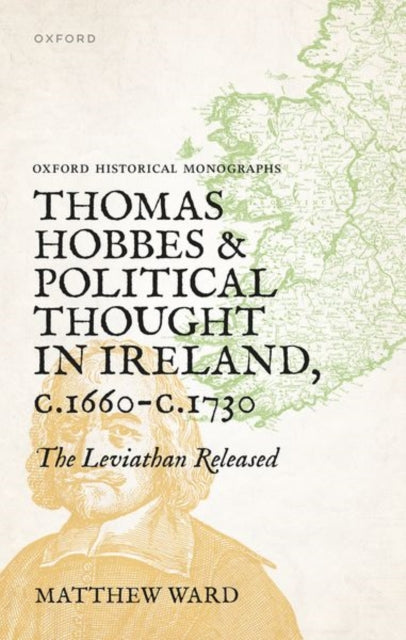
Thomas Hobbes and Political Thought in Ireland c.1660- c.1730: The Leviathan Released
Thomas Hobbes and Political Thought in Ireland c.1660- c.1730: The Leviathan Released
💎 Earn 531 Points (£5.31) on this item.
We can order this item for you. Delivery usually takes about 4 to 6 weeks.
This item is not held in our immediate stock. We will order it for you after checkout.
Estimated delivery: About 4 to 6 weeks
- Condition: Brand new
- UK Delivery times: Usually arrives within 2 - 3 working days
- UK Shipping: Fee starts at £3.89. Subject to product weight & dimension
Bulk ordering. Want 15 or more copies? Get a personalised quote and bigger discounts. Learn more about bulk orders.
Couldn't load pickup availability
- More about Thomas Hobbes and Political Thought in Ireland c.1660- c.1730: The Leviathan Released
A history of political thought in Ireland, c.1660-1730, is presented from the perspective of the reception of Thomas Hobbes, the English philosopher. Despite the assumption that there is not much to study, Matthew Ward highlights the variety and sophistication of political thought in Ireland. Hobbes' political thought was preoccupied with sovereignty, which he conceptualized in terms of natural law and made the defining characteristic of the commonwealth. His readers in Ireland read him closely and compulsively, often fixating on his treatment of subjects that were overlooked by his readers in England. The reception of Hobbes in Ireland also tells of the distinctiveness of Ireland as a context of political thought, as his readers were not only concerned with a distinctive selection of subjects but also received him more positively than his readers in England. Sir William Petty, John Vesey, and Edward Synge were key figures in the reception of Hobbes in Ireland, engaging with aspects and implications of his concept of sovereignty to intervene in Irish politics.
Format: Hardback
Length: 304 pages
Publication date: 25 January 2024
Publisher: Oxford University Press
A History of Political Thought in Ireland, c.1660-1730, explores the reception of Thomas Hobbes' ideas in Ireland during the 17th and 18th centuries. Contrary to popular belief, political thought in Ireland has received relatively little attention from historians, with some assuming that there is not much to study. However, the reception of Hobbes in Ireland challenges this notion. Matthew Ward emphasizes the diversity and sophistication of political thought in Ireland during this period. Hobbes, an English philosopher, was particularly interested in sovereignty, which he conceptualized in terms of natural law and considered the defining characteristic of the commonwealth or the Leviathan. However, his political thought extended beyond sovereignty to encompass a wide range of political issues. Hobbes' readers in Ireland were deeply engaged with his works and read him closely and compulsively. They were particularly interested in his treatment of subjects such as taxation, corporations, and the organization of empire, which were overlooked by his readers in England. The reception of Hobbes in Ireland also sheds light on the distinctiveness of Ireland as a context of political thought. Hobbes' readers in Ireland were not only concerned with a distinctive selection of subjects but also received him more positively than his readers in England. In England, Hobbes' concept of sovereignty was criticized for undermining Parliament, the Anglican Church, and the common law. The Leviathan, considered too compelling to ignore, had to be tamed. In contrast, in Ireland, where these institutions were weaker, the Leviathan could be reinterpreted and reimagined in ways that were more compatible with Irish political and social structures. This reinterpretation of Hobbes' ideas in Ireland reflects the country's unique historical and cultural context and highlights the importance of considering the local reception of philosophical ideas in the study of political thought. Overall, A History of Political Thought in Ireland, c.1660-1730, provides valuable insights into the reception of Thomas Hobbes' ideas in Ireland and challenges the notion that political thought in Ireland is insignificant or unworthy of study. It demonstrates the richness and complexity of political thought in Ireland during this period and highlights the importance of considering the local context in the interpretation of philosophical ideas.
Weight: 510g
Dimension: 146 x 224 x 24 (mm)
ISBN-13: 9780198904120
UK and International shipping information
UK and International shipping information
We deliver throughout the United Kingdom and to 128 countries and territories worldwide, including the United States, Australia, Canada, Germany, Spain and France.