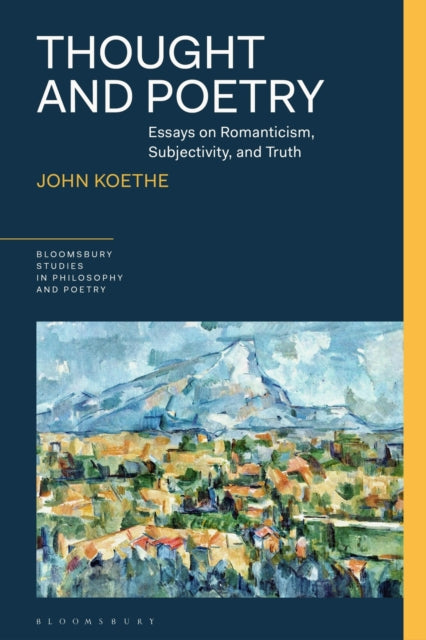
JohnKoethe
Thought and Poetry: Essays on Romanticism, Subjectivity, and Truth
Thought and Poetry: Essays on Romanticism, Subjectivity, and Truth
💎 Earn 504 Points (£5.04) on this item.
We can order this item for you. Delivery usually takes about 4 to 6 weeks.
This item is not held in our immediate stock. We will order it for you after checkout.
Estimated delivery: About 4 to 6 weeks
- Condition: Brand new
- UK Delivery times: Usually arrives within 2 - 3 working days
- UK Shipping: Fee starts at £2.39. Subject to product weight & dimension
Bulk ordering. Want 15 or more copies? Get a personalised quote and bigger discounts. Learn more about bulk orders.
Couldn't load pickup availability
- More about Thought and Poetry: Essays on Romanticism, Subjectivity, and Truth
This collection explores the connections between philosophy and poetry, addressing objective and subjective views of the self and the world. It highlights the theme of romanticism and the sublime and defends a non-rigorous approach to philosophically writing about poetry.
Format: Hardback
Length: 210 pages
Publication date: 21 April 2022
Publisher: Bloomsbury Publishing PLC
This collection, spanning a chronology of John Koethe's thoughts on the connections between philosophy and poetry, aims to challenge the dichotomies that often separate these two fields. Through a thoughtful exploration of the philosophical conception of the self in modern poetry, the essays identify resonances between poets such as William Wordsworth, Wallace Stevens, and John Ashbery, as well as philosophers like Kant, Schopenhauer, and Wittgenstein. Koethe delves particularly into the realm of romantic poetry and the concept of the sublime, linking these to subjective individual experiences and the objective perspective on the natural world. In a subsequent essay, he further explores this theme in relation to the mind-body problem, employing an associative and impressionistic style to write philosophically about poetry. Koethe firmly establishes his approach, emphasizing that such writing should not strive for the rigor of philosophical argumentation. By bridging the gap between philosophy and poetry, this collection makes a substantial contribution to unsettling the oppositions that exist between these two realms and offers a fresh perspective on the interplay between the self and the world.
Introduction:
This collection explores the intricate connections between philosophy and poetry, addressing both objective and subjective perspectives of the self and the world. By bringing together a chronology of John Koethe's thoughts on the subject, the book aims to challenge the dichotomies that often separate these two fields. Through a thoughtful exploration of the philosophical conception of the self in modern poetry, the essays identify resonances between poets such as William Wordsworth, Wallace Stevens, and John Ashbery, as well as philosophers like Kant, Schopenhauer, and Wittgenstein. Koethe delves particularly into the realm of romantic poetry and the concept of the sublime, linking these to subjective individual experiences and the objective perspective on the natural world. In a subsequent essay, he further explores this theme in relation to the mind-body problem, employing an associative and impressionistic style to write philosophically about poetry. Koethe firmly establishes his approach, emphasizing that such writing should not strive for the rigor of philosophical argumentation. By bridging the gap between philosophy and poetry, this collection makes a substantial contribution to unsettling the oppositions that exist between these two realms and offers a fresh perspective on the interplay between the self and the world.
Philosophical Conception of the Self in Modern Poetry:
In the essays included in this collection, Koethe examines the philosophical conception of the self in modern poetry. He explores how poets such as Wordsworth, Stevens, and Ashbery portray the self in their works and how these portrayals align with philosophical ideas. Koethe highlights the ways in which poets use language and imagery to convey subjective experiences and how these experiences can be understood in light of philosophical concepts. For instance, he discusses how Wordsworth's poetry portrays the self as interconnected with nature, emphasizing the importance of subjective experience in understanding the world. Similarly, Koethe analyzes how Stevens's poetry employs abstract language and imagery to convey the self's relationship with the world, highlighting the subjective nature of perception and the limitations of objective knowledge.
Connections between Poets and Philosophers:
One of the key themes of this collection is the connections between poets and philosophers. Koethe identifies resonances between the ideas of poets and philosophers, highlighting how both fields can contribute to a deeper understanding of the self and the world. For example, he discusses how Wordsworth's philosophy of nature aligns with Stevens's poetry, emphasizing the importance of subjective experience in understanding the natural world. Koethe also explores how Schopenhauer's philosophy of the will aligns with Ashbery's poetry, highlighting the subjective nature of human experience and the limitations of rationality.
Romantic Poetry and the Sublime:
Koethe pays particular attention to romantic poetry and the concept of the sublime. He argues that romantic poetry captures the subjective experience of the self in relation to the natural world, emphasizing the importance of the individual's subjective perception and interpretation of the world. Koethe further explores how the sublime can be understood in light of philosophical concepts, highlighting how it can be seen as a manifestation of the limitations of human understanding and the power of the natural world.
Conclusion:
In conclusion, this collection offers a rich and insightful exploration of the connections between philosophy and poetry. By challenging the dichotomies that often separate these two fields, the book provides a fresh perspective on the interplay between the self and the world. Through a thoughtful examination of the philosophical conception of the self in modern poetry, the connections between poets and philosophers, and the theme of the sublime, the collection offers valuable insights into the nature of subjective experience and the objective perspective on the natural world. This collection is a must-read for anyone interested in the intersection of philosophy and literature, as well as anyone seeking to deepen their understanding of the human experience.
Dimension: 234 x 156 (mm)
ISBN-13: 9781350262447
This item can be found in:
UK and International shipping information
UK and International shipping information
UK Delivery and returns information:
- Delivery within 2 - 3 days when ordering in the UK.
- Shipping fee for UK customers from £2.39. Fully tracked shipping service available.
- Returns policy: Return within 30 days of receipt for full refund.
International deliveries:
Shulph Ink now ships to Australia, Belgium, Canada, France, Germany, Ireland, Italy, India, Luxembourg Saudi Arabia, Singapore, Spain, Netherlands, New Zealand, United Arab Emirates, United States of America.
- Delivery times: within 5 - 10 days for international orders.
- Shipping fee: charges vary for overseas orders. Only tracked services are available for most international orders. Some countries have untracked shipping options.
- Customs charges: If ordering to addresses outside the United Kingdom, you may or may not incur additional customs and duties fees during local delivery.