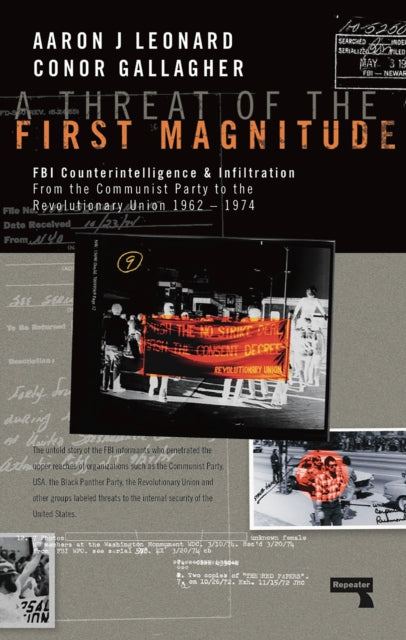
Aaron J. Leonard,Conor A. Gallagher
Threat of the First Magnitude: FBI Counterintelligence & Infiltration From the Communist Party to the Revolutionary Union - 1962-1974
Threat of the First Magnitude: FBI Counterintelligence & Infiltration From the Communist Party to the Revolutionary Union - 1962-1974
💎 Earn 67 Points (£0.67) on this item.
YOU SAVE £5.44
- Condition: Brand new
- UK Delivery times: Usually arrives within 2 - 3 working days
- UK Shipping: Fee starts at £2.39. Subject to product weight & dimension
Bulk ordering. Want 15 or more copies? Get a personalised quote and bigger discounts. Learn more about bulk orders.
Couldn't load pickup availability
- More about Threat of the First Magnitude: FBI Counterintelligence & Infiltration From the Communist Party to the Revolutionary Union - 1962-1974
In the late 1960s, the FBI created a fake Maoist organization called the Ad Hoc Committee for Scientific Socialist Line to infiltrate the highest levels of the Communist Party USA, the Black Panther Party, and other groups labeled threats to the internal security of the United States. This book provides a view of the historic inner-workings of the Bureau's counterintelligence operations, which matches or exceeds the sophistication of any contenders.
Format: Paperback / softback
Length: 330 pages
Publication date: 16 January 2018
Publisher: Watkins Media
In the late fall or early winter of 1962, a document titled "Whither the Party of Lenin" began circulating among members of the Communist Party USA (CPUSA) based in the Chicago area. The document was signed by The Ad Hoc Committee for Scientific Socialist Line, indicating that it was not the work of factionally inclined CP comrades but rather something conceived by the FBI's counter-intelligence imagination.
"A Threat of the First Magnitude" delves into the story of the FBI's fake Maoist organization and the informants they used to penetrate the highest levels of the CPUSA, the Black Panther Party, the Revolutionary Union, and other groups labeled threats to the internal security of the United States in the 1960s and 1970s. As the FBI once again finds itself in the spotlight of US politics, "A Threat of the First Magnitude" provides a comprehensive view of the historic inner workings of the Bureau's counterintelligence operations. It encompasses a range of techniques, from generating fake news and utilizing sensitive intelligence methods to handling reliable sources. The book's level of sophistication in this regard is unmatched by any other contenders, offering a deep insight into the FBI's tactics and strategies during a crucial period of American history.
The CPUSA, which had a significant presence in the Chicago area, was a target of intense FBI scrutiny during the 1960s and 1970s. The Bureau saw the party as a potential threat to national security, particularly due to its Marxist-Leninist ideology and its support for radical social and political movements. To gather information and disrupt the CPUSA's activities, the FBI created a fake Maoist organization called the "Weather Underground."
The Weather Underground was a group of left-wing activists who believed in armed revolution and the overthrow of the US government. The FBI recruited several members of the group, including Bernardine Dohrn, Bill Ayers, and Mary Daly, who were known for their radical views and involvement in various anti-war and social justice movements.
The FBI used these informants to penetrate the CPUSA and other left-wing organizations. They provided the Bureau with valuable intelligence, including information about the party's internal structure, its plans and activities, and the identities of its members. The FBI also used the informants to spread false information and create dissension within the CPUSA and other left-wing groups.
One of the most significant aspects of the FBI's counterintelligence operations was its use of sensitive intelligence methods. The Bureau employed a range of techniques, including wiretapping, surveillance, and infiltration, to gather information about its targets. These methods were often controversial and faced legal challenges, but the FBI argued that they were necessary to protect national security.
One of the most famous examples of the FBI's use of sensitive intelligence methods was its surveillance of Martin Luther King Jr. and the Civil Rights Movement. The Bureau used wiretaps, surveillance, and infiltration to gather information about King's activities and his associates, including Rosa Parks and John Lewis. The Bureau also used this information to discredit King and his movement, and to undermine their efforts to achieve civil rights.
Another example of the FBI's use of sensitive intelligence methods was its infiltration of the Black Panther Party. The Bureau created a fake organization called the "Community Action Project" (CAP) to infiltrate the Black Panther Party and gather information about its activities and members. The CAP was led by a former FBI agent named J. Edgar Hoover, who used his position to manipulate and control the Black Panther Party's leadership.
The FBI's counterintelligence operations also involved the use of informants. The Bureau recruited a range of individuals, including former members of the CPUSA, Black Panther Party, and other left-wing organizations, to provide information to the Bureau. These informants were often paid for their information and were promised immunity from prosecution if they provided useful information.
However, the use of informants also had its drawbacks. Informants could be unreliable, and their information could be false or misleading. The FBI had to be careful not to rely too heavily on informants, as they could be used to manipulate and control their targets. Additionally, the use of informants could create tensions within the left-wing movement, as some members may feel betrayed by their former colleagues.
Despite these challenges, the FBI's counterintelligence operations were successful in disrupting the CPUSA and other left-wing organizations. The Bureau's use of sensitive intelligence methods and informants helped it gather valuable intelligence and prevent terrorist attacks and other acts of violence. However, the operations also raised important ethical and legal questions about the balance between national security and individual rights.
In conclusion, "A Threat of the First Magnitude" provides a detailed and comprehensive account of the FBI's fake Maoist organization and the informants it used to penetrate the highest levels of the CPUSA, the Black Panther Party, the Revolutionary Union, and other groups labeled threats to the internal security of the United States in the 1960s and 1970s. The book offers a view of the historic inner workings of the Bureau's counterintelligence operations that matches or exceeds the sophistication of any contenders. The use of fake news, sensitive intelligence methods, and informants by the FBI was controversial and faced legal challenges, but the Bureau argued that they were necessary to protect national security. However, the operations also raised important ethical and legal questions about the balance between national security and individual rights. As the FBI continues to play a significant role in US politics, it is important to consider the impact of its counterintelligence operations on the rights and freedoms of individuals and communities.
Weight: 310g
Dimension: 126 x 197 x 25 (mm)
ISBN-13: 9781910924709
This item can be found in:
UK and International shipping information
UK and International shipping information
UK Delivery and returns information:
- Delivery within 2 - 3 days when ordering in the UK.
- Shipping fee for UK customers from £2.39. Fully tracked shipping service available.
- Returns policy: Return within 30 days of receipt for full refund.
International deliveries:
Shulph Ink now ships to Australia, Belgium, Canada, France, Germany, Ireland, Italy, India, Luxembourg Saudi Arabia, Singapore, Spain, Netherlands, New Zealand, United Arab Emirates, United States of America.
- Delivery times: within 5 - 10 days for international orders.
- Shipping fee: charges vary for overseas orders. Only tracked services are available for most international orders. Some countries have untracked shipping options.
- Customs charges: If ordering to addresses outside the United Kingdom, you may or may not incur additional customs and duties fees during local delivery.