MayDarwich
Threats and Alliances in the Middle East: Saudi and Syrian Policies in a Turbulent Region
Threats and Alliances in the Middle East: Saudi and Syrian Policies in a Turbulent Region
💎 Earn 160 Points (£1.60) on this item.
We can order this item for you. Delivery usually takes about 4 to 6 weeks.
This item is not held in our immediate stock. We will order it for you after checkout.
Estimated delivery: About 4 to 6 weeks
YOU SAVE £1.90
- Condition: Brand new
- UK Delivery times: Usually arrives within 2 - 3 working days
- UK Shipping: Fee starts at £2.39. Subject to product weight & dimension
Bulk ordering. Want 15 or more copies? Get a personalised quote and bigger discounts. Learn more about bulk orders.
Couldn't load pickup availability
- More about Threats and Alliances in the Middle East: Saudi and Syrian Policies in a Turbulent Region
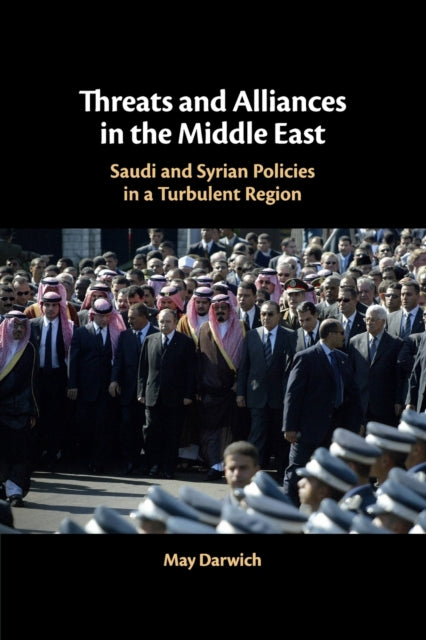
Examining how ideational and material forces influence leaders' perceptions of threats and alliance choices in the Middle East, particularly during the Iran-Iraq War, Lebanon War, and Gaza War, May Darwich's study highlights the role of identity in shaping perceptions of threat. It has implications for international relations theory and beyond.
Format: Paperback / softback
Length: 220 pages
Publication date: 29 October 2020
Publisher: Cambridge University Press
Examining the divergent perceptions of threats and the subsequent alliance choices of two Arab states, Saudi Arabia and Syria, during three pivotal wars in the region: the Iran-Iraq War (1980-1988), the Lebanon War (2006), and the Gaza War (2009), May Darwich delves into the intricate interplay between ideational and material forces that shape leaders' perceptions in the Middle East and their broader international relationships. Through comprehensive comparative case studies, Darwich seeks to enhance our understanding of why and under what conditions identity can assume a dominant role in shaping the perception of threat, while material power takes precedence in other instances. By engaging in robust discussions about the interplay between identity and material power in shaping state behavior in the Middle East, this study holds significant implications for international relations theory and beyond.
The Iran-Iraq War (1980-1988) marked a significant period of conflict in the Middle East, with both Iran and Iraq claiming territorial ambitions and religious affiliations. The war was characterized by intense military action, including aerial bombings, ground battles, and chemical weapons deployments. Saudi Arabia, a close ally of the United States, played a pivotal role in the coalition that formed to oppose Iraq, providing financial and logistical support to the US-led military effort.
During the war, Saudi Arabia's perception of the threat posed by Iraq was influenced by several factors. Firstly, the country was concerned about the spread of Shi'ite Islam, which it viewed as a threat to its Sunni-dominated regime. Secondly, Saudi Arabia was concerned about the potential for Iraq to acquire weapons of mass destruction (WMD), which it believed could be used against it or its allies. Thirdly, Saudi Arabia was concerned about the destabilization of the region, which it saw as a potential threat to its own security and economic interests.
As a result of these perceived threats, Saudi Arabia aligned itself with the United States and other coalition members to oppose Iraq. The country provided financial and logistical support to the US-led military effort, including the deployment of Saudi troops to the Gulf region. Saudi Arabia's involvement in the war was motivated by its desire to protect its own security and interests, as well as to promote regional stability.
However, the war also had significant consequences for Saudi Arabia and the region. The war led to the deaths of thousands of Saudi and Iraqi soldiers, as well as civilians, and caused significant economic damage to both countries. The war also contributed to the rise of extremist groups, such as al-Qaeda, which later launched attacks on Saudi Arabia and other Western countries.
The Lebanon War (2006) was another conflict that significantly impacted the Middle East. The war was triggered by the assassination of Lebanese Prime Minister Rafic Hariri, who was believed to have been killed by members of the Syrian government. The conflict quickly escalated, with Hezbollah, a Shi'ite Muslim militant group supported by Syria, launching attacks on Israel.
Saudi Arabia's perception of the threat posed by Hezbollah and Syria during the Lebanon War was influenced by several factors. Firstly, Saudi Arabia was concerned about the spread of Shi'ite Islam, which it viewed as a threat to its Sunni-dominated regime. Secondly, Saudi Arabia was concerned about the potential for Hezbollah to acquire weapons of mass destruction (WMD), which it believed could be used against it or its allies. Thirdly, Saudi Arabia was concerned about the destabilization of the region, which it saw as a potential threat to its own security and economic interests.
As a result of these perceived threats, Saudi Arabia aligned itself with Israel and other Western countries to oppose Hezbollah and Syria. The country provided financial and logistical support to the Israeli military effort, including the deployment of Saudi troops to Lebanon. Saudi Arabia's involvement in the war was motivated by its desire to protect its own security and interests, as well as to promote regional stability.
However, the war also had significant consequences for Saudi Arabia and the region. The war led to the deaths of thousands of Lebanese and Israeli soldiers, as well as civilians, and caused significant economic damage to both countries. The war also contributed to the rise of extremist groups, such as Hezbollah, which later launched attacks on Saudi Arabia and other Western countries.
The Gaza War (2009) was a conflict that erupted between Israel and Hamas, a Palestinian militant group. The war was characterized by intense military action, including aerial bombings, ground battles, and rocket attacks. Saudi Arabia's perception of the threat posed by Hamas during the Gaza War was influenced by several factors. Firstly, Saudi Arabia was concerned about the spread of Shi'ite Islam, which it viewed as a threat to its Sunni-dominated regime. Secondly, Saudi Arabia was concerned about the potential for Hamas to acquire weapons of mass destruction (WMD), which it believed could be used against it or its allies. Thirdly, Saudi Arabia was concerned about the destabilization of the region, which it saw as a potential threat to its own security and economic interests.
As a result of these perceived threats, Saudi Arabia aligned itself with Israel and other Western countries to oppose Hamas. The country provided financial and logistical support to the Israeli military effort, including the deployment of Saudi troops to Gaza. Saudi Arabia's involvement in the war was motivated by its desire to protect its own security and interests, as well as to promote regional stability.
However, the war also had significant consequences for Saudi Arabia and the region. The war led to the deaths of thousands of Palestinian and Israeli soldiers, as well as civilians, and caused significant economic damage to both countries. The war also contributed to the rise of extremist groups, such as Hamas, which later launched attacks on Saudi Arabia and other Western countries.
In conclusion, the Iran-Iraq War, the Lebanon War, and the Gaza War were three pivotal conflicts that significantly impacted the Middle East. Saudi Arabia's perception of the threat posed by these conflicts was influenced by several factors, including its concerns about the spread of Shi'ite Islam, the potential for WMD acquisition, and regional destabilization. The country's alliance choices were motivated by its desire to protect its own security and interests, as well as to promote regional stability. However, these conflicts also had significant consequences for Saudi Arabia and the region, including the deaths of thousands of soldiers and civilians, economic damage, and the rise of extremist groups.
Weight: 330g
Dimension: 152 x 229 x 15 (mm)
ISBN-13: 9781108737630
UK and International shipping information
UK and International shipping information
UK Delivery and returns information:
- Delivery within 2 - 3 days when ordering in the UK.
- Shipping fee for UK customers from £2.39. Fully tracked shipping service available.
- Returns policy: Return within 30 days of receipt for full refund.
International deliveries:
Shulph Ink now ships to Australia, Belgium, Canada, France, Germany, Ireland, Italy, India, Luxembourg Saudi Arabia, Singapore, Spain, Netherlands, New Zealand, United Arab Emirates, United States of America.
- Delivery times: within 5 - 10 days for international orders.
- Shipping fee: charges vary for overseas orders. Only tracked services are available for most international orders. Some countries have untracked shipping options.
- Customs charges: If ordering to addresses outside the United Kingdom, you may or may not incur additional customs and duties fees during local delivery.