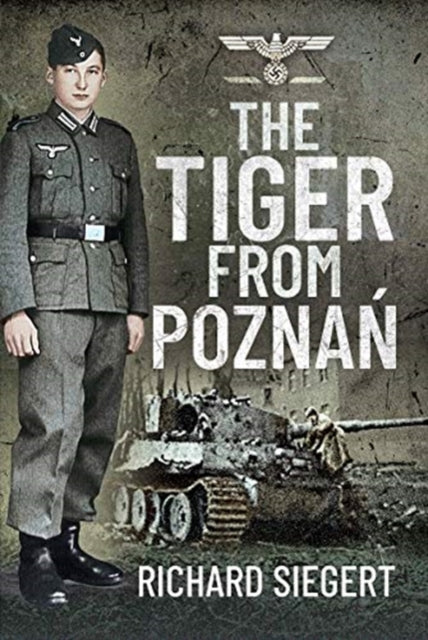
Richard Siegert
Tiger from Pozna?
Tiger from Pozna?
💎 Earn 70 Points (£0.70) on this item.
YOU SAVE £5.84
- Condition: Brand new
- UK Delivery times: Usually arrives within 2 - 3 working days
- UK Shipping: Fee starts at £2.39. Subject to product weight & dimension
Bulk ordering. Want 15 or more copies? Get a personalised quote and bigger discounts. Learn more about bulk orders.
Couldn't load pickup availability
- More about Tiger from Pozna?
During the Second World War, Pozna? was a crucial river crossing and railway junction on the Polish-German border. When the Red Army approached in January 1945, the city's 80-100,000 German civilians were evacuated, leaving a garrison of 15,000 men to face a siege by a superior and ruthless enemy. This is the account of Eastern Front veteran Richard Siegert, the gunner and later commander of the defenders' sole Tiger tank, the only survivor of that crew able to pass its record on to posterity. The crew fought gallantly against impossible odds, even when the Tiger was immobilized and could only act as a stationary anti-tank gun post or pillbox during the last heroic days of fighting for the citadel.
\n Format: Hardback
\n Length: 184 pages
\n Publication date: 11 August 2021
\n Publisher: Pen & Sword Books Ltd
\n
In the Second World War, Pozna? played a crucial role as a river crossing and railway junction on the Polish-German border. As the Red Army approached in January 1945, the city's 80-100,000 German civilians were swiftly evacuated, leaving behind a garrison of approximately 15,000 men, primarily poorly-armed infantry. Faced with a siege by a vastly superior and ruthless enemy eager to acquire this vital transport center, which was essential for advancing on Berlin, the garrison found themselves in a daunting situation.
This is the account of Eastern Front veteran Richard Siegert, who served as the gunner and later commander of the defenders' sole Tiger tank. Tragically, since the death of the driver in a futile attempt to escape from a POW camp in Russia shortly after the war's end, Siegert is the only survivor of that crew who can pass on its record to posterity. His account details the courageous battles the crew fought against seemingly insurmountable odds, even when the Tiger was immobilized and could only act as a stationary anti-tank gun post or pillbox during the final heroic days of fighting for the citadel.
The Tiger tank, named "Tiger I," was a formidable weapon in the hands of the German army during World War II. It was designed by the renowned German engineer Ferdinand Porsche and produced in large numbers between 1940 and 1945. The Tiger I featured a powerful 88 mm gun, thick armor, and a high-speed engine, making it a formidable opponent on the battlefield.
However, the Tiger I also had its weaknesses. One of its most significant flaws was its vulnerability to anti-tank weapons, particularly the Soviet Union's 76 mm gun and the American 90 mm gun. These weapons could penetrate the Tiger's armor at close range, causing significant damage and disabling the tank.
Despite these weaknesses, the Tiger I played a crucial role in the German offensive on the Eastern Front. It was used in conjunction with other German tanks, such as the Panther and the Panzer IV, to break through Soviet lines and advance toward Moscow. The Tiger I's speed and maneuverability made it a fearsome weapon in close combat, and its powerful gun could decimate enemy infantry and armor.
However, the Tiger I's success was also accompanied by significant losses. The tank was expensive to produce and maintain, and its high fuel consumption made it vulnerable to supply shortages. Additionally, the Tiger I was vulnerable to enemy air attacks, which could destroy or disable the tank with a single hit.
Despite these challenges, the Tiger I remained a symbol of German military power and was widely admired by both the German army and the enemy. Its appearance on the battlefield was a sight to behold, and its reputation as a fearsome tank continued to inspire fear and respect in the years to come.
In conclusion, the Tiger I was a formidable weapon in the hands of the German army during World War II. Its powerful gun, thick armor, and high-speed engine made it a terrifying opponent on the battlefield. However, its weaknesses to anti-tank weapons and supply shortages also made it vulnerable to defeat. Despite these challenges, the Tiger I played a crucial role in the German offensive on the Eastern Front and remains a symbol of German military power and innovation.
\n Weight: 530g\n
Dimension: 164 x 240 x 20 (mm)\n
ISBN-13: 9781526779175\n \n
UK and International shipping information
UK and International shipping information
UK Delivery and returns information:
- Delivery within 2 - 3 days when ordering in the UK.
- Shipping fee for UK customers from £2.39. Fully tracked shipping service available.
- Returns policy: Return within 30 days of receipt for full refund.
International deliveries:
Shulph Ink now ships to Australia, Belgium, Canada, France, Germany, Ireland, Italy, India, Luxembourg Saudi Arabia, Singapore, Spain, Netherlands, New Zealand, United Arab Emirates, United States of America.
- Delivery times: within 5 - 10 days for international orders.
- Shipping fee: charges vary for overseas orders. Only tracked services are available for most international orders. Some countries have untracked shipping options.
- Customs charges: If ordering to addresses outside the United Kingdom, you may or may not incur additional customs and duties fees during local delivery.