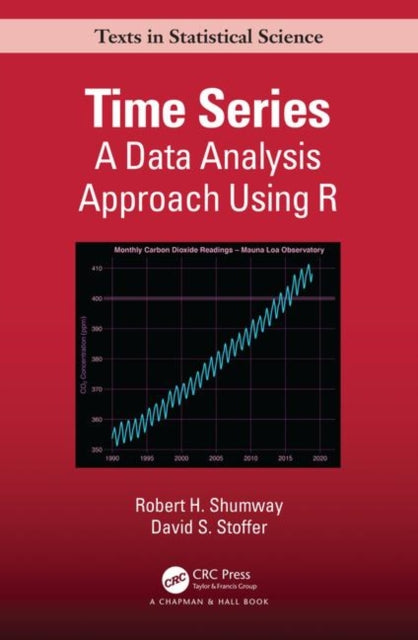
Robert Shumway,DavidStoffer
Time Series: A Data Analysis Approach Using R
Time Series: A Data Analysis Approach Using R
💎 Earn 363 Points (£3.63) on this item.
YOU SAVE £4.31
- Condition: Brand new
- UK Delivery times: Usually arrives within 2 - 3 working days
- UK Shipping: Fee starts at £2.39. Subject to product weight & dimension
Bulk ordering. Want 15 or more copies? Get a personalised quote and bigger discounts. Learn more about bulk orders.
Couldn't load pickup availability
- More about Time Series: A Data Analysis Approach Using R
The text provides a balanced and comprehensive treatment of time and frequency domain methods with examples using data to illustrate solutions to problems in the biological, physical, social sciences, and medicine. It is suitable for a one semester/quarter introductory time series course with prerequisites in linear regression, basic calculus-based probability skills, and math skills at the high school level. All numerical examples use the R statistical package.
Format: Hardback
Length: 259 pages
Publication date: 20 May 2019
Publisher: Taylor & Francis Ltd
Modern time series analysis is a powerful tool for analyzing dependent data, offering a comprehensive treatment of both time and frequency domain methods with an emphasis on data analysis. It provides a balanced and comprehensive approach to problems in the biological, physical, and social sciences, as well as medicine, and includes numerous examples using data to illustrate solutions. The text is suitable for a one semester/quarter introductory time series course, requiring an understanding of linear regression, basic calculus-based probability skills, and math skills at the high school level. All of the numerical examples use the R statistical package, making it accessible to readers without prior experience with the software.
Time series analysis is a fundamental tool for analyzing dependent data, providing insights into the behavior of systems over time. It involves the analysis of data collected at regular intervals, such as daily, weekly, or monthly, to identify patterns, trends, and relationships. Time series analysis can be used in a wide range of fields, including biology, physics, social sciences, and medicine.
One of the key advantages of time series analysis is its ability to handle complex data sets. Time series data can be noisy, irregular, and non-stationary, making it difficult to analyze using traditional statistical methods. However, time series analysis techniques can handle these challenges and provide accurate and reliable results.
Time series analysis can be divided into two main domains: the time domain and the frequency domain. The time domain focuses on the analysis of the data at each individual time point, while the frequency domain focuses on the analysis of the data at different frequencies.
In the time domain, time series analysis techniques include descriptive statistics, such as mean, variance, and standard deviation, as well as statistical models, such as linear regression, exponential smoothing, and autoregressive moving average (ARMA) models. Descriptive statistics can help to identify the basic characteristics of the data, while statistical models can be used to predict future values of the data.
In the frequency domain, time series analysis techniques include spectral analysis, wavelet analysis, and Fourier analysis. Spectral analysis can be used to identify the frequency components of the data, while wavelet analysis can be used to identify the time-frequency components of the data. Fourier analysis can be used to identify the frequency components of the data at different frequencies.
Time series analysis can be used to solve a wide range of problems. For example, it can be used to discover natural and anthropogenic climate change, evaluate pain perception experiments using functional magnetic resonance imaging, and analyze economic and financial problems.
One of the challenges of time series analysis is the identification of patterns and trends. Patterns and trends can be difficult to identify because they can be hidden by noise and irregularities in the data. Time series analysis techniques can help to identify these patterns and trends by using statistical models and descriptive statistics.
Another challenge of time series analysis is the prediction of future values of the data. Predicting future values of the data can be difficult because the data can be noisy and irregular. Time series analysis techniques can help to predict future values of the data by using statistical models and descriptive statistics.
In addition to its applications in the biological, physical, and social sciences, time series analysis has also been used in medicine. For example, it can be used to monitor the progress of patients with chronic diseases, such as diabetes and heart disease, and to predict the onset of new diseases.
Time series analysis can be performed using a variety of software packages, including R, Python, and MATLAB. R is a popular statistical package that is widely used in time series analysis. Python is a popular programming language that is widely used in data analysis and machine learning. MATLAB is a popular software package that is widely used in engineering and scientific research.
In conclusion, modern time series analysis is a powerful tool for analyzing dependent data, offering a comprehensive treatment of both time and frequency domain methods with an emphasis on data analysis. It provides a balanced and comprehensive approach to problems in the biological, physical, and social sciences, as well as medicine, and includes numerous examples using data to illustrate solutions. The text is suitable for a one semester/quarter introductory time series course, requiring an understanding of linear regression, basic calculus-based probability skills, and math skills at the high school level. All of the numerical examples use the R statistical package, making it accessible to readers without prior experience with the software.
Weight: 606g
Dimension: 164 x 242 x 16 (mm)
ISBN-13: 9780367221096
UK and International shipping information
UK and International shipping information
UK Delivery and returns information:
- Delivery within 2 - 3 days when ordering in the UK.
- Shipping fee for UK customers from £2.39. Fully tracked shipping service available.
- Returns policy: Return within 30 days of receipt for full refund.
International deliveries:
Shulph Ink now ships to Australia, Belgium, Canada, France, Germany, Ireland, Italy, India, Luxembourg Saudi Arabia, Singapore, Spain, Netherlands, New Zealand, United Arab Emirates, United States of America.
- Delivery times: within 5 - 10 days for international orders.
- Shipping fee: charges vary for overseas orders. Only tracked services are available for most international orders. Some countries have untracked shipping options.
- Customs charges: If ordering to addresses outside the United Kingdom, you may or may not incur additional customs and duties fees during local delivery.