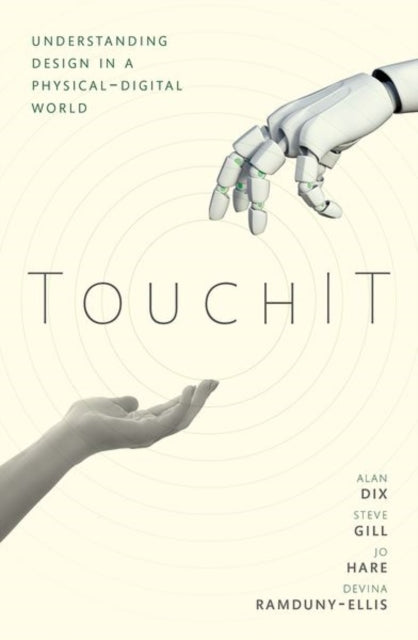
AlanDix,SteveGill,DevinaRamduny-Ellis,JoHare
TouchIT: Understanding Design in a Physical-Digital World
TouchIT: Understanding Design in a Physical-Digital World
YOU SAVE £3.96
- Condition: Brand new
- UK Delivery times: Usually arrives within 2 - 3 working days
- UK Shipping: Fee starts at £3.89. Subject to product weight & dimension
Bulk ordering. Want 15 or more copies? Get a personalised quote and bigger discounts. Learn more about bulk orders.
Couldn't load pickup availability
- More about TouchIT: Understanding Design in a Physical-Digital World
Digital technology is fundamentally altering the world we live in, but can only be truly understood in relation to the physical world we all inhabit. TouchIT brings together insights from human-computer interaction and industrial design to explore these themes and explore how people understand this world and how designers can create usable hybrid physical-digital products.
Format: Hardback
Length: 608 pages
Publication date: 11 August 2022
Publisher: Oxford University Press
Digital technology is fundamentally transforming the world we inhabit, but it can only be fully understood in relation to the physical world we all share. The most successful future products and policies will be those that take this rich digital/physical ecology seriously. The physical world is increasingly filled with digital products, blurring the boundaries between digital and physical reality. From mundane devices like mobile phones and washing machines to esoteric research such as tangible computation and body implants, we continually bridge two worlds, literally touching buttons and dials, and simultaneously interacting with the digital systems that lie behind them. The connection between pure thought and abstract information is through solid keyboard and mouse, but the material world of buildings, cars, and running shoes is also suffused with computation through sensors, displays, and flashing LEDs. How can people understand this world and how can designers create usable hybrid physical-digital products?
TouchIT brings together insights from human-computer interaction and industrial design, exploring these themes under four main headings: human body and mind, objects and things, space, and information and computation. In considering each, the authors look into the underlying physical processes, our human understanding of them, and then the way these inform and are informed by digital design. The end draws together the theoretical and practical implications of this for design, including practical advice, potential tools, and philosophical underpinnings.
The physical world is increasingly filled with digital products, blurring the boundaries between digital and physical reality. From mundane devices like mobile phones and washing machines to esoteric research such as tangible computation and body implants, we continually bridge two worlds, literally touching buttons and dials, and simultaneously interacting with the digital systems that lie behind them. The connection between pure thought and abstract information is through solid keyboard and mouse, but the material world of buildings, cars, and running shoes is also suffused with computation through sensors, displays, and flashing LEDs. How can people understand this world and how can designers create usable hybrid physical-digital products?
TouchIT brings together insights from human-computer interaction and industrial design, exploring these themes under four main headings: human body and mind, objects and things, space, and information and computation. In considering each, the authors look into the underlying physical processes, our human understanding of them, and then the way these inform and are informed by digital design. The end draws together the theoretical and practical implications of this for design, including practical advice, potential tools, and philosophical underpinnings.
The physical world is increasingly filled with digital products, blurring the boundaries between digital and physical reality. From mundane devices like mobile phones and washing machines to esoteric research such as tangible computation and body implants, we continually bridge two worlds, literally touching buttons and dials, and simultaneously interacting with the digital systems that lie behind them. The connection between pure thought and abstract information is through solid keyboard and mouse, but the material world of buildings, cars, and running shoes is also suffused with computation through sensors, displays, and flashing LEDs. How can people understand this world and how can designers create usable hybrid physical-digital products?
TouchIT brings together insights from human-computer interaction and industrial design, exploring these themes under four main headings: human body and mind, objects and things, space, and information and computation. In considering each, the authors look into the underlying physical processes, our human understanding of them, and then the way these inform and are informed by digital design. The end draws together the theoretical and practical implications of this for design, including practical advice, potential tools, and philosophical underpinnings.
The physical world is increasingly filled with digital products, blurring the boundaries between digital and physical reality. From mundane devices like mobile phones and washing machines to esoteric research such as tangible computation and body implants, we continually bridge two worlds, literally touching buttons and dials, and simultaneously interacting with the digital systems that lie behind them. The connection between pure thought and abstract information is through solid keyboard and mouse, but the material world of buildings, cars, and running shoes is also suffused with computation through sensors, displays, and flashing LEDs. How can people understand this world and how can designers create usable hybrid physical-digital products?
TouchIT brings together insights from human-computer interaction and industrial design, exploring these themes under four main headings: human body and mind, objects and things, space, and information and computation. In considering each, the authors look into the underlying physical processes, our human understanding of them, and then the way these inform and are informed by digital design. The end draws together the theoretical and practical implications of this for design, including practical advice, potential tools, and philosophical underpinnings.
The physical world is increasingly filled with digital products, blurring the boundaries between digital and physical reality. From mundane devices like mobile phones and washing machines to esoteric research such as tangible computation and body implants, we continually bridge two worlds, literally touching buttons and dials, and simultaneously interacting with the digital systems that lie behind them. The connection between pure thought and abstract information is through solid keyboard and mouse, but the material world of buildings, cars, and running shoes is also suffused with computation through sensors, displays, and flashing LEDs. How can people understand this world and how can designers create usable hybrid physical-digital products?
TouchIT brings together insights from human-computer interaction and industrial design, exploring these themes under four main headings: human body and mind, objects and things, space, and information and computation. In considering each, the authors look into the underlying physical processes, our human understanding of them, and then the way these inform and are informed by digital design. The end draws together the theoretical and practical implications of this for design, including practical advice, potential tools, and philosophical underpinnings.
The physical world is increasingly filled with digital products, blurring the boundaries between digital and physical reality. From mundane devices like mobile phones and washing machines to esoteric research such as tangible computation and body implants, we continually bridge two worlds, literally touching buttons and dials, and simultaneously interacting with the digital systems that lie behind them. The connection between pure thought and abstract information is through solid keyboard and mouse, but the material world of buildings, cars, and running shoes is also suffused with computation through sensors, displays, and flashing LEDs. How can people understand this world and how can designers create usable hybrid physical-digital products?
TouchIT brings together insights from human-computer interaction and industrial design, exploring these themes under four main headings: human body and mind, objects and things, space, and information and computation. In considering each, the authors look into the underlying physical processes, our human understanding of them, and then the way these inform and are informed by digital design. The end draws together the theoretical and practical implications of this for design, including practical advice, potential tools, and philosophical underpinnings.
Weight: 782g
Dimension: 139 x 204 x 39 (mm)
ISBN-13: 9780198718581
UK and International shipping information
UK and International shipping information
We deliver throughout the United Kingdom and to 128 countries and territories worldwide, including the United States, Australia, Canada, Germany, Spain and France.