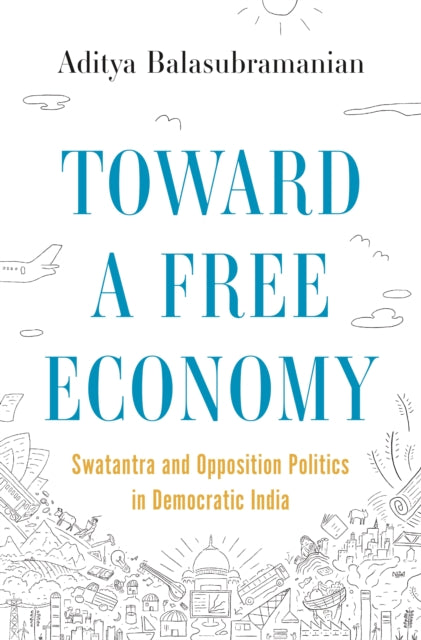
Aditya Balasubramanian
Toward a Free Economy: Swatantra and Opposition Politics in Democratic India
Toward a Free Economy: Swatantra and Opposition Politics in Democratic India
💎 Earn 152 Points (£1.52) on this item.
YOU SAVE £7.51
- Condition: Brand new
- UK Delivery times: Usually arrives within 2 - 3 working days
- UK Shipping: Fee starts at £2.39. Subject to product weight & dimension
Bulk ordering. Want 15 or more copies? Get a personalised quote and bigger discounts. Learn more about bulk orders.
Couldn't load pickup availability
- More about Toward a Free Economy: Swatantra and Opposition Politics in Democratic India
In India, economic conservatism emerged as a response to the Indian National Congress Party's dominance of Indian democracy. The Swatantra Party encouraged Indians to break with the Congress Party and embrace a "free economy" through opposition politics. This "free economy" was characterized by anticommunism, unfettered private economic activity, decentralized development, and the defense of private property. Swatantra's leaders used ideas and practice to create a conservative alternative to the progressive dominant party in a two-party system, and made creative use of India's institutions to bring checks and balances to the political system. Aditya Balasubramanian's book "Toward a Free Economy" challenges the narrative of neoliberalism as an antidemocratic project and demonstrates how economic conservatism emerged and was disseminated in a postcolonial society consistent with the logic of democracy.
Format: Hardback
Length: 352 pages
Publication date: 18 July 2023
Publisher: Princeton University Press
Neoliberalism, often portrayed as an antidemocratic, expert-driven initiative designed to insulate markets from politics, is a concept that originated in the North Atlantic and has been projected globally. However, in Toward a Free Economy, the author challenges this conventional understanding by demonstrating how economic conservatism emerged and spread in a postcolonial society that aligns with the principles of democracy.
Twelve years after the British departed from India, a Swatantra Party emerged, urging Indians to break away from the Indian National Congress Party, which had led the anticolonial nationalist movement and now dominated Indian democracy. The Swatantra Party rejected Congress's heavy-industrial developmental state and its associated rhetoric of socialism, instead promising a "free economy" through its project of opposition politics.
As the "free economy" concept circulated across various genres and regions, it took on diverse meanings, shaped by factors such as language, caste, class, and regional contexts. These articulations, while informed by neoliberalism, emerged primarily from communities in southern and western India, where they embraced new forms of entrepreneurial activity. At their core, these articulations encompassed anticommunism, unfettered private economic activity, decentralized development, and the defense of private property.
Opposition politics played a central role in the Swatantra Party's agenda. The party's leaders envisioned a conservative alternative to the progressive dominant party in a two-party system. They communicated their ideas and mobilized people around issues such as inflation, taxation, and property rights. Additionally, the party made creative use of India's institutions to bring checks and balances to the political system.
Democracy's persistence in India stands out among postcolonial societies. The country has experienced a series of political transitions, including the adoption of a democratic constitution, the expansion of civil liberties, and the growth of a vibrant civil society. However, India continues to face challenges related to economic inequality, political polarization, and social unrest.
In conclusion, Toward a Free Economy offers a fresh perspective on the history of economic conservatism in India after independence. By challenging the conventional understanding of neoliberalism and demonstrating how economic conservatism emerged and spread in a democratic context, the book sheds light on the complex dynamics of postcolonial societies and the role of opposition politics in shaping economic and political outcomes.
Weight: 708g
Dimension: 161 x 244 x 33 (mm)
ISBN-13: 9780691205243
UK and International shipping information
UK and International shipping information
UK Delivery and returns information:
- Delivery within 2 - 3 days when ordering in the UK.
- Shipping fee for UK customers from £2.39. Fully tracked shipping service available.
- Returns policy: Return within 30 days of receipt for full refund.
International deliveries:
Shulph Ink now ships to Australia, Belgium, Canada, France, Germany, Ireland, Italy, India, Luxembourg Saudi Arabia, Singapore, Spain, Netherlands, New Zealand, United Arab Emirates, United States of America.
- Delivery times: within 5 - 10 days for international orders.
- Shipping fee: charges vary for overseas orders. Only tracked services are available for most international orders. Some countries have untracked shipping options.
- Customs charges: If ordering to addresses outside the United Kingdom, you may or may not incur additional customs and duties fees during local delivery.