Boaventurade Sousa Santos
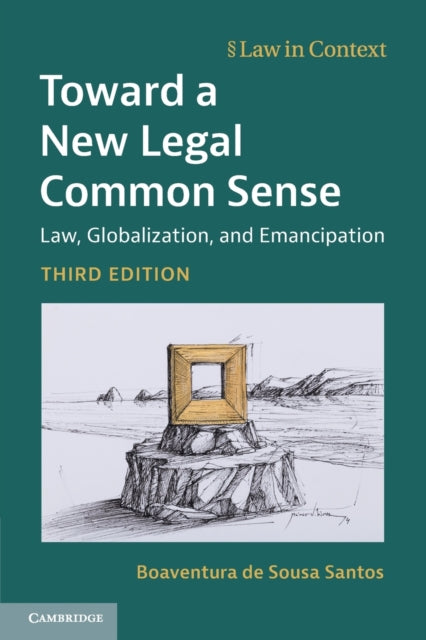
Toward a New Legal Common Sense: Law, Globalization, and Emancipation
Toward a New Legal Common Sense: Law, Globalization, and Emancipation
💎 Earn 240 Points (£2.40) on this item.
We can order this item for you. Delivery usually takes about 4 to 6 weeks.
This item is not held in our immediate stock. We will order it for you after checkout.
Estimated delivery: About 4 to 6 weeks
YOU SAVE £2.86
- Condition: Brand new
- UK Delivery times: Usually arrives within 2 - 3 working days
- UK Shipping: Fee starts at £2.39. Subject to product weight & dimension
Bulk ordering. Want 15 or more copies? Get a personalised quote and bigger discounts. Learn more about bulk orders.
Couldn't load pickup availability
- More about Toward a New Legal Common Sense: Law, Globalization, and Emancipation
The concept of a paradigmatic transition suggests that we are moving from a modern paradigm that has become stagnant to a new, emerging one. The shift towards greater social regulation in the modern era has led to the suppression of social emancipation, symbolizing the exhaustion of modernity. At the same time, this transition indicates the possibility of a new paradigm or paradigms that prioritize social emancipation.
Format: Paperback / softback
Length: 600 pages
Publication date: 01 October 2020
Publisher: Cambridge University Press
Paradigmatic transition is a concept that suggests we are currently in a period of transition between two distinct paradigms: modernity, which appears to have reached its limits in terms of regeneration, and a new, emerging time, of which we have only glimpsed glimpses so far.
Modernity, as a sociocultural paradigm, emerged in the sixteenth century with a fundamental tension between social regulation and social emancipation. This dynamic drove the era and was a dominant force for much of its history. However, by the twenty-first century, modernity had shifted significantly in favor of regulation, at the expense of social emancipation.
The collapse of emancipation into regulation signifies the exhaustion of the paradigm of modernity. It indicates that the traditional understanding of social liberation and progress has reached its endpoint and cannot be sustained in the face of new challenges and opportunities. At the same time, it heralds the emergence of a new paradigm or paradigms that will shape the future of society.
This updated 2020 edition of the book is designed specifically for students enrolled in law and globalization courses, as well as political science, philosophy, and sociology students who are pursuing optional subjects. It provides a comprehensive and up-to-date exploration of the concept of paradigmatic transition, its historical context, and its implications for contemporary society.
The book begins by examining the origins and development of modernity as a sociocultural paradigm. It explores the tensions between social regulation and social emancipation that have characterized modernity throughout its history and how these tensions have shifted over time. The book also examines the consequences of the collapse of emancipation into regulation, including the loss of individual freedom, the erosion of social justice, and the rise of authoritarianism.
In the second part of the book, the authors explore the emerging new paradigms that are shaping the future of society. They discuss the concept of post-modernity, which is characterized by a rejection of the grand narratives of modernity and a focus on the complexities and contradictions of contemporary life. They also examine the emergence of new technologies, such as artificial intelligence and blockchain, which are transforming the way we live, work, and interact with each other.
The book concludes by discussing the challenges and opportunities that arise from the transition between modernity and the new paradigms. It emphasizes the importance of critical thinking, creativity, and adaptability in navigating this period of change and the need for individuals and societies to be open to new ideas and perspectives.
Overall, this updated 2020 edition of the book provides a comprehensive and accessible introduction to the concept of paradigmatic transition, its historical context, and its implications for contemporary society. It is an essential resource for students and scholars interested in law, globalization, politics, philosophy, and sociology.
Weight: 990g
Dimension: 156 x 232 x 42 (mm)
ISBN-13: 9781316610459
Edition number: 3 Revised edition
UK and International shipping information
UK and International shipping information
UK Delivery and returns information:
- Delivery within 2 - 3 days when ordering in the UK.
- Shipping fee for UK customers from £2.39. Fully tracked shipping service available.
- Returns policy: Return within 30 days of receipt for full refund.
International deliveries:
Shulph Ink now ships to Australia, Belgium, Canada, France, Germany, Ireland, Italy, India, Luxembourg Saudi Arabia, Singapore, Spain, Netherlands, New Zealand, United Arab Emirates, United States of America.
- Delivery times: within 5 - 10 days for international orders.
- Shipping fee: charges vary for overseas orders. Only tracked services are available for most international orders. Some countries have untracked shipping options.
- Customs charges: If ordering to addresses outside the United Kingdom, you may or may not incur additional customs and duties fees during local delivery.