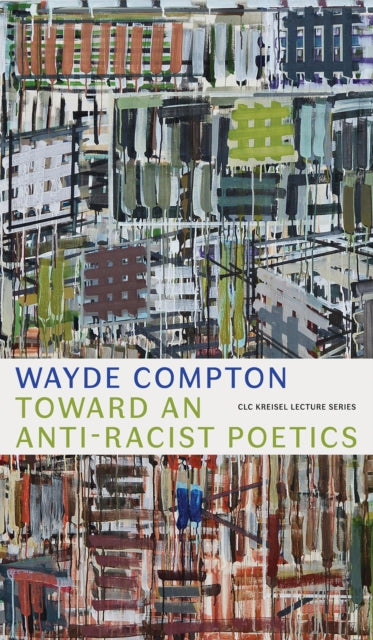
Wayde Compton
Toward an Anti-Racist Poetics
Toward an Anti-Racist Poetics
YOU SAVE £2.42
- Condition: Brand new
- UK Delivery times: Usually arrives within 2 - 3 working days
- UK Shipping: Fee starts at £3.89. Subject to product weight & dimension
Bulk ordering. Want 15 or more copies? Get a personalised quote and bigger discounts. Learn more about bulk orders.
Couldn't load pickup availability
- More about Toward an Anti-Racist Poetics
Toward an Anti-Racist Poetics challenges white universalism in literary production and reception, advocating for a poetic approach that makes space for diversity by doing away with universalism in lyric and avant-garde verse. It offers validation for poets of colour and is for all writers seeking to engage in anti-racist work.
Format: Paperback / softback
Length: 72 pages
Publication date: 22 February 2024
Publisher: University of Alberta Press
Toward an Anti-Racist Poetics: A Personal and Thoughtful Exploration of Racial Positionality in Literary Production and Reception
Wayde Compton's book, Toward an Anti-Racist Poetics, challenges the pervasive white universalism that permeates literary production and reception today. Through personal and thoughtful exploration, Compton examines how we can collectively develop a poetic approach that embraces diversity by rejecting universalism in both lyric and avant-garde verse. Poignant and contemporary examples illustrate how white authors often overlook the racial significance of their whiteness. In their relentless pursuit of form experimentation, they fail to recognize themselves as "white artists." Compton emphasizes the importance of understanding one's own history and positionality and letting go of the notion of a common aesthetic. Toward an Anti-Racist Poetics provides validation for poets of color who work outside of dominant Western forms and is a valuable resource for all writers committed to anti-racist work.
Compton begins by acknowledging that he has never felt that his subjectivity was universal. He recognizes that his experiences and perspectives are shaped by his racial position, and he seeks to explore how this affects his writing and the broader literary landscape. He argues that white universalism is a harmful and limiting force that perpetuates inequality and oppression.
One of the key themes of Toward an Anti-Racist Poetics is the idea of "white artists." Compton notes that white authors often fail to see themselves as racial beings, and this can lead to a lack of empathy and understanding for people of color. He argues that this lack of self-awareness can be harmful to both the author and the reader.
To address this issue, Compton advocates for a more inclusive and diverse approach to poetry. He suggests that poets should embrace their racial identities and use their writing to explore the complexities of race and racism. He also encourages poets to experiment with form and style, to create new and innovative works that challenge traditional notions of poetry.
Compton provides several examples of how white authors have failed to recognize their racial position. He discusses the work of Robert Frost, who was known for his lyrical and romantic poems, but who often portrayed people of color as exotic and otherworldly. He also discusses the work of T.S. Eliot, who was known for his avant-garde poetry, but who often used language that was difficult to understand for people of color.
Compton argues that these examples demonstrate that white authors often fail to see themselves as racial beings. They are so focused on their own experiences and perspectives that they fail to see the broader social and political context in which their writing takes place. This can lead to a lack of empathy and understanding for people of color, and it can also perpetuate inequality and oppression.
Compton also suggests that white authors should be more aware of the historical and cultural context in which their writing takes place. He notes that many of the themes and images that are common in Western literature have their roots in colonialism and slavery. He argues that it is important for white authors to acknowledge this history and to work towards creating a more inclusive and diverse literary landscape.
One of the challenges that Compton faces in Toward an Anti-Racist Poetics is the fact that white universalism is deeply ingrained in Western culture. It is often seen as a virtue, and it is difficult for people to challenge it. Compton argues that this is a mistake, and that it is important for people to recognize the harm that it can cause.
Compton suggests that one way to challenge white universalism is to engage in critical reading. He argues that critical reading involves reading a text with a critical eye, and looking for the ways in which it perpetuates inequality and oppression. He suggests that poets should read works by people of color, and that they should be willing to challenge their own assumptions and beliefs.
Compton also suggests that poets should be more aware of their own biases and prejudices. He notes that many poets are unaware of the ways in which their own experiences and perspectives can influence their writing. He suggests that poets should be willing to work on themselves and to challenge their own biases and prejudices.
In addition to his discussion of white universalism, Compton also explores the role of poetry in social and political change. He argues that poetry can be a powerful tool for social and political change, and that it can help to raise awareness of important issues. He suggests that poets should be willing to use their writing to advocate for social justice and to challenge the status quo.
Toward an Anti-Racist Poetics is a powerful and thought-provoking book that challenges the pervasive white universalism that permeates literary production and reception today. Through personal and thoughtful exploration, Compton examines how we can collectively develop a poetic approach that embraces diversity by rejecting universalism in both lyric and avant-garde verse. Poignant and contemporary examples illustrate how white authors often overlook the racial significance of their whiteness. Compton advocates for a more inclusive and diverse approach to poetry, and he provides several examples of how white authors have failed to recognize their racial position. He also suggests that white authors should be more aware of the historical and cultural context in which their writing takes place, and that they should be willing to engage in critical reading and to challenge their own biases and prejudices. Toward an Anti-Racist Poetics is a valuable resource for all writers committed to anti-racist work.
Weight: 100g
Dimension: 229 x 133 x 6 (mm)
ISBN-13: 9781772127430
UK and International shipping information
UK and International shipping information
We deliver throughout the United Kingdom and to 128 countries and territories worldwide, including the United States, Australia, Canada, Germany, Spain and France.