Dr Sara Caputo
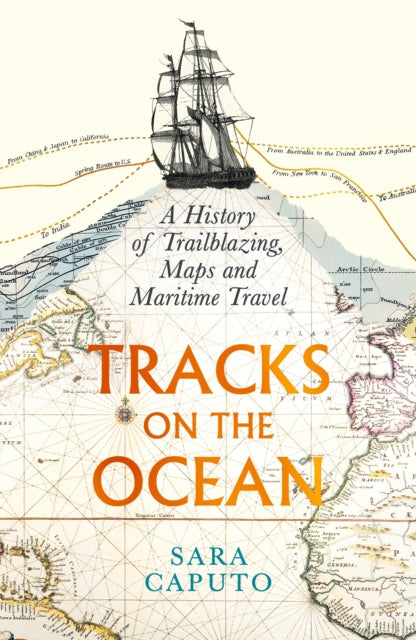
Tracks on the Ocean: A History of Trailblazing, Maps and Maritime Travel
Tracks on the Ocean: A History of Trailblazing, Maps and Maritime Travel
💎 Earn 106 Points (£1.06) on this item.
YOU SAVE £8.76
- Condition: Brand new
- UK Delivery times: Usually arrives within 2 - 3 working days
- UK Shipping: Fee starts at £2.39. Subject to product weight & dimension
Bulk ordering. Want 15 or more copies? Get a personalised quote and bigger discounts. Learn more about bulk orders.
Couldn't load pickup availability
- More about Tracks on the Ocean: A History of Trailblazing, Maps and Maritime Travel
Sara Caputo's Tracks on the Ocean explores the hidden history of the modern world through the tracks left on maps and the sea, from ancient Greek itineraries to twenty-first-century digital mapping.
Caputo reveals how marks on maps have changed the course of modernity, from Ferdinand Magellan's route to the Pacific to the scientific charts of the Royal Navy.
Format: Hardback
Length: 320 pages
Publication date: 29 August 2024
Publisher: Profile Books Ltd
Longlisted for the 2025 BSHS Hughes Prize, Ingenious: Tracks on the Ocean by Felipe Fernández-Armesto and Philip Ball is a fascinating and entertaining exploration of the history of maritime voyages and their impact on the world. The book takes readers on a journey from ancient Greek itineraries to twenty-first-century digital mapping, tracing the development of maritime routes and the significance of maps in shaping our understanding of the world.
Ferdinand Magellan's route to the Pacific, for example, embodied the promise of adventure and colonization, while the scientific charts of the Royal Navy inspired others to plan conquests, navigate treacherous waters, and establish settlements across the oceans. Caputo reveals how marks on maps have changed the course of modernity, from ancient Greek itineraries to twenty-first-century digital mapping, via the voyages of Drake and Cook, the decks of Napoleonic warships, and the boiler rooms of ocean liners.
One of the key themes of the book is the way that maps have been used to control and dominate the world. Maps have been used to justify colonialism, to claim territory, and to assert power over other nations. For example, the British Empire used maps to claim vast swathes of land in Africa, Asia, and the Americas, and to justify its policies of exploitation and oppression. Similarly, the Soviet Union used maps to justify its expansion into Eastern Europe and the Middle East.
However, maps have also been used to promote peace and understanding. For example, the United Nations has used maps to map out the boundaries of countries and to promote peacekeeping and conflict resolution. Maps have also been used to document the natural world and to promote environmental conservation.
Despite the many positive uses of maps, there are also many negative consequences. Maps can be inaccurate, misleading, and biased. For example, maps can be used to justify discrimination and violence against certain groups of people. Maps can also be used to promote economic inequality and to exploit natural resources.
To address these negative consequences, Caputo argues that we need to develop a more nuanced understanding of maps. We need to recognize that maps are not just tools for navigation but also tools for power and control. We need to be aware of the biases and limitations of maps and to work to create more accurate and unbiased maps.
One way to achieve this is to use more diverse sources of data. Maps can be created using a variety of sources, including satellite imagery, aerial photography, and ground surveys. By using more diverse sources of data, we can create more accurate maps that reflect the true nature of the world.
Another way to achieve this is to use more participatory mapping techniques. Participatory mapping techniques involve the participation of local communities in the creation of maps. By involving local communities in the creation of maps, we can ensure that the maps reflect the needs and interests of the local community.
In addition to these techniques, we also need to be aware of the ethical implications of mapping. Maps can be used to harm individuals and communities. For example, maps can be used to target military operations or to track the movements of refugees. We need to be careful to ensure that maps are used in a responsible and ethical manner.
Despite these challenges, maps continue to play a critical role in our world. Maps are used to navigate the world, to plan for the future, and to understand the natural world. Maps are also used to promote peace and understanding.
In conclusion, Tracks on the Ocean by Felipe Fernández-Armesto and Philip Ball is a fascinating and entertaining exploration of the history of maritime voyages and their impact on the world. The book takes readers on a journey from ancient Greek itineraries to twenty-first-century digital mapping, tracing the development of maritime routes and the significance of maps in shaping our understanding of the world. While maps have been used to control and dominate the world, they have also been used to promote peace and understanding. To address these negative consequences, we need to develop a more nuanced understanding of maps and to use more diverse sources of data and participatory mapping techniques. By doing so, we can create more accurate and unbiased maps that reflect the true nature of the world.
Weight: 558g
Dimension: 164 x 243 x 33 (mm)
ISBN-13: 9781788168823
Edition number: Main
This item can be found in:
UK and International shipping information
UK and International shipping information
UK Delivery and returns information:
- Delivery within 2 - 3 days when ordering in the UK.
- Shipping fee for UK customers from £2.39. Fully tracked shipping service available.
- Returns policy: Return within 30 days of receipt for full refund.
International deliveries:
Shulph Ink now ships to Australia, Belgium, Canada, France, Germany, Ireland, Italy, India, Luxembourg Saudi Arabia, Singapore, Spain, Netherlands, New Zealand, United Arab Emirates, United States of America.
- Delivery times: within 5 - 10 days for international orders.
- Shipping fee: charges vary for overseas orders. Only tracked services are available for most international orders. Some countries have untracked shipping options.
- Customs charges: If ordering to addresses outside the United Kingdom, you may or may not incur additional customs and duties fees during local delivery.