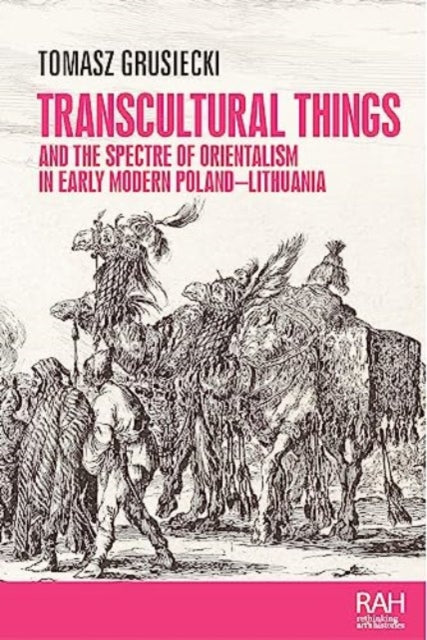
Tomasz Grusiecki
Transcultural Things and the Spectre of Orientalism in Early Modern Poland-Lithuania
Transcultural Things and the Spectre of Orientalism in Early Modern Poland-Lithuania
💎 Earn 376 Points (£3.76) on this item.
YOU SAVE £9.77
- Condition: Brand new
- UK Delivery times: Usually arrives within 2 - 3 working days
- UK Shipping: Fee starts at £2.39. Subject to product weight & dimension
Bulk ordering. Want 15 or more copies? Get a personalised quote and bigger discounts. Learn more about bulk orders.
Couldn't load pickup availability
- More about Transcultural Things and the Spectre of Orientalism in Early Modern Poland-Lithuania
Transcultural things explores how four sets of artefacts from the Polish-Lithuanian Commonwealth, such as maps, fashions, Ottomanesque costumes, and carpets, were used to narrate and visualise the cultural landscape of Polish-Lithuanian elites. It shows how artefacts began to signify as vernacular idioms, often obscuring their non-local origin and tainting subsequent discussions of the imagined purity of national culture.
Format: Hardback
Length: 264 pages
Publication date: 05 December 2023
Publisher: Manchester University Press
Transcultural Things explores a fascinating collection of four artefacts from the Polish-Lithuanian Commonwealth, shedding light on the complex interplay between culture, identity, and national heritage. These artefacts include maps that trace the roots of Poland-Lithuania to the supposedly 'Oriental land of Sarmatia,' portrayals of fashions that claim to link Polish culture to a distant and revered past, Ottomanesque costumes worn by Polish ambassadors, and carpets labelled as Polish despite their foreign provenance.
While modern scholarship views these objects as exemplars of national heritage, early modern beholders approached them with a more flexible mindset. They recognized the possibility of framing material things as local cultural forms while simultaneously acknowledging their foreign derivation. This nuanced perspective reveals how artefacts began to signify as vernacular idioms, often obscuring their non-local origin and shaping subsequent discussions about the imagined purity of national culture.
The book delves into the historical context of these artefacts, exploring how they were produced, circulated, and interpreted by different groups within the Polish-Lithuanian Commonwealth. It uncovers the ways in which these objects were used to construct and reinforce cultural identities, as well as how they were manipulated and contested by individuals and institutions seeking to shape the nation's heritage.
Through a detailed analysis of these artefacts, Transcultural Things offers valuable insights into the complex processes of cultural transmission, appropriation, and transformation. It challenges the notion of a linear and homogeneous national culture and highlights the ways in which different cultures interact and influence each other over time.
Moreover, the book raises important questions about the role of artefacts in shaping public perception and the construction of national heritage. It explores how artefacts can be used to promote certain narratives and ideologies, while also perpetuating harmful stereotypes and biases. It encourages readers to critically evaluate the sources and meanings of cultural objects and to consider the broader social and political contexts in which they are produced and consumed.
In conclusion, Transcultural Things is a thought-provoking and insightful book that offers a fresh perspective on the complex relationship between culture, identity, and national heritage. It provides valuable insights into the historical and cultural processes that shaped the Polish-Lithuanian Commonwealth and sheds light on the ways in which artefacts can be used to construct and contest narratives of national identity. This book will be of interest to scholars and students of history, cultural studies, and heritage, as well as anyone who is interested in the ways in which material culture shapes our understanding of the past and the present.
Weight: 684g
Dimension: 162 x 241 x 24 (mm)
ISBN-13: 9781526164360
UK and International shipping information
UK and International shipping information
UK Delivery and returns information:
- Delivery within 2 - 3 days when ordering in the UK.
- Shipping fee for UK customers from £2.39. Fully tracked shipping service available.
- Returns policy: Return within 30 days of receipt for full refund.
International deliveries:
Shulph Ink now ships to Australia, Belgium, Canada, France, Germany, Ireland, Italy, India, Luxembourg Saudi Arabia, Singapore, Spain, Netherlands, New Zealand, United Arab Emirates, United States of America.
- Delivery times: within 5 - 10 days for international orders.
- Shipping fee: charges vary for overseas orders. Only tracked services are available for most international orders. Some countries have untracked shipping options.
- Customs charges: If ordering to addresses outside the United Kingdom, you may or may not incur additional customs and duties fees during local delivery.