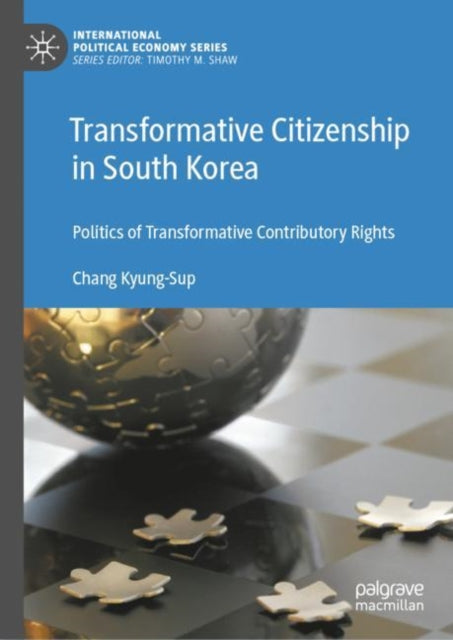
Chang Kyung-Sup
Transformative Citizenship in South Korea: Politics of Transformative Contributory Rights
Transformative Citizenship in South Korea: Politics of Transformative Contributory Rights
💎 Earn 227 Points (£2.27) on this item.
We can order this item for you. Delivery usually takes about 4 to 6 weeks.
This item is not held in our immediate stock. We will order it for you after checkout.
Estimated delivery: About 4 to 6 weeks
YOU SAVE £9.57
- Condition: Brand new
- UK Delivery times: Usually arrives within 2 - 3 working days
- UK Shipping: Fee starts at £2.39. Subject to product weight & dimension
Bulk ordering. Want 15 or more copies? Get a personalised quote and bigger discounts. Learn more about bulk orders.
Couldn't load pickup availability
- More about Transformative Citizenship in South Korea: Politics of Transformative Contributory Rights
South Korea's postcolonial history has been marked by societal transformations leading to a modern society. Citizens have developed transformative contributory rights, claiming effective claims to national and social resources, opportunities, and respect based on their contributions to collective transformative goals. This book analyzes how this dynamic has shaped South Koreans' developmental, social, educational, reproductive, and cultural citizenship.
Format: Hardback
Length: 286 pages
Publication date: 12 January 2022
Publisher: Springer Nature Switzerland AG
South Korea's postcolonial history has been a remarkable journey of dramatic societal transformations, leading to the emergence of a fully-fledged modernity or compressed modernity. This transformative process has given rise to a transformation-oriented state, society, and citizenry, where each transformation becomes an ultimate purpose in itself, its processes and means constituting the primary sociopolitical order, and the transformation-embedded interests forming the core social identity. As a result, a distinct mode of citizenship has emerged, characterized by transformative contributory rights, namely, effective or legitimate claims to national and social resources, opportunities, and respects that accrue to each citizen's contributions to the nation's or society's collective transformative goals.
The South Korean people have been strongly encouraged or have self-motivated themselves to actively participate in these collective transformations, aiming to frame and substantiate their citizenship through the conditions, processes, and outcomes of these transformative engagements. This book, in a concrete and systematic manner, delves into the intricate ways in which this transformative dynamic has shaped South Korea's developmental, social, educational, reproductive, and cultural citizenship.
The journey towards modernity in South Korea has been marked by a series of significant societal transformations. From the colonial era to the establishment of a democratic government, South Korea has undergone a profound shift in its social, economic, and political landscape. The country has experienced rapid industrialization, urbanization, and the rise of a middle class, leading to a significant increase in social mobility and access to education and healthcare.
However, this progress has not been without its challenges. South Korea has faced economic instability, political polarization, and social inequality, which have contributed to social tensions and protests. The country has also been grappling with issues related to its national identity, cultural heritage, and relationship with neighboring countries, particularly North Korea.
In response to these challenges, South Korea has embarked on a series of transformative initiatives aimed at promoting social cohesion, economic development, and cultural diversity. These initiatives include policies promoting gender equality, social welfare programs, and efforts to promote cultural exchange and understanding.
One of the key aspects of South Korea's postcolonial history has been its emphasis on education. The country has invested heavily in its education system, providing free and compulsory education to its citizens from an early age. This education system has produced a highly educated and skilled workforce, which has contributed to South Korea's economic growth and technological innovation.
In addition to education, South Korea has also prioritized social welfare programs to address the needs of its citizens. These programs include healthcare, housing, and social security benefits, which have helped to reduce poverty and inequality. The country has also implemented policies to promote gender equality, including the establishment of women's rights organizations and the promotion of women's participation in the workforce.
South Korea's postcolonial history has also been marked by its efforts to promote cultural diversity and heritage. The country has a rich cultural heritage, including traditional music, dance, literature, and cuisine. The government has implemented policies to preserve and promote these cultural traditions, including the establishment of cultural institutions and the promotion of cultural exchange programs.
However, South Korea's postcolonial history has also been marked by its struggles with national identity and cultural heritage. The country has faced challenges related to its relationship with neighboring countries, particularly North Korea, which has contributed to tensions and conflicts. The country has also faced challenges related to its rapid industrialization and urbanization, which have led to the displacement of traditional communities and the loss of cultural heritage.
In conclusion, South Korea's postcolonial history has been a journey of dramatic societal transformations, leading to the emergence of a fully-fledged modernity or compressed modernity. The country has experienced rapid industrialization, urbanization, and the rise of a middle class, but has also faced challenges related to economic instability, political polarization, and social inequality. In response to these challenges, South Korea has embarked on a series of transformative initiatives aimed at promoting social cohesion, economic development, and cultural diversity. These initiatives include policies promoting gender equality, social welfare programs, and efforts to promote cultural exchange and understanding. South Korea's postcolonial history has also been marked by its struggles with national identity and cultural heritage, which have contributed to tensions and conflicts. However, the country's commitment to social progress and its dedication to promoting cultural diversity and heritage continue to inspire and motivate its citizens.
Weight: 534g
Dimension: 155 x 216 x 26 (mm)
ISBN-13: 9783030876890
Edition number: 1st ed. 2022
This item can be found in:
UK and International shipping information
UK and International shipping information
UK Delivery and returns information:
- Delivery within 2 - 3 days when ordering in the UK.
- Shipping fee for UK customers from £2.39. Fully tracked shipping service available.
- Returns policy: Return within 30 days of receipt for full refund.
International deliveries:
Shulph Ink now ships to Australia, Belgium, Canada, France, Germany, Ireland, Italy, India, Luxembourg Saudi Arabia, Singapore, Spain, Netherlands, New Zealand, United Arab Emirates, United States of America.
- Delivery times: within 5 - 10 days for international orders.
- Shipping fee: charges vary for overseas orders. Only tracked services are available for most international orders. Some countries have untracked shipping options.
- Customs charges: If ordering to addresses outside the United Kingdom, you may or may not incur additional customs and duties fees during local delivery.