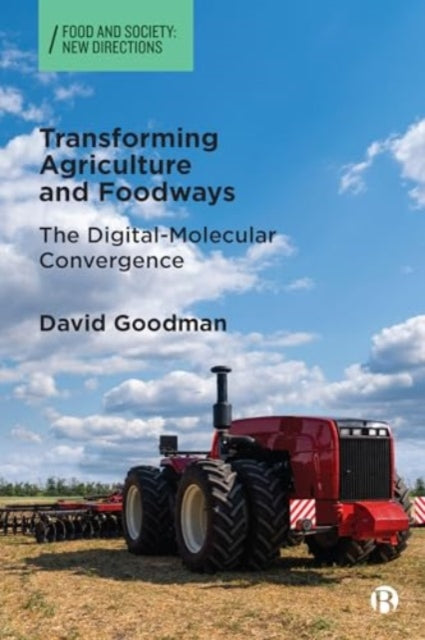
DavidGoodman
Transforming Agriculture and Foodways: The Digital-Molecular Convergence
Transforming Agriculture and Foodways: The Digital-Molecular Convergence
💎 Earn 103 Points (£1.03) on this item.
YOU SAVE £4.35
- Condition: Brand new
- UK Delivery times: Usually arrives within 2 - 3 working days
- UK Shipping: Fee starts at £2.39. Subject to product weight & dimension
Bulk ordering. Want 15 or more copies? Get a personalised quote and bigger discounts. Learn more about bulk orders.
Couldn't load pickup availability
- More about Transforming Agriculture and Foodways: The Digital-Molecular Convergence
The convergence of digital and molecular technologies is transforming food production and eating habits in the US, Western Europe, and Australasia, leading to innovation in Precision Agriculture, farmer independence, gene editing, alternative proteins, and app-based home food deliveries. However, the food system is under pressure to respond to global climate change but shows little evidence of transitioning to sustainable low-carbon trajectories.
Format: Paperback / softback
Length: 152 pages
Publication date: 10 September 2024
Publisher: Bristol University Press
A wave of innovation driven by the convergence of digital and molecular technologies is transforming food production and ways of eating in the US, Western Europe, and Australasia. This book explores a range of contemporary agri-food issues, such as the digitalisation of farm production, aka Precision Agriculture, farmer independence, gene editing, alternative proteins, and the rise of app-based home food deliveries. This is the first book to provide a systemic analysis of technological innovation and its socio-economic consequences in modern food systems, including the 'hollowing out of rural communities and pronounced industrial concentration. The food system is under growing public pressure to respond to global climate change, but this book finds little evidence of transition to sustainable low-carbon trajectories.
A Wave of Innovation Driven by the Convergence of Digital and Molecular Technologies
The US, Western Europe, and Australasia are experiencing a wave of innovation driven by the convergence of digital and molecular technologies, transforming food production and ways of eating. This book explores a range of contemporary agri-food issues, such as the digitalisation of farm production, aka Precision Agriculture, farmer independence, gene editing, alternative proteins, and the rise of app-based home food deliveries. This is the first book to provide a systemic analysis of technological innovation and its socio-economic consequences in modern food systems, including the 'hollowing out of rural communities and pronounced industrial concentration.
The Digitalisation of Farm Production
Precision Agriculture, also known as digitalisation of farm production, is a key driver of innovation in the food system. It involves the use of advanced technologies such as sensors, drones, and artificial intelligence to improve farm productivity, reduce waste, and increase sustainability. Precision Agriculture has the potential to transform the way we produce food, making it more efficient, sustainable, and profitable. However, it also raises concerns about the impact on rural communities and the loss of traditional farming practices.
Farmer Independence
Farmer independence is another important aspect of the food system. Farmers are increasingly seeking to control their own production processes and markets, rather than being dependent on large corporations or government subsidies. This has led to the growth of farmer-owned cooperatives, direct-to-consumer sales, and alternative food networks. However, farmer independence can also be challenging, as farmers face a range of economic, social, and environmental challenges.
Gene Editing
Gene editing is a revolutionary technology that has the potential to transform the food system. It involves the precise modification of an organism's genetic material to achieve desired traits or characteristics. Gene editing has been used to develop new crop varieties that are more resistant to pests, diseases, and environmental stressors, as well as to create new animal breeds that are more productive and sustainable. However, gene editing also raises ethical and social concerns, such as the potential for unintended consequences and the loss of biodiversity.
Alternative Proteins
Alternative proteins are a growing area of research and development in the food system. They include plant-based proteins, such as soy, pea, and lentil, as well as animal-based proteins, such as beef, pork, and poultry. Alternative proteins are often more sustainable, environmentally friendly, and healthier than traditional animal-based proteins. However, they also face challenges, such as consumer acceptance and the need for infrastructure development.
The Rise of App-Based Home Food Deliveries
App-based home food deliveries have become increasingly popular in recent years. They allow consumers to order food from local restaurants and food producers directly to their homes, providing a convenient and affordable way to eat. However, app-based home food deliveries also raise concerns about the impact on traditional food systems, such as the loss of jobs and the potential for food waste.
The Hollowing Out of Rural Communities and Pronounced Industrial Concentration
The food system is under growing public pressure to respond to global climate change, but this book finds little evidence of transition to sustainable low-carbon trajectories. The hollowing out of rural communities and pronounced industrial concentration are two of the main challenges facing the food system. Rural communities are losing their economic base as agriculture becomes more mechanized and industrialized, while industrial concentration is leading to a concentration of power and wealth in the hands of a few large corporations.
Conclusion
In conclusion, a wave of innovation driven by the convergence of digital and molecular technologies is transforming food production and ways of eating in the US, Western Europe, and Australasia. This book explores a range of contemporary agri-food issues, such as the digitalisation of farm production, farmer independence, gene editing, alternative proteins, and the rise of app-based home food deliveries. While these innovations have the potential to improve the food system, they also raise concerns about the impact on rural communities and the loss of traditional farming practices. The food system is under growing public pressure to respond to global climate change, but this book finds little evidence of transition to sustainable low-carbon trajectories.
Dimension: 234 x 156 (mm)
ISBN-13: 9781529231502
This item can be found in:
UK and International shipping information
UK and International shipping information
UK Delivery and returns information:
- Delivery within 2 - 3 days when ordering in the UK.
- Shipping fee for UK customers from £2.39. Fully tracked shipping service available.
- Returns policy: Return within 30 days of receipt for full refund.
International deliveries:
Shulph Ink now ships to Australia, Belgium, Canada, France, Germany, Ireland, Italy, India, Luxembourg Saudi Arabia, Singapore, Spain, Netherlands, New Zealand, United Arab Emirates, United States of America.
- Delivery times: within 5 - 10 days for international orders.
- Shipping fee: charges vary for overseas orders. Only tracked services are available for most international orders. Some countries have untracked shipping options.
- Customs charges: If ordering to addresses outside the United Kingdom, you may or may not incur additional customs and duties fees during local delivery.