Shulph Ink
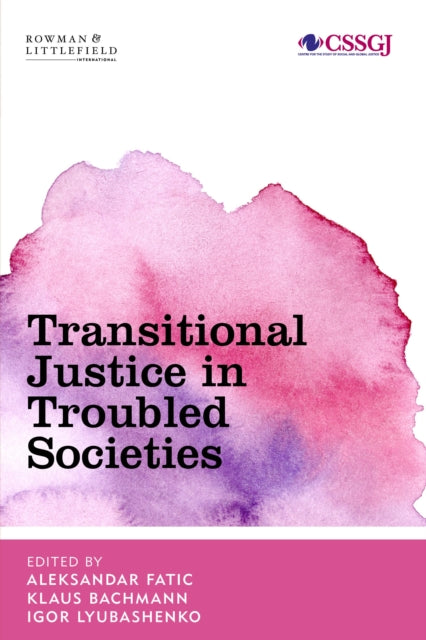
Transitional Justice in Troubled Societies
Transitional Justice in Troubled Societies
💎 Earn 141 Points (£1.41) on this item.
We can order this item for you. Delivery usually takes about 4 to 6 weeks.
This item is not held in our immediate stock. We will order it for you after checkout.
Estimated delivery: About 4 to 6 weeks
YOU SAVE £3.68
- Condition: Brand new
- UK Delivery times: Usually arrives within 2 - 3 working days
- UK Shipping: Fee starts at £2.39. Subject to product weight & dimension
Bulk ordering. Want 15 or more copies? Get a personalised quote and bigger discounts. Learn more about bulk orders.
Couldn't load pickup availability
- More about Transitional Justice in Troubled Societies
The book argues that the success of transitional justice is dependent on the achievement of political goals, and provides case studies from crisis spots around the world.
Format: Paperback / softback
Length: 248 pages
Publication date: 22 August 2023
Publisher: Bloomsbury Publishing PLC
Transitional justice is a crucial strategic topic for the practical implementation of transitional justice in post-conflict societies. The dilemma is defined by the extent to which the actual achievement of the political goals of transition is a necessary condition for the long-term observance and implementation of justice. While in many cases, the 'blind criminal justice does not enhance, and even militates against, the achievement of political transitions, an understanding of transitional justice as a fundamentally political process is novel, controversial, and a concept which may shape the future of transitional justice. This collection contributes to developing this concept both theoretically and through concrete and current case studies from the world's most pronounced crisis spots for transitional justice.
Transitional justice is a complex and multifaceted process that aims to address the legacies of past conflicts and promote peace and stability in post-conflict societies. It involves a range of measures, including truth-telling, accountability, reparations, and institutional reform, to address the human rights violations and injustices that occurred during the conflict.
One of the key challenges facing transitional justice is the dilemma of achieving political goals while also ensuring the observance and implementation of justice. This dilemma arises because transitional justice is often seen as a means to achieve political stability and legitimacy, rather than as an end in itself. As a result, transitional justice measures may be implemented in a way that prioritizes political interests over the needs of victims and survivors.
To address this dilemma, this book argues that the actual achievement of the political goals of transition is a necessary condition for the long-term observance and implementation of justice. This means that transitional justice measures must be designed and implemented in a way that is consistent with the political goals of the transition, and that they must be able to address the underlying causes of the conflict.
One of the key challenges facing transitional justice is the need to address the legacy of past human rights violations and injustices. This requires a comprehensive approach that involves a range of measures, including truth-telling, accountability, reparations, and institutional reform. Truth-telling is a critical component of transitional justice, as it allows victims and survivors to learn the truth about the events that occurred during the conflict and to hold those responsible accountable. Accountability is also important, as it ensures that those responsible for human rights violations are held accountable for their actions. Reparations are a way of providing compensation to victims and survivors for the harm that they have suffered, and institutional reform is necessary to ensure that the institutions that were responsible for the human rights violations are reformed to prevent future abuses.
Another challenge facing transitional justice is the need to address the political and social divisions that have emerged as a result of the conflict. This requires a process of reconciliation and peacebuilding that involves a range of measures, including dialogue, mediation, and community-based initiatives. Dialogue is a critical component of reconciliation, as it allows individuals and groups to come together and discuss their differences and find common ground. Mediation is a process of resolving conflicts that involves a third party who helps the parties to reach a settlement. Community-based initiatives are a way of building trust and promoting social cohesion in communities that have been affected by the conflict.
In addition to these challenges, transitional justice also faces a range of practical challenges, including resource constraints, political instability, and social unrest. Resource constraints can make it difficult for transitional justice measures to be implemented, while political instability can make it difficult for transitional justice measures to be implemented in a way that is consistent with the political goals of the transition. Social unrest can make it difficult for transitional justice measures to be implemented in a way that is consistent with the needs of victims and survivors.
To address these practical challenges, this book argues that transitional justice measures must be designed and implemented in a way that is sustainable and that is able to respond to changing circumstances. This means that transitional justice measures must be designed and implemented in a way that is flexible and adaptable, and that they must be able to respond to the needs of victims and survivors as they change over time.
One of the key ways that transitional justice measures can be designed and implemented in a sustainable and adaptable way is through the use of participatory approaches. Participatory approaches involve the participation of victims and survivors in the design and implementation of transitional justice measures, and they allow them to have a say in the decisions that are made about their lives. Participatory approaches can also help to build trust and promote social cohesion in communities that have been affected by the conflict.
Another way that transitional justice measures can be designed and implemented in a sustainable and adaptable way is through the use of international support. International support can provide resources and expertise to transitional justice measures, and it can help to ensure that they are implemented in a way that is consistent with international human rights standards. International support can also help to promote the long-term observance and implementation of justice in post-conflict societies.
In conclusion, transitional justice is a crucial strategic topic for the practical implementation of transitional justice in post-conflict societies. The dilemma of achieving political goals while also ensuring the observance and implementation of justice is a complex and multifaceted issue that requires a comprehensive approach that involves a range of measures, including truth-telling, accountability, reparations, and institutional reform. By designing and implementing transitional justice measures in a sustainable and adaptable way, we can help to promote peace and stability in post-conflict societies and to ensure that the human rights violations and injustices that occurred during the conflict are never repeated.
Weight: 378g
Dimension: 152 x 228 x 20 (mm)
ISBN-13: 9781786605894
This item can be found in:
UK and International shipping information
UK and International shipping information
UK Delivery and returns information:
- Delivery within 2 - 3 days when ordering in the UK.
- Shipping fee for UK customers from £2.39. Fully tracked shipping service available.
- Returns policy: Return within 30 days of receipt for full refund.
International deliveries:
Shulph Ink now ships to Australia, Belgium, Canada, France, Germany, Ireland, Italy, India, Luxembourg Saudi Arabia, Singapore, Spain, Netherlands, New Zealand, United Arab Emirates, United States of America.
- Delivery times: within 5 - 10 days for international orders.
- Shipping fee: charges vary for overseas orders. Only tracked services are available for most international orders. Some countries have untracked shipping options.
- Customs charges: If ordering to addresses outside the United Kingdom, you may or may not incur additional customs and duties fees during local delivery.